
같은 10회인데 왜 근비대 효과가 다를까? 당신의 10회는 정말 효과가 있는가
10회는 자극의 크기를 나타내는 수치가 아니라 그 세트를 멈춘 시점의 반복 횟수일 뿐입니다. 같은 10회라도 여력, 부하, 동작의 질, 목표 근육의 사용 방식이 다르면 근비대로 이어지는 자극도 달라집니다.
10회에서 한계에 가까워진 세트와 5회를 더 할 수 있는데 10회에서 멈춘 세트를 같은 '10회'로 취급하지 않는 것이 출발점입니다.
"10회를 하면 같은 자극"이라는 직관은 어디서 어긋나는가
10회 전후는 대부분의 운동에서 폼을 유지하기 쉽고 근비대 목적의 세트를 짜기 좋은 회수입니다. 하지만 다루기 쉽다는 것과 10회 자체에 특별한 효과가 있다는 것은 별개입니다. 회수는 부하와 노력도를 함께 고려할 때 비로소 의미를 갖습니다.
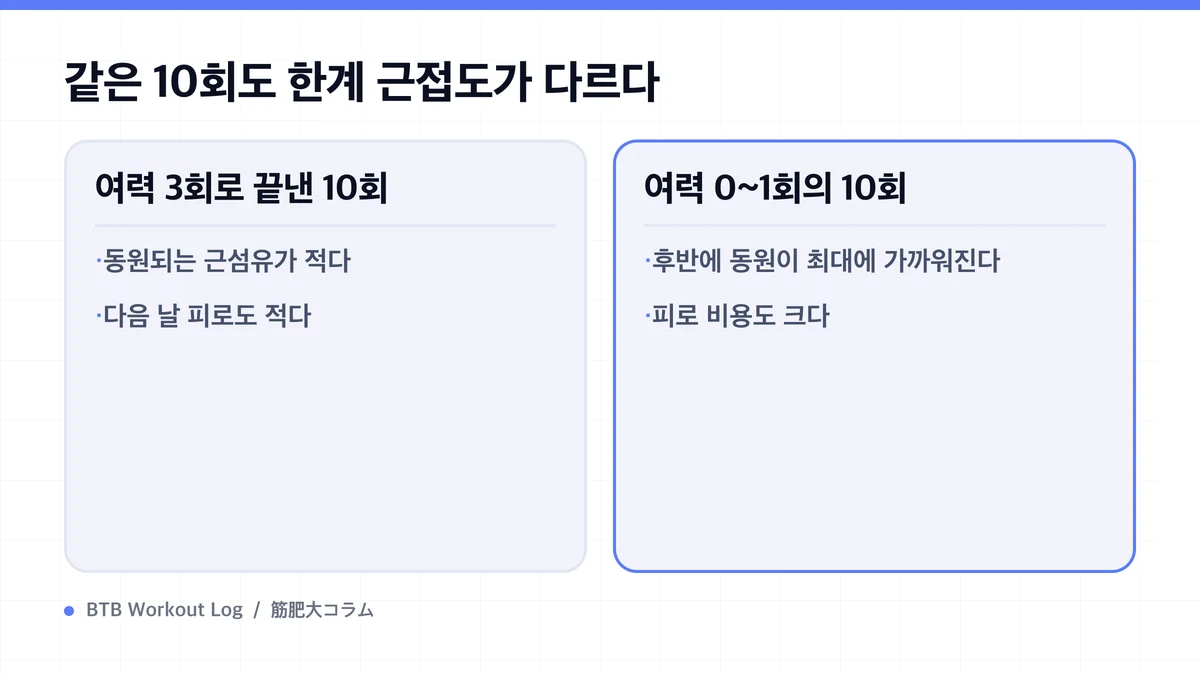
어떤 중량이 10회에 한계라면 그 10회는 RIR0, 즉 "한 번도 더 못 한다"는 세트입니다. 반면 그 중량으로 15회를 할 수 있는 사람이 10회에서 멈추면 RIR5입니다. 둘 다 기록에는 10회로 남지만 한계까지의 거리는 크게 다릅니다. 같은 사람도 1세트 차의 10회는 RIR4, 피로가 쌓인 4세트 차의 10회는 RIR1일 수 있습니다.
흔한 착각은 회수 범위를 먼저 정하면 강도가 자동으로 맞춰진다고 생각하는 것입니다. 실제로는 "8~12회로 진행한다"는 처방만으로는 부족합니다. 어디까지 할지에 더해 몇 회를 남길지를 지정하지 않으면, 준비 세트에서 한계 세트까지 섞여 버립니다. 회수로 부하를 정할 때도 목표 회수에서 얼마나 여력이 남는지까지 확인해야 합니다.
차이를 만드는 핵심은 10회 차에서 한계에 얼마나 가까운가
근육은 반복 횟수를 세어서 성장 반응을 바꾸지 않습니다. 근섬유가 충분한 힘을 발휘하고 세트가 진행되면서 필요한 운동 단위가 동원됨으로써 근비대로 이어지는 기계적 장력을 받습니다. 높은 부하에서는 초반부터 큰 힘이 필요하고, 낮은 부하에서는 피로가 진행되어 한계에 가까워질수록 동원이 높아집니다.
이러한 차이를 현장에서 근사하는 것이 RIR(Reps in Reserve, 남은 여력)입니다. 10회 종료 시점에 RIR 1~3이면 일반적으로 근비대를 노린 하드 세트로 다루기 좋은 범위입니다. RIR5 이상이면 목적과 전체 프로그램에 따라 다르지만, 단독 워킹 세트로서는 자극이 부족할 수 있습니다. 반대로 RIR0까지 가면 자극은 커질 수 있지만 폼 흐트러짐과 다음 세트로의 피로도 늘어납니다.
다만 "마지막 몇 회만 유효하다"고 고정적으로 생각하는 것도 과도한 단순화입니다. 한계까지의 거리와 근비대의 관계에는 폭이 있으며 매 세트 실패까지 가야 한다고 단정할 수 없습니다. 중요한 것은 표면상의 10이라는 숫자가 아니라 충분한 노력도를 회복 가능한 범위에서 반복할 수 있다는 점입니다. RIR에 의한 강도 관리와 한계까지 추진하는 효과와 대가를 따로 생각하면 10회의 의미를 판단하기 쉬워집니다.
사용 중량이 다르면 10회에서 요구되는 힘과 피로도 달라진다
같은 RIR에서 10회를 끝내도 운동과 부하가 다르면 세트의 성질은 같지 않습니다. 높은 부하에서는 매 회 발휘되는 힘이 크고 근력 적응이나 고중량 취급 기술을 얻기 쉬운 반면, 관절과 폼에 대한 요구가 높아질 수 있습니다. 낮은 부하에서는 많은 반복을 쉽게 쌓을 수 있지만 한계에 가까워지기까지 시간이 오래 걸리며, 국소적 화끈거림이나 호흡 곤란이 먼저 제약이 될 수 있습니다.
연구 전체로는 세트의 노력도를 맞추면 상당히 넓은 부하 범위에서 근비대가 일어날 수 있다고 알려져 있습니다. 이는 "부하는 무엇이든 좋다"는 뜻이 아닙니다. 예를 들어 25회를 할 수 있는 가벼운 중량을 10회에서 멈추면 여력이 아직 크고, 10회에서 한계에 가까운 중량과 같은 급으로 볼 수 없습니다. 낮은 부하를 선택할수록 충분한 노력도에 도달했는지 확인이 중요해집니다.
또한 운동을 넘나드는 회수 비교도 주의가 필요합니다. 스쿼트 100kg의 10회와 레그 익스텐션 50kg의 10회는 사용 근군, 안정성, 가동 범위, 전신 피로가 다릅니다. "어느 쪽이 더 강한가"를 회수만으로 판단하지 말고 각 운동의 역할에 맞는 부하 범위를 선택합니다. 부하 범위의 특징은 고중량과 고회수의 사용 구분으로 정리하면 실용적입니다.
같은 중량·같은 10회라도 동작 조건이 바뀌면 비교가 무너진다
Weight and RIR might match, but how your target muscle gets challenged shifts with form. Ten reps at full range with controlled tempo differs completely from ten reps where the final reps use partial range and body momentum to finish. You don't need to dismiss the second approach outright, but when measuring progress from session to session, you have to separate strict reps from assisted ones.
Setup variables matter too. Bench angle, grip width, foot and back positioning—change any of these and the load distribution between your target muscle and helpers shifts, even if the rep count stays at ten. Extremely slow tempos alter time per rep and loadable weight, making them incomparable to standard-tempo tens. Slower isn't automatically better; what matters is reproducing your intended movement at a speed that preserves comparability.
Rest intervals and exercise order get overlooked. Ten reps after three minutes of rest is not the same set as ten reps after sixty seconds. Abbreviated rest can push you near failure early, then drop reps or load in later sets, making it harder to accumulate high-quality work across the session. When comparing to previous sessions, keep rest times and order roughly consistent. Set design also hinges on how you approach intervals.
After hitting ten, use RIR and form to decide what comes next
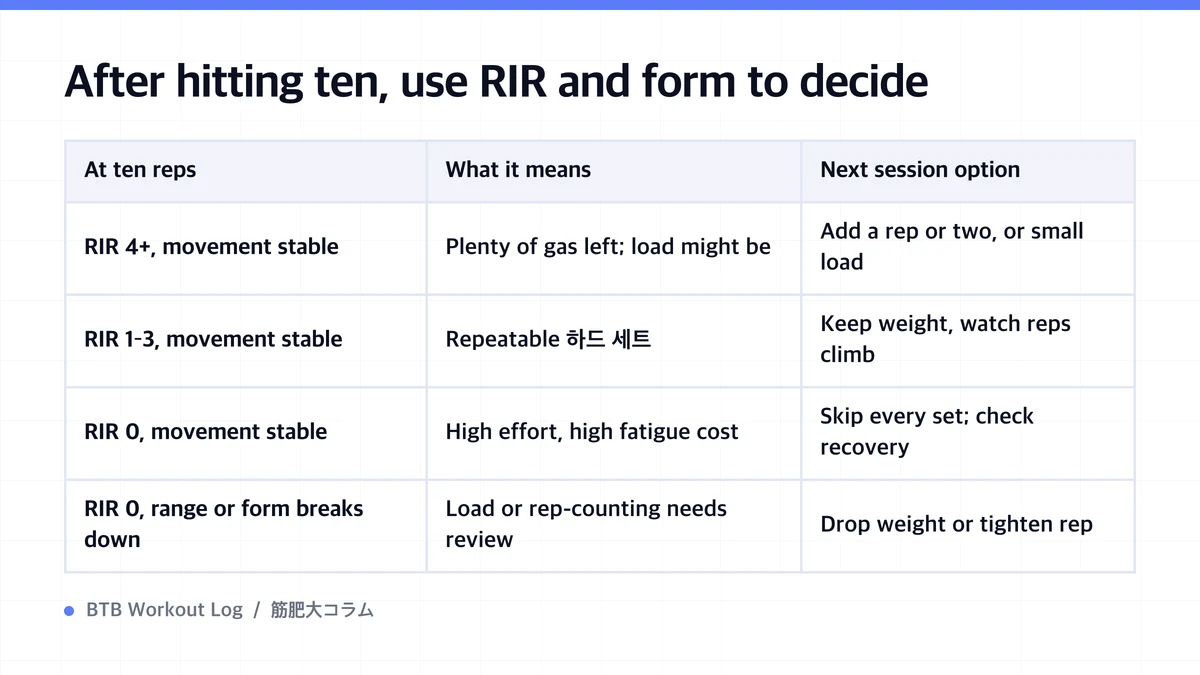
When you complete ten reps as a working set for 근비대, don't stop at just marking it done—carry the state you finish in into next session's plan. Here's how to frame it:
| At ten reps | What it means | Next session option |
|---|---|---|
| RIR 4+, movement stable | Plenty of gas left; load might be light for the goal | Add a rep or two, or small load jump |
| RIR 1–3, movement stable | Repeatable 하드 세트 | Keep weight, watch reps climb |
| RIR 0, movement stable | High effort, high fatigue cost | Skip every set; check recovery before repeating |
| RIR 0, range or form breaks down | Load or rep-counting needs review | Drop weight or tighten rep standards |
This table doesn't judge a whole program from one set. RIR is a rough estimate, and when you're new to a lift, error runs wide. With safe 머신 work, occasionally test your true max reps; that calibrates your "two left in the tank" feel. You don't need to grind to failure on 프리웨이트.
Sleep, food, pain, and fatigue from earlier exercises all shift rep output on any given day. Don't swing load based on one ten-rep effort—look at the trend over several sessions under the same conditions. If RIR crashes across multiple sets, check not just load but whether your total sets and rest fit your recovery capacity.
Turn rep counts into usable information for your next load choice
In practice, lock down a 렙 범위 and target RIR for each lift, then nail down movement conditions. Say you're aiming for 8–12 reps at RIR 1–3. If you hit ten with RIR 3 this session, next time try eleven at the same load. If ten landed at RIR 0, either lock in rep quality at that weight or back off slightly.
Minimum log items: weight, reps, RIR per set. For key lifts, jot down rest time, 가동 범위, and form tweaks in a line or two. When ten reps at the same weight shifts from RIR 0 to RIR 2, your capacity climbed even though the number stayed at ten. Conversely, if you're holding ten reps by shrinking your 가동 범위, the count looks unchanged but progress is harder to call.
Once you hit your target 렙 범위 upper limit with goal RIR and locked form, then nudge load up. Running that 점진적 과부하 cycle hinges on keeping the same conditions across sessions—no switching to different exercises or setups mid-run. The real job of logging is turning ten reps from an end goal into a checkpoint. That's how you steer the next move.
자주 묻는 질문
- Should I avoid ten reps entirely if I'm training for 근비대?
- No. Ten-rep ballpark is a practical rep range for most lifts. The catch is you can't grade a set by the number alone—dial in your target RIR, form standards, and 가동 범위. If ten reps land you in RIR 1–3, it's a solid choice.
- Is it better to lock all sets at the same weight for ten reps?
- Not required. Later sets fatigue you more, so hitting the same weight for fewer reps is normal. Rather than shrink your 가동 범위 to hold ten, stick to your RIR and form targets, then log what actually happened—ten, nine, eight—so you have real data to compare.
- How do I pin down my RIR reading when the set ends?
- Log the same lift and form repeatedly, and occasionally push a safe 머신 exercise to true failure so you see how your guess stacks against reality. If you get more reps next time at the same load than you expected, you probably left bigger cushion last session. Dial your sense in over weeks, not one session.
정리
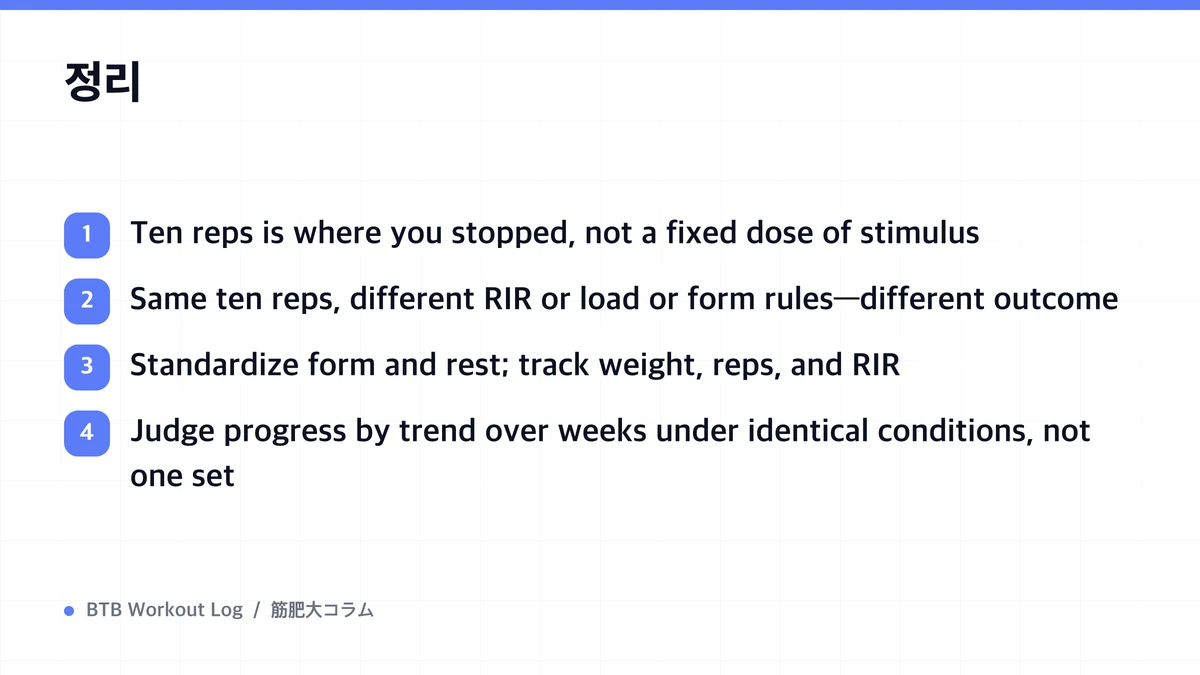
- Ten reps is where you stopped, not a fixed dose of stimulus
- Same ten reps, different RIR or load or form rules—different outcome
- Standardize form and rest; track weight, reps, and RIR
- Judge progress by trend over weeks under identical conditions, not one set
참고문헌
- Low- vs High-load Resistance Training for Strength and Hypertrophy: Meta-analysis
- Resistance Exercise Load Does Not Determine Training-mediated Hypertrophic Gains in Young Men
- Training to Repetition Failure or Non-failure: Systematic Review and Meta-analysis
- Proximity-to-Failure and Muscle Hypertrophy: Systematic Review with Meta-analysis
- Repetitions in Reserve Is a Reliable Tool for Prescribing Resistance Training Load