
매번 한계까지 몰아붙이지 않아도 근육은 커진다 | 완전히 지칠 필요 없는 이유
근육 성장에는 매 세트 마지막 반복에서 실패하는 것이 필수가 아니라, 충분한 긴장을 동반한 반복을 축적하고 회복 가능한 범위에서 그 자극을 지속하는 것이 필요합니다. 한계보다 조금 앞에서도 이 조건은 충족됩니다.
한계까지 가는 세트는 자극의 강도를 확인하기 쉽지만, 성공과 실패의 경계에만 근비대를 시작하는 특별한 메커니즘이 있는 건 아닙니다. 중요한 건 '실패했는가'가 아니라 한계까지 얼마나 가깝게 접근했고, 그 대가가 다음 세트나 다음 운동에 어떻게 남았는지입니다.
실패한 그 1회만이 근비대의 스위치가 아니다
여기서 말하는 한계, 즉 반복 실패란 일정한 부하를 정확한 동작으로 더 이상 들어올 수 없는 지점입니다. 마지막 반복을 완료한 세트와 다음 반복을 중간에 멈춘 세트 사이에는 기록상 분명한 경계가 있습니다. 하지만 몸 안에서 일어나는 변화는 그 경계에서 갑자기 영에서 최대로 전환되지 않습니다.
세트가 진행되면서 발휘할 수 있는 힘에 여유가 없어지고, 들어올림 속도가 떨어지며, 같은 동작을 계속하는 데 드는 노력이 증가합니다. 한계 직전까지 근육은 이미 높은 힘을 반복해서 요구받고 있습니다. 아직 1회 더 할 수 있는 상태에서 멈췄다고 해서 그전까지의 반복에서 생긴 긴장이 무효가 될 이유는 없습니다. 반대로 동작을 바꿔가며 겨우 한계까지 도달해도 목표 근육에 대한 부하가 유지되지 않으면, 실패한 사실만 높이 평가할 수 없습니다.
한계까지 몰아붙이는 운동은 자극을 얻는 한 방법이지만, 실패 자체가 목표가 되면 동작의 질과 다음 세트를 놓치게 됩니다. 근비대를 생각할 때는 성공 반복 바깥에 있는 '실패한 1회'보다, 그곳에 접근하는 과정에서 어떤 반복을 쌓았는지 보는 것이 더 실질적입니다.
한계 전에도 필요한 근섬유는 동원된다
근육은 처음부터 모든 근섬유를 같은 비율로 사용하지 않으며, 요구되는 힘에 따라 운동 단위를 동원합니다. 비교적 무거운 부하에서는 시작 직후부터 큰 힘이 필요합니다. 가벼운 부하라도 반복을 계속해서 먼저 작동한 근섬유가 피로해지면, 같은 힘을 유지하기 위해 추가 운동 단위가 참여합니다. 따라서 사용 중량이 달라도 충분히 노력한 세트라면 근비대 자극을 만들 수 있습니다.
다만 '한계까지 갈 필요 없다'는 '편한 정도에서 멈춰도 된다'는 뜻이 아닙니다. RIR(Reps In Reserve)은 세트 종료 시점에 아직 몇 회 더 할 수 있었는지를 나타내는 지표입니다. RIR이 너무 크면 특히 가벼운 부하에서 필요한 동원에 미치지 못한 채 세트를 끝낼 수 있습니다. 한편 RIR이 0이 아니면 자극이 없다는 이분법도 정확하지 않습니다. RIR 관리에서는 0인지 아닌지가 아니라, 목표 범위에 얼마나 일관되게 접근했는지를 다룹니다.
부하가 가벼울수록 반복의 전반부에 여유가 있어 일반적으로 한계에 접근할 필요성이 높아집니다. 중~고중량 복합 운동에서는 RIR을 조금 남겨도 높은 힘을 발휘하기 쉽고, 기술을 유지하면서 자극을 확보할 수 있습니다. 이는 고중량과 저중량의 활용과도 관련된 부분으로, '모든 운동을 같은 RIR로'하기보다 부하와 운동 특성에 맞춰 판단하는 것이 합리적입니다.
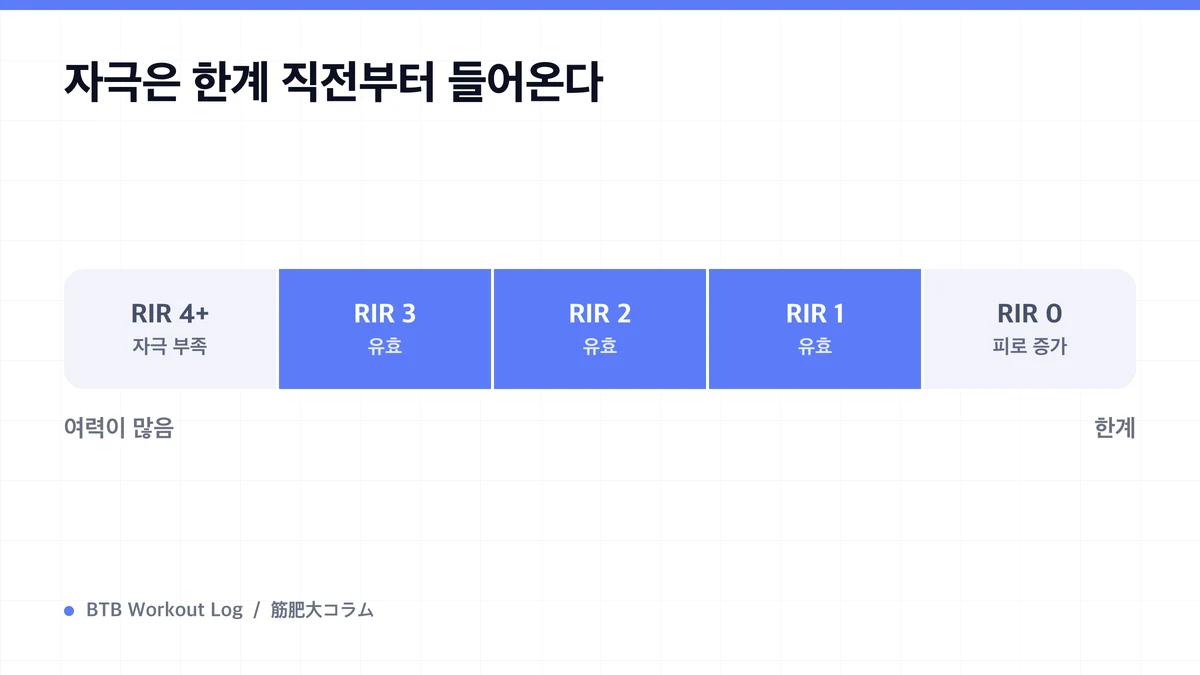
한계에 가까워질수록 자극보다 피로 상승이 더 클 수 있다
한계에 가까운 마지막 반복은 편하지 않습니다. 높은 노력이 필요하므로 자극을 강화하는 방향으로 작용합니다. 그러나 한계 직전부터 실패까지의 그 1회에서 자극만 늘고 피로는 같다는 건 없습니다. 국소적 피로, 숨 가쁨, 집중력 소모, 동작 속도 저하가 동시에 커집니다.
이 대가는 그 세트만 보면 과소평가됩니다. 1세트째를 실패까지 했을 결과 2세트째 이후 반복 수가 크게 떨어지면, 같은 자세로 할 수 있는 질 높은 반복이 주 전체에서 줄어들 수 있습니다. 다음 운동까지 피로가 남아 중량이나 반복 수를 되찾지 못하면 빈도와 점진성에도 영향을 미칩니다. 근비대는 단발 세트의 강도가 아니라 회복 가능한 자극을 수주, 수개월 동안 쌓은 결과이므로, 매번의 최대 노력이 장기 최고 성과로 이어지진 않습니다.
이 관계는 자극과 피로가 직선적으로 늘어난다고 생각하지 않을 때 더 잘 이해됩니다. 한계에서 먼 세트를 조금 더 엄하게 할 가치는 크지만, 이미 충분히 가까운 세트를 실패까지 밀어붙이는 추가 이득은 작을 수 있습니다. 한편 피로는 눈에 띄게 늘어날 수 있습니다. 세트 수도 마찬가지로 추가할수록 항상 이득이 되는 건 아닙니다. 세트 수를 너무 많이 늘리는 문제처럼 1세트의 몰아붙임 정도도 회복 가능한 범위가 있습니다.
연구는 '실패 불필요'를 어디까지 뒷받침하는가
Systematic reviews and meta-analyses comparing training to failure against stopping short show no clear difference in 근비대 overall, establishing that failure is not a prerequisite. Another review on proximity to failure found no evidence that training to momentary muscular failure outperforms non-failure training. The notion that results increase in a straight line the closer you get to your limit doesn't hold up.
That said, you can't read "any RIR works the same" from this. Study definitions of failure, loads, set counts, participant experience, and volume all vary. Research centers on young adults, leaving gaps for conclusions about advanced lifters only or optimal RIR per exercise. Some analyses showed small advantages for failure in experienced subgroups, but extending that uniformly across all conditions warrants caution.
What transfers from research to practice: failure becomes optional, not mandatory, and sets far from your limit aren't justified either. Rather than treating RIR 1 and RIR 3 as a precise dividing line everyone must follow, the evidence-backed approach is to get close enough, then watch your 회복 and progress. That's how you calibrate what works for you.
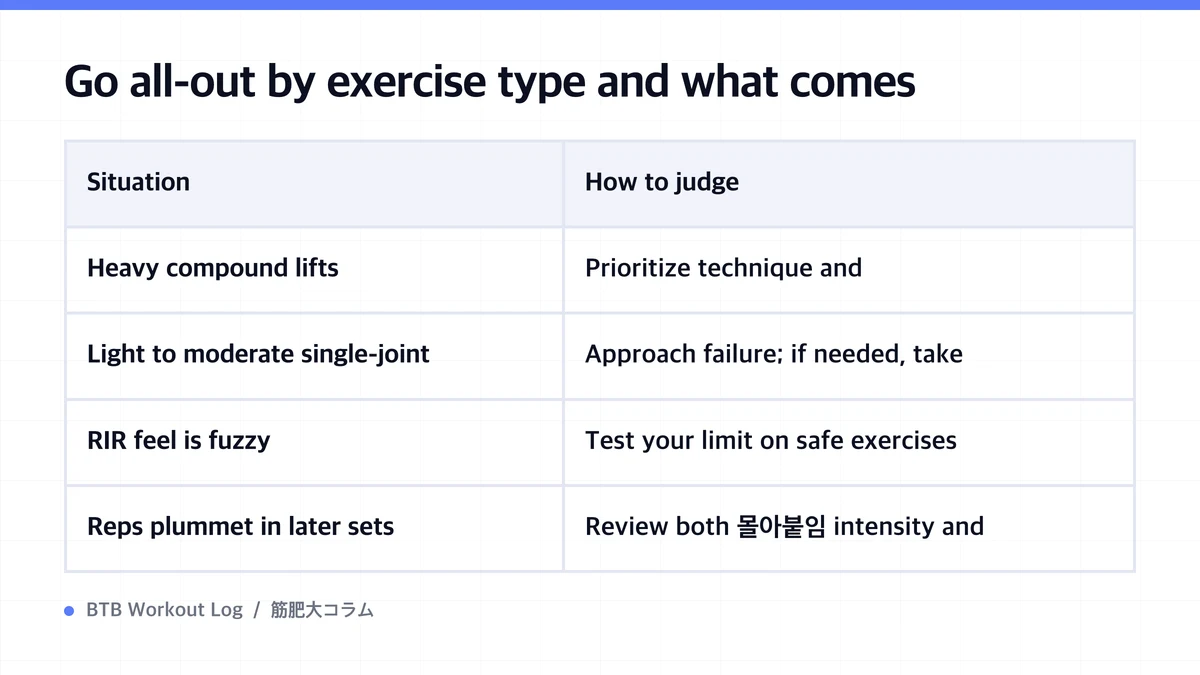
Go all-out by exercise type and what comes next
The baseline rule: leave 여력 in earlier sets, edge closer to failure in later ones. Compound lifts like squats and bench press demand whole-body stability and technique—stopping at RIR 1–3 keeps form intact and preserves quality for subsequent sets. Single-joint moves like leg extensions or cable curls carry less risk on failure and let you concentrate load on the target muscle, so you might take the final set to RIR 0 to get a feel for where you actually stand.
| Situation | How to judge |
|---|---|
| Heavy compound lifts | Prioritize technique and follow-up sets; center on RIR 1–3 |
| Light to moderate single-joint and 머신 work | Approach failure; if needed, take only the last set to RIR 0 |
| RIR feel is fuzzy | Test your limit on safe exercises occasionally to recalibrate estimates |
| Reps plummet in later sets | Review both 몰아붙임 intensity and rest intervals |
Track each set's RIR, weight, reps, form consistency, rep drop under identical conditions, and 회복 to your next session. Since RIR isn't entirely objective, occasionally go to failure on safe exercises and check whether your "2 reps left" estimate was right. If weight or reps climb while you stick to your planned RIR on the same lift, you're making progress without failing every time.
Layer RIR feel onto your weight and rep trends, then watch whether cutting back on 몰아붙임 preserves your weekly volume and next session's numbers. That's how you dial in how close to the edge you actually need to be.
자주 묻는 질문
- If I'm not going to failure, how much 여력 should I leave?
- Most sets can start from RIR 1–3. Lighter loads call for getting closer to failure; heavy compounds demand prioritizing technique. Judge whether you're on track by watching weight and reps climb at your planned RIR and whether you 회복 before the next session.
- If I can't judge RIR accurately, should I always go to failure?
- No—instead, periodically hit RIR 0 on safe 머신 or 단관절 lifts to fine-tune your estimates. Comparing what you said you had left to what you actually did next builds pattern recognition. You'll learn how wide your margin of error tends to be.
- Where should I place the all-out set?
- Aim for the last set of a safe 머신 or 단관절 exercise late in the session—failing safely becomes easier, and you shield earlier sets from the fallout. Stay away from heavy compounds early on where fatigue can wreck subsequent sets. If reps keep tanking or weight drops next session, scale back frequency.
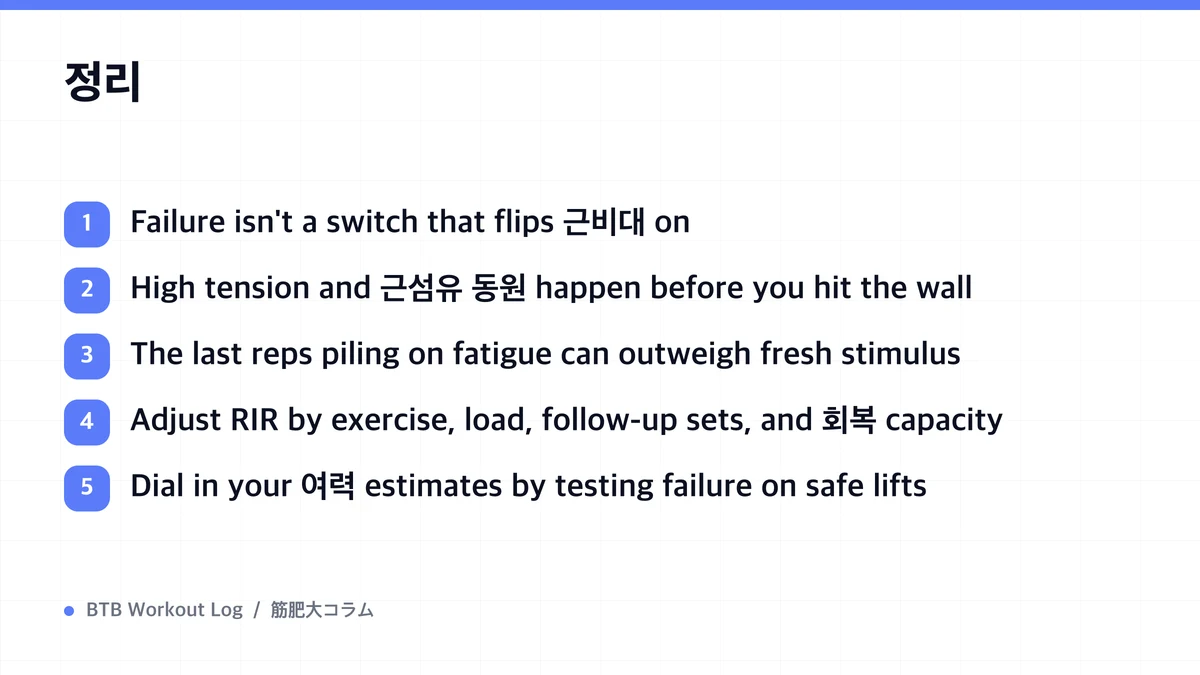
정리
- Failure isn't a switch that flips 근비대 on
- High tension and 근섬유 동원 happen before you hit the wall
- The last reps piling on fatigue can outweigh fresh stimulus
- Adjust RIR by exercise, load, follow-up sets, and 회복 capacity
- Dial in your 여력 estimates by testing failure on safe lifts