相信「正確姿勢只有一種」,你可能正在吃虧|肌肉肥大背後真正的原因
The real danger isn't caring about form—it's treating one specific look as the universal standard for everyone, then forcing it on people regardless of skeletal differences, injuries, target muscles, or what equipment they're using.
Good form does have principles worth following. But meeting those principles doesn't mean there's only one way to move. You can adjust the pattern to fit the individual while keeping it repeatable and controlled.
"Textbook Form Is the Only Right Way" — Where's the Danger
在動作指導中,足距、握距、關節角度、槓鈴軌跡往往被示範為一套標準型態。有基準確實能幫助快速習得動作,也容易察覺明顯的形式崩解,所以作為初期示範是有用的。問題出在當這套示範被提升為應該讓所有人以相同形式重現的完成形態時才浮現。
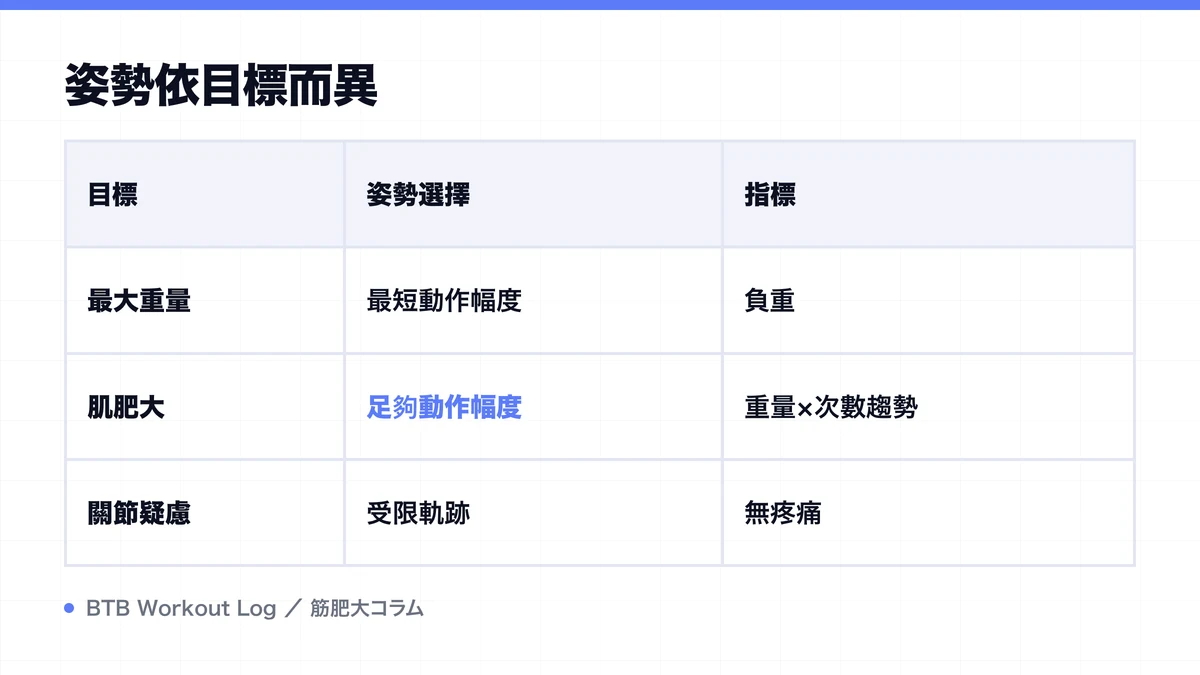
四肢長度、關節容易活動的方向、目前的活動能力、器械結構因人而異。更何況同樣是臥推,究竟是作為競技項目舉起大重量,還是以肌肉肥大為目標穩定對大胸肌施加負荷,優先考慮的條件也不同。硬要去配合一個外觀,反而可能強制練習者採取不順手的姿勢,或者把符合訓練目標的調整當成「錯誤」丟棄。
反過來說,「既然有個人差異,怎樣自由就好」的想法也太極端了。無法控制的反彈、被重量壓垮而改變的軌跡、為了累積次數而縮小的動作幅度,這些都需要和有意識的調整區分開來。以全關節活動範圍為基礎的理由並不是要所有人的關節都活動到相同的最大角度,而是為了讓目標肌肉在更寬的範圍內工作,使動作條件一致。
The Approach to Stabilizing Form Is Correct
The advice to "lock in your form" has real merit. To accurately measure progress in weight or reps, your conditions from one session to the next need to stay consistent. If grip width, stance width, seat position, range of motion, and use of momentum shift every time, you can't tell whether the numbers went up because you got stronger or just because you made the movement easier.
What you're fixing here isn't a single rigid posture like in a photo—it's the specific conditions you've chosen to work within. Pick your target muscles and the role of the lift, then standardize your starting and ending positions, main bar path, and tempo strategy within a pain-free, controllable range. Only with this repeatability can you track 漸進超負荷 as real increases in weight or reps.
| Category | What to Check | Approach |
|---|---|---|
| Non-negotiables | Movement is controlled, no sharp pain, target range of motion is maintained | Don't let form break down mid-set |
| Standardize | Grip, stance width, seat, range of motion, degree of momentum | Use these for session-to-session comparison |
| Adjustable | Joint angles, bar path, stance variation, equipment, exercise variation | Match your goal and individual differences |
Where Does Individual Variation End and Form Breakdown Begin?
Individual variations that are acceptable and form breakdowns caused by insufficient strength capacity cannot be distinguished by appearance alone. The standard for judgment is whether the change is intentional, reproducible, and aligned with your training goal. For example, if widening your squat stance results in stable depth at your target range, that's a legitimate adjustment. If foot width or center of gravity shifts suddenly only in the latter half of a set, suspect fatigue-induced breakdown.
Range of motion follows the same principle. Full range is a solid default starting point, but it's not synonymous with "reaching the end of joint travel." The standard is the range where you maintain tension on the target muscle and control your posture. If pain or equipment limitations exist, adjusting your 動作幅度 is an option—but this should be recorded separately from deliberately shortening range to handle heavier weight. The same premise matters for choosing between full range and partials, as covered in our comparison of full range versus partial reps.
Changing part of your form also shifts load distribution and difficulty curves within the same exercise name. Recording a set with a different grip as your previous personal record under identical conditions isn't valid. Simply separating "I lifted more weight" from "I lifted the same weight with the same movement pattern," and you can track form adjustments and progress together without conflict.
What the Research Shows: Change Your Approach, Change Your Results
Research on bench press shows that varying bench angles and execution methods produce inconsistent activation across different chest regions and performance outcomes. The same pattern holds for back and shoulder work—exercise selection and execution conditions change how muscle activation is distributed. This reveals how difficult it is to make a single movement pattern the optimal solution for all goals.
However, a form that produces high muscle activity in a short measurement window cannot be directly labeled the superior form for long-term 肌肉肥大. Muscle activity measurements, lifting performance, and 肌肉肥大 months later are separate evaluations. If study participants differ in experience, the exercises tested, the loads used, or the measurement sites, the observed outcomes will shift accordingly.
Resistance training reviews also treat 肌肉肥大 stimulus as multiple variables—not load alone, but frequency, intensity, volume, and movement pattern. Form relates to movement pattern and how load is distributed. Rather than extracting "one universal path" from research, it's more practical to lock your goal, standardize your conditions, and track your response.
Why one form can look like the right answer
Coaching environments rely on simple rules—"knees in," "elbows at this angle"—because they stick better. They help when you're learning a complex move, but they're originally cues for one person fixing one problem. Once the context shifts, these stay as universal law, and adjustable elements become absolutes.
Elite athletes' videos get copied as gospel. A movement optimized for their skeleton, sport rules, years of training, and loaded capacity doesn't transplant directly to your 肌肉肥大 work. Video also shows one angle, one rep—it won't capture discomfort, stability feel, local muscle fatigue in your target, or rep-to-rep consistency across sets.
Don't let "the pump" or burn sensation alone decide. Feel is useful for form adjustments, but a strong pump doesn't determine long-term superiority. Separate the sensation from the result, then check weight and reps under identical conditions, RIR, and 恢復.
In practice: decide by goal, constraint, then record
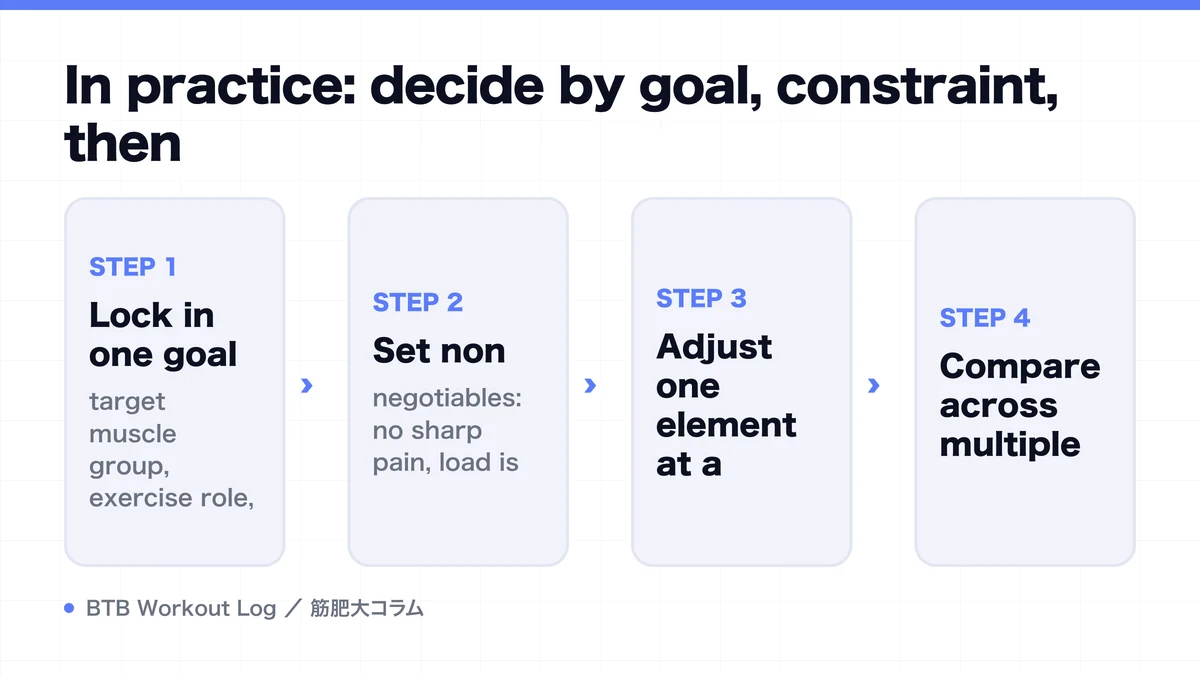
Instead of hunting for the "correct" video, narrow down by this sequence:
- Lock in one goal: target muscle group, exercise role, 次數範圍.
- Set non-negotiables: no sharp pain, load is controllable, target 動作幅度 is repeatable.
- Adjust one element at a time: don't change grip, stance width, seat height, and path simultaneously.
- Compare across multiple sessions: same RIR, check reps, stability, fatigue in non-target areas, 恢復 until next session.
- Lock in what works: once improvement is clear, hold those conditions steady while advancing weight or reps.
If sharp pain arrives, worsens with reps, or remains despite load reduction, don't micro-adjust—stop the exercise and see a specialist. If the pattern looks different from the textbook but you're stable, performing as intended, and progressing on goal, ask whether it needs fixing first.
Like not treating weight gains per session as the only progress marker, don't directly compare numbers from a form change to earlier data. Treat them as separate conditions.
常見問題
- Should I match someone else's form if we're doing the same lift?
- Even in the same exercise, limb length, comfortable joint angles, equipment, and goals shift what stance width or path suits you. Use a reference as a starting point, but prioritize pain-free, controlled motion and the ability to hit your target 動作幅度 and conditions.
- Does my previous record disappear if I change form?
- No, but track it separately as a personal best under those conditions. Log the date you changed grip or 動作幅度, build a new baseline over a few sessions, then compare weight and rep gains from there forward.
- Is any form fine as long as nothing hurts?
- No pain is essential, but it's not enough. Check whether load stays controllable, your target muscle and 動作幅度 hold, and form stays solid in the final reps. Stop if you feel sharp or worsening discomfort, and consult a specialist if needed.
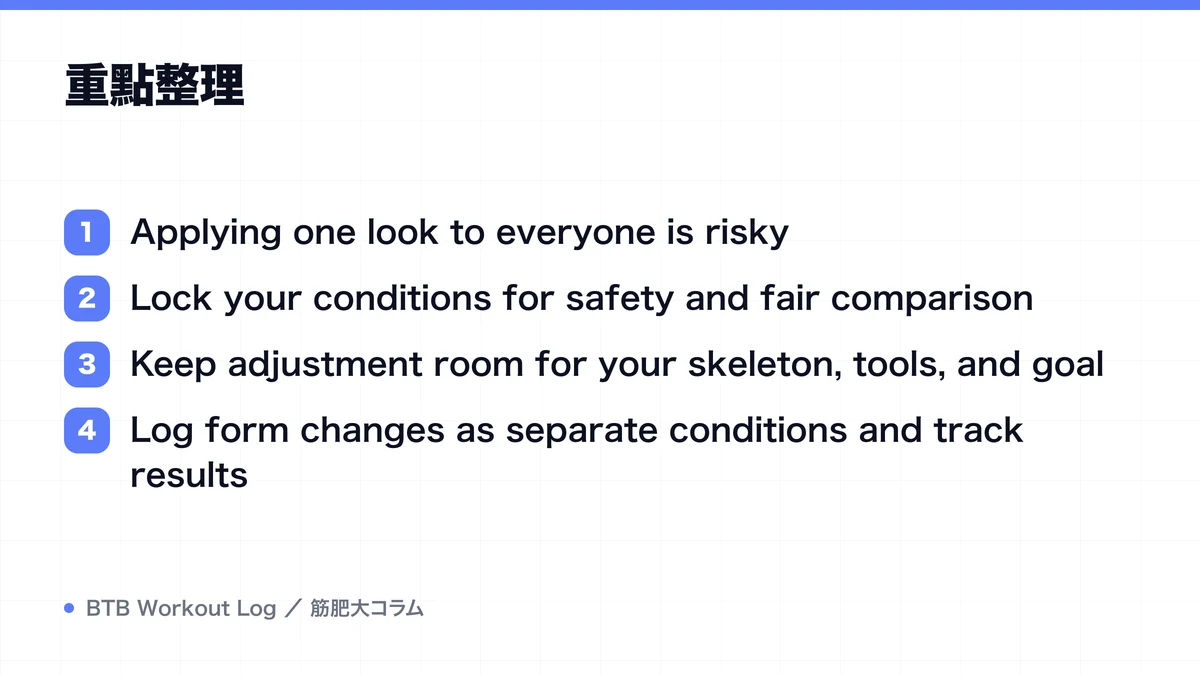
重點整理
- Applying one look to everyone is risky
- Lock your conditions for safety and fair comparison
- Keep adjustment room for your skeleton, tools, and goal
- Log form changes as separate conditions and track results
參考文獻
- Non-uniform Excitation of the Pectoralis Major During Flat and Inclined Bench Press
- The Effects of Bench Press Variations in Competitive Athletes on Muscle Activity and Performance
- Variations in Muscle Activation During Traditional Latissimus Dorsi Exercises
- Different Shoulder Exercises Affect the Activation of Deltoid Portions
- The Influence of Frequency, Intensity, Volume and Mode of Strength Training on Whole Muscle Cross-sectional Area in Humans