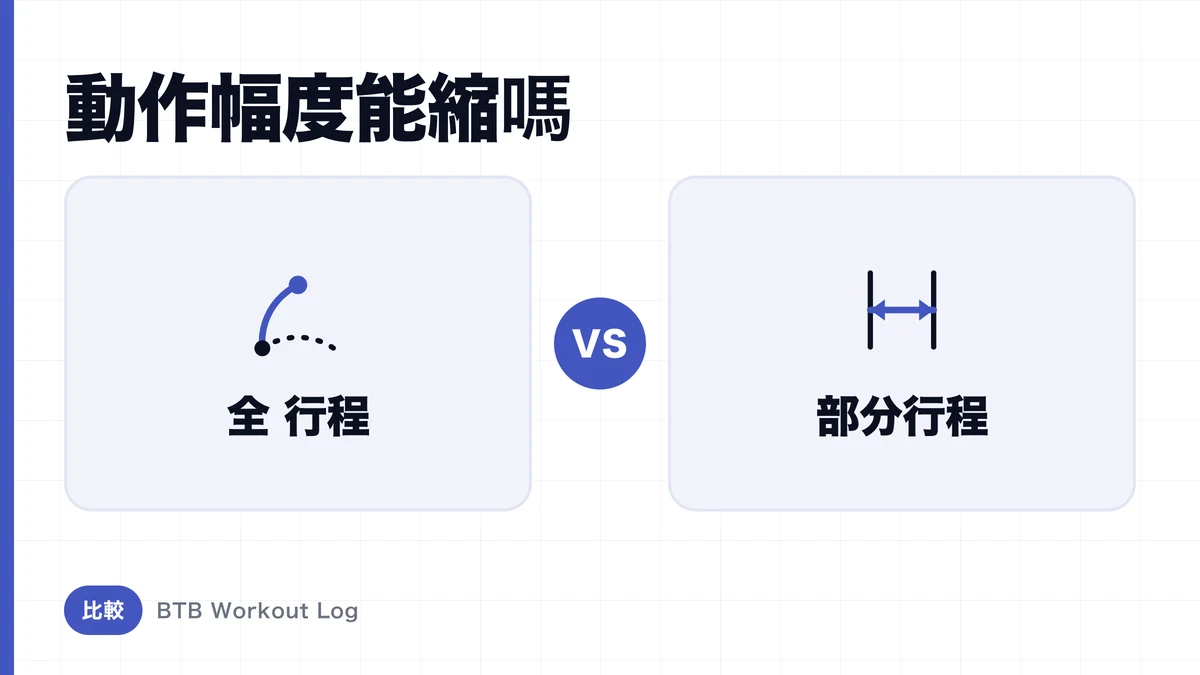
全程動作幅度 vs 半程動作,哪個對肌肉肥大更有效?用研究檢驗正在被動搖的常識
完整動作幅度是肌肉肥大的穩定基準,但限制在長肌長側的部分幅度,在動作和目的相符的情況下可以成為有力選擇。不能將只在短肌長側進行的部分幅度一概視為等同。
該比較的不是槓鈴移動的距離,而是目標肌肉在哪個肌肉長度能獲得張力、在疲勞成本下能累積多少有效反覆、在相同條件下能否追蹤進度。
比較完整動作幅度與部分幅度前,先定義區間
完整動作幅度不是指關節的物理極限,而是對目標肌肉保持張力、沒有疼痛或明顯代償動作的起點到終點。個人骨骼和器具會改變端點,但在評估同一動作時要保持端點一致。詳細基準請參考為什麼完整動作幅度是基準。
部分動作幅度則是只在完整幅度的某個區間內反覆。但使用長肌長側的部分幅度(肌肉伸展位置)、短肌長側的部分幅度(肌肉收縮位置)、或在卡點附近的部分幅度時,刺激和目的都不同。用「部分幅度」這一個詞彙統稱會破壞比較的有效性。
即使重量·次數相同也需要注意。縮短動作幅度通常能用更重的重量,相同重量也能做更多次。但移動距離和肌肉長度改變了,反覆的內容就不同。要分開評估肌肉肥大效果、局部疲勞、時間、負荷設定和再現性等多個面向。
平均來看完整幅度更穩妥,但長肌長側可能是例外
全動作幅度的優勢,在於一次反覆中能讓目標肌群在較廣的肌肉長度範圍內出力。它不會只偏重某個短區段,而是能完整利用該動作的阻力曲線,因此當你沒有明確理由要限制動作幅度時,很適合作為基本選擇。只要固定動作姿勢與起止位置,也更容易比較重量與次數的進步。
不過,部分幅度並非一定比較差。若一個動作能在目標肌群被拉長的位置提供足夠阻力,偏向肌肉較長位置的部分幅度,可能帶來接近全動作幅度的肌肉肥大效果,甚至可能因測量部位不同而更有優勢。重點不是「只做了一半」,而是被省略與保留的區段中,哪一段對目標肌群產生的張力更大。想釐清動作幅度如何改變刺激,可以搭配閱讀動作幅度改變刺激的原理。
但還不能因此把這個趨勢套用到全身所有動作。肌群、動作、器材的阻力方向、訓練資歷,以及肌肉肥大的測量位置不同,結果都可能改變。至於偏向肌肉較短位置的部分幅度,目前缺乏足夠依據認為它能達到與肌肉較長位置相同的效果。如果主要目的是追求收縮感,或練習特定區段,最好不要把它當成肌肉肥大訓練的主軸。實際安排上,平均而言應以全動作幅度為起點,再視條件以偏向肌肉較長位置的部分幅度作為替代或補充。

更短的動作幅度更快,但效率不一定更高
部分幅度因為一個反覆的移動距離短,相同次數下能縮短組的時間,在完整幅度會卡住的區間可以加更多反覆。在穩定的機械或單關節動作上,於完整幅度組後加少量長肌長側反覆,確實容易集中目標肌肉的額外刺激。
但次數增加不能直接等於時間效率或肌肉肥大效果的改善。短區間的20次和完整幅度的20次內容完全不同。高重量部分幅度可能增加輔助肌群和關節負擔,避開弱點區間導致目標肌肉刺激不均。反過來,完整幅度可能因為姿勢維持和轉換消耗太多全身疲勞,還沒充分刺激目標肌肉就結束組。
時間效率不是「一組能短幾秒」,而要計入獲得所需刺激需要幾組、到下次訓練前能否充分恢復。採用部分幅度後還不斷增加組數,省下的時間可能遠不及恢復成本的增加。反之,完整幅度若每次都浪費時間在控制不了的端點,改變動作幅度或選擇新動作才是解決之道。
改變動作幅度時,重量·次數·RIR 的基準也要分開
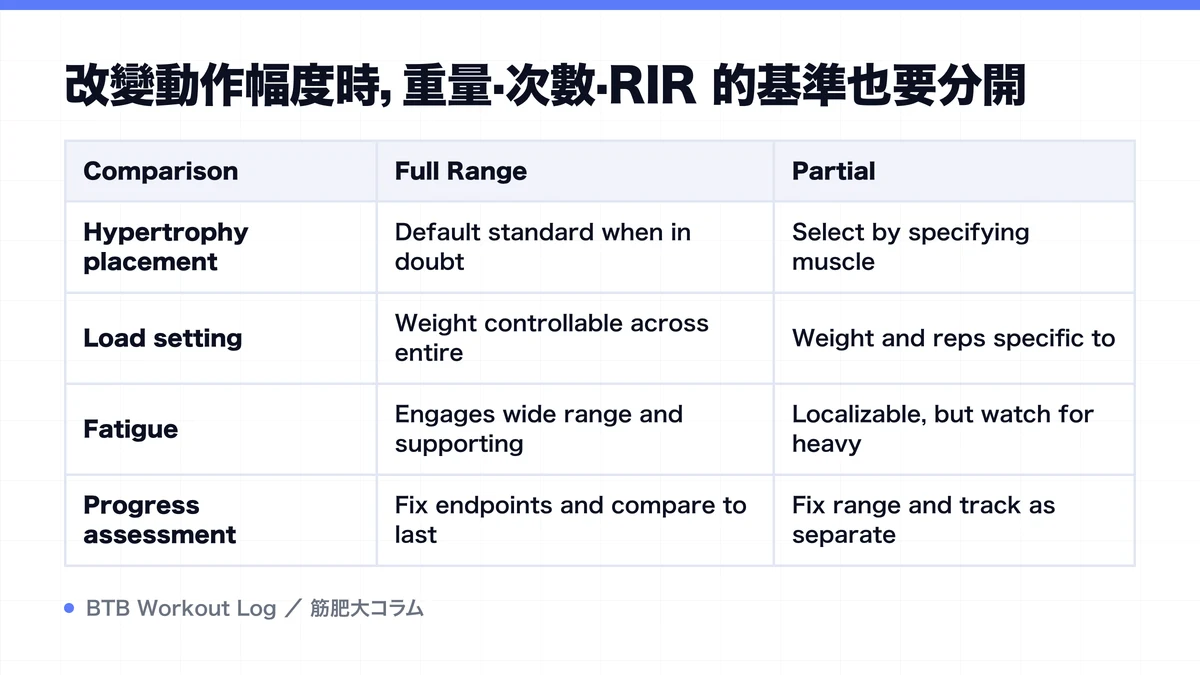
| Comparison | Full Range | Partial |
|---|---|---|
| Hypertrophy placement | Default standard when in doubt | Select by specifying muscle length and goal |
| Load setting | Weight controllable across entire range | Weight and reps specific to limited range |
| Fatigue | Engages wide range and supporting muscles easily | Localizable, but watch for heavy load escalation |
| Progress assessment | Fix endpoints and compare to last session | Fix range and track as separate variation |
Changing range of motion alters difficulty at the same weight, so you cannot carry over previous RIR. RIR shows remaining reps—how many more you could do—but a weight at RIR 2 in full range is not necessarily RIR 2 in partial. For the first few reps, maintain reserve, lock in your range, then set RIR and rep range specific to that condition.
In your log, keep full range and partial separate rather than mixing them under the same exercise name—it stays clearer. Note your start and end points: "bottom half," "knee angle marker," "stop at chest," so you can recreate them. Track as a distinct variation. This prevents mistaking a jump in weight from a shortened range as true progressive overload.
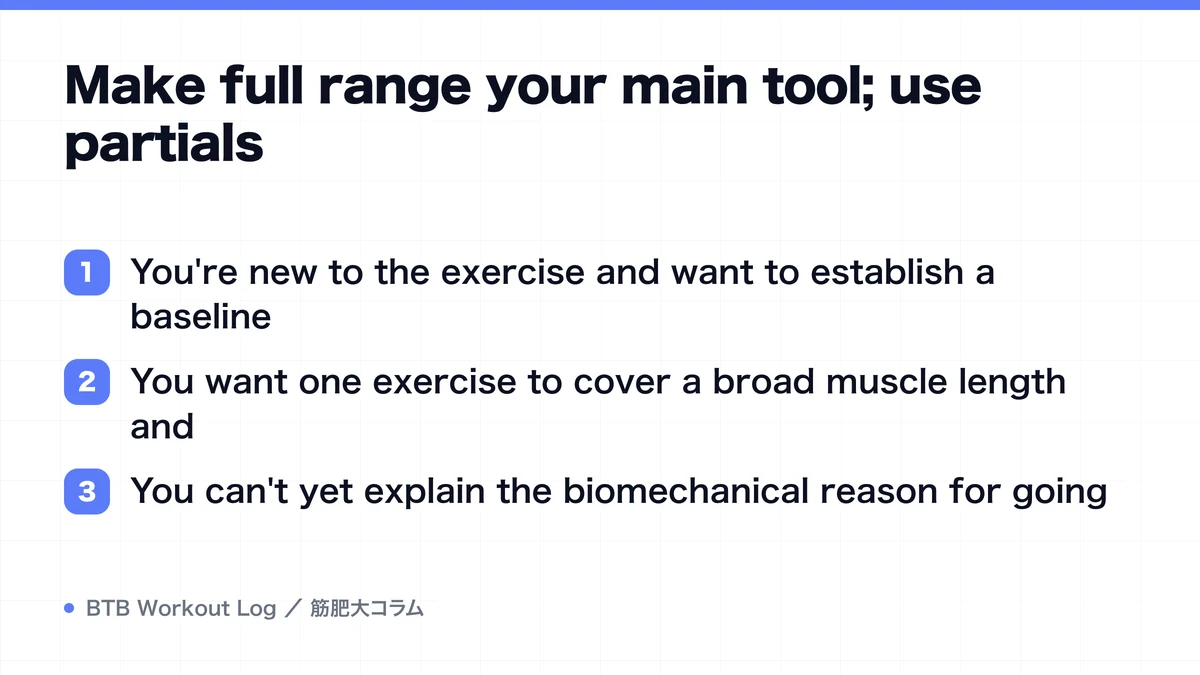
Make full range your main tool; use partials when you can explain the goal in one sentence
When to favor full range
- You're new to the exercise and want to establish a baseline for progress
- You want one exercise to cover a broad muscle length and reduce imbalance
- You can't yet explain the biomechanical reason for going partial
When to consider long-length partials
- Tension stays on even in the stretched position, and you can stabilize the movement
- Your intention is clear: adding reps in the later portion of full range
- You can compare results over weeks as a separate condition from full range
Short-length partials pay off when your goal extends beyond hypertrophy: technique in a specific band, control at peak contraction, sport-specific carryover. If you narrow range to avoid pain, staying pain-free is reasonable—but it's not a license to chase heavy loads while ignoring the cause. Form isn't one fixed position; separate what you protect from what you adjust. That framework appears in form adjustment standards too.
To compare, hold the same 每週組數 and effort level, locking your range for several weeks. During that time, watch target muscle performance, discomfort, recovery until next session, and weight/rep progression. The average isn't what matters—pick the range you can reproduce where you keep making progress and recovering. Mixing different ranges into the same personal record breaks the comparison. BTB Workout Log lets you separate variations in your records.
常見問題
- Can I build a whole program using only long-length partials?
- It may work for certain muscles and lifts, but you don't need to replace every exercise. Start with full range as your baseline, then trial long-length partials as a separate variation only for moves where tension holds in the stretched position. That way bias in stimulus and progress tracking both become clearer.
- If I can lift heavier in a partial than full range, does that mean partials are higher intensity?
- More external load doesn't mean more stimulus to the target muscle when range of motion, muscle length, and the difficult portion all change. Set weight, reps, and RIR specific to the partial, and rate it separately from your full-range personal record.
- Is it effective to add partials after reaching the end of a full-range set?
- In a stable lift where you can hold the long-length range, yes—it can deliver bonus stimulus. But doing it every set raises fatigue and total volume. Start by adding it only to your final set or two, then watch next session's rep count and joint feel before scaling up.
重點整理
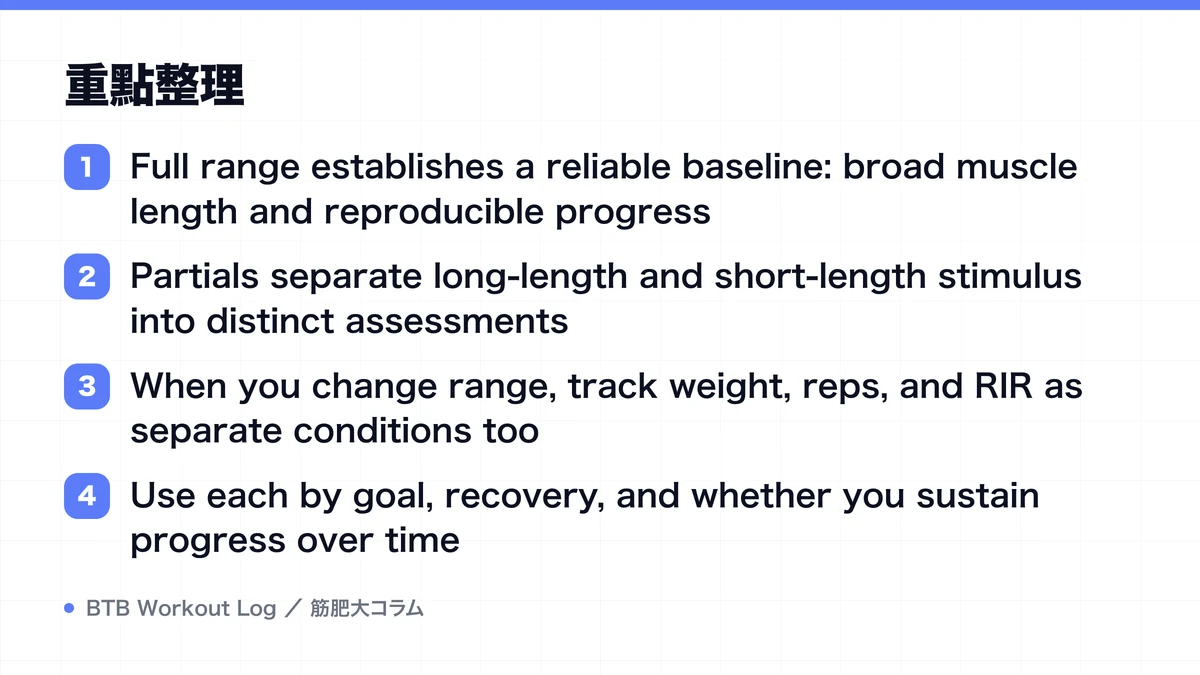
- Full range establishes a reliable baseline: broad muscle length and reproducible progress
- Partials separate long-length and short-length stimulus into distinct assessments
- When you change range, track weight, reps, and RIR as separate conditions too
- Use each by goal, recovery, and whether you sustain progress over time
參考文獻
- The Mechanisms of Muscle Hypertrophy and Their Application to Resistance Training
- Mechanisms of Muscle Hypertrophy: Current Understanding and Future Directions
- The Influence of Frequency, Intensity, Volume and Mode of Strength Training on Whole Muscle Cross-sectional Area in Humans
- Low- vs High-load Resistance Training for Strength and Hypertrophy: Meta-analysis
- Muscle Hypertrophy Is Independent of Load Across Upper and Lower Limbs When Effort Is Matched