為什麼肌肉肥大訓練要用全程動作幅度?用半程動作可能正在讓你吃虧
動作幅度成為基準的原因是,它讓目標肌肉在更寬廣的肌長度下發力,同時更容易統一每次的動作條件。但這不表示「愈深入關節極限愈好」。
根據動作類型和身體特徵決定起點和終點,以目標肌肉能控制負荷的範圍為基準。部分幅度並非無效,而是當你能解釋其目的時的選擇之一。
動作幅度不是「動到關節極限」
訓練中所說的動作幅度,不是指關節在物理上能活動的最大範圍,而是保持目標肌肉的負荷、能控制姿勢的範圍內,從一端動到另一端。以深蹲為例,腳跟離地、臀部位置無法穩定、出現疼痛的深度都不算動作幅度。啞鈴飛鳥也不是上臂下降得愈多愈好,而是肩膀穩定、大胸肌能承接的位置才是下端。
因此動作幅度不是每個人都相同的角度。骨架、關節活動度、器械軌跡、動作目的都會改變起終點。然而對同一個人做同一個動作,端點應該盡可能維持一致。上次深、這次淺,即使重量或次數增加,也不能算做相同工作量的比較。動作幅度不是姿態的裝飾,而是與負荷、次數並列的訓練條件。
之所以成為基準,是因為容易統一刺激和比較條件
肌肉肥大中,機械張力——肌纖維在發力時受到的張力——被認為是核心刺激。當關節運動時,目標肌肉的長度、外部負荷的力矩臂、發力的難易都會連續變化。換句話說,即使重量相同,每次反覆的任何位置也不會受到完全相同的刺激。動作幅度相比只反覆某個短區間,更容易確保目標肌肉有機會在不同長度和關節角度下發力。
另一個原因是容易判定進度。如果優先追求高重量,疲勞階段可能變淺,也可能在數週內逐漸縮短起始位置。在這種情況下記錄「增加5kg」,其實無法分辨是實際肌力進步,還是動作幅度變短後負荷技能的提升。這個問題與為何僅看重量不足夠相關。
如果一開始就以動作幅度為基準,比較重量、次數、RIR時基礎就會一致。這不是說動作幅度在所有情況下都產生最大肌肥大,而是這是最容易解釋改變成因的出發點。
「愈深愈好」「愈重愈好」兩種說法都不完整
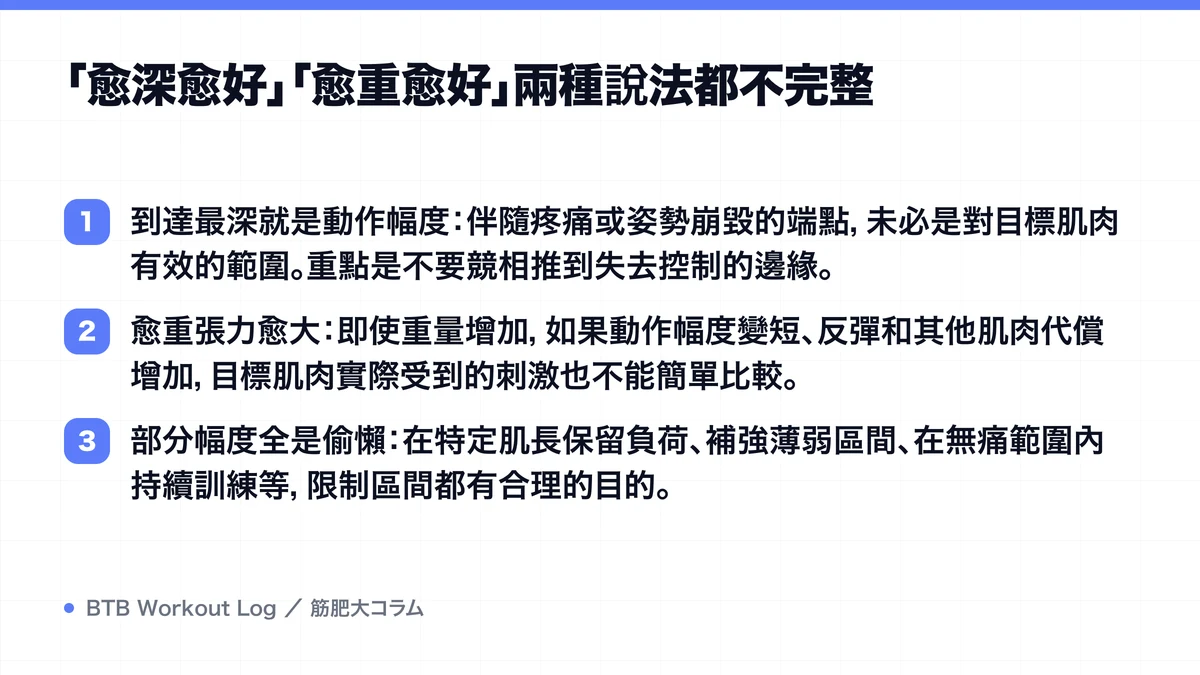
動作幅度的混亂源於把它單純當作移動距離。實踐中需要區分以下三點:
- 到達最深就是動作幅度:伴隨疼痛或姿勢崩毀的端點,未必是對目標肌肉有效的範圍。重點是不要競相推到失去控制的邊緣。
- 愈重張力愈大:即使重量增加,如果動作幅度變短、反彈和其他肌肉代償增加,目標肌肉實際受到的刺激也不能簡單比較。
- 部分幅度全是偷懶:在特定肌長保留負荷、補強薄弱區間、在無痛範圍內持續訓練等,限制區間都有合理的目的。
反面的誤解也存在。僅憑「採用了動作幅度」這個事實,組數本身並不會變得有效。如果負荷太輕、保留過多餘力,或者用慣性而非目標肌肉發力,即使動作幅度寬廣刺激也可能不足。動作幅度應該與RIR、負荷、組數、動作速度一起評估。RIR標準也要一致,前後比較才有意義。
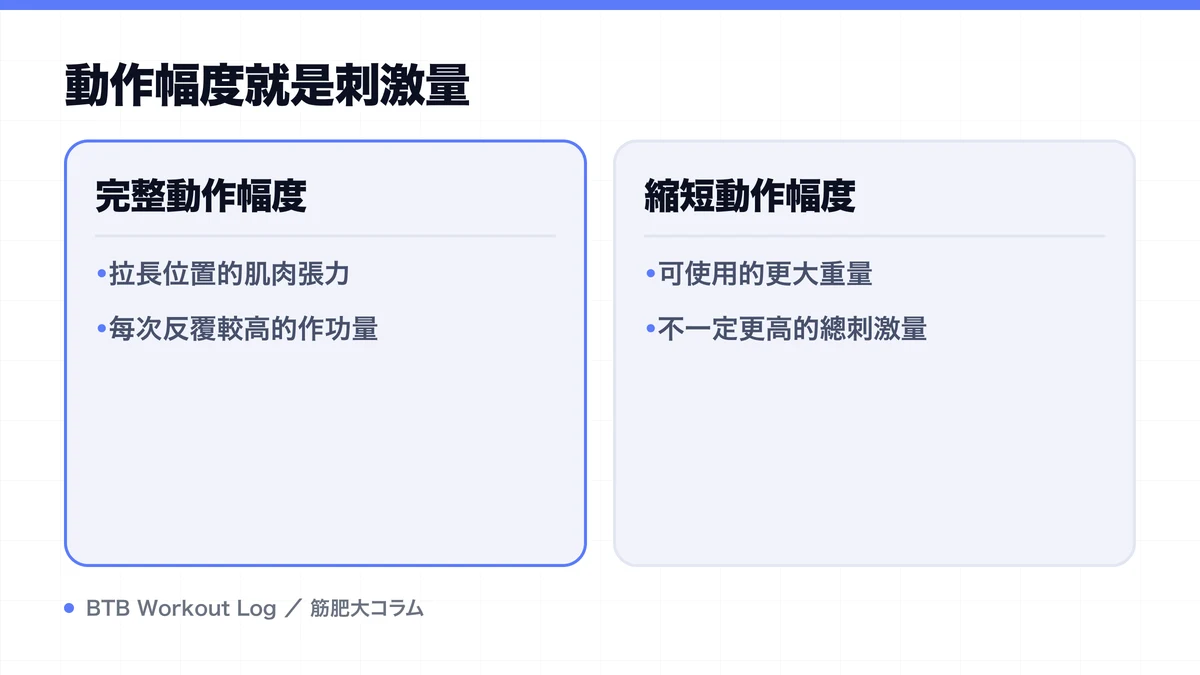
動作幅度改變,肌肉發力條件也改變
一次反覆動作中,肌肉長度和關節周圍的力學條件會同時改變。有些動作會讓肌肉在拉長的位置承受較大張力;但也可能因器材的阻力方向,讓負荷在端點減弱。另一些機械則會在肌肉縮短的位置施加較強負荷。因此,光看「槓鈴或握把移動了多遠」,無法判斷目標肌群究竟在哪一段真正出力。
全動作幅度的優點,不是能平均刺激每一個角度,而是能完整經歷該動作原有的阻力曲線。如果特定區段的刺激仍然不足,再搭配其他動作或刻意加入部分動作幅度即可。一開始就把動作限制在很短的區段,反而難以看出自己省略了哪一段肌肉長度,又需要補強什麼。
閱讀研究時,也不能把動作幅度單獨抽出來解讀。肌肉肥大會受到頻率、強度、訓練量和運動形式等多項變因影響,而且每項研究採用的動作、受試者、動作幅度定義與測量部位也不相同。與其把平均結果直接套用到自己的所有動作,不如先建立能穩定重現的全動作幅度,再觀察身體反應與進步。全動作幅度與部分動作幅度的比較,請參考全動作幅度與部分動作幅度的運用方式;刺激改變的原因則會在本文後半段說明。
Use full range as your baseline, reserve exceptions for deliberate reasons
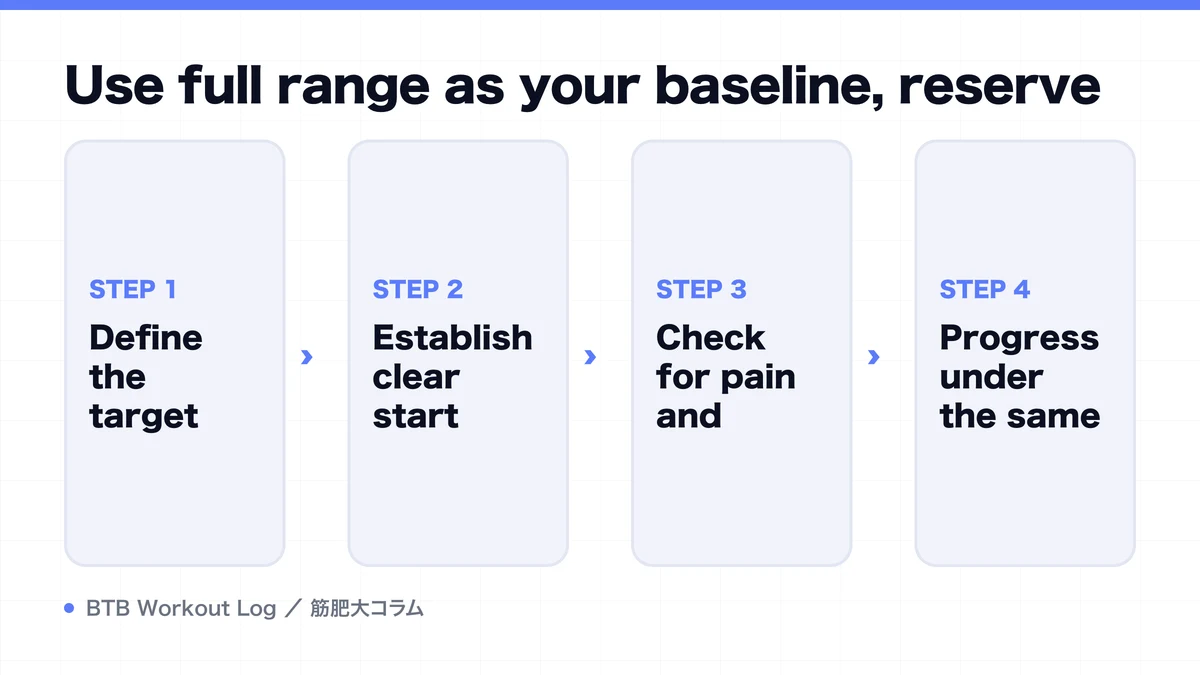
Set the 動作幅度 for each exercise using this order to make it easier to repeat:
- Define the target muscle and the exercise's role: A chest stretch fly and a heavy, stable chest press both involve the shoulder joint, but they prioritize different endpoints.
- Establish clear start and end points: Bar touching the chest, knees and hips aligned, handle reaching a specific position—use cues you can verify without relying on video or memory.
- Check for pain and compensation: If you feel sharp pain, joint instability, excessive momentum, or fatigue in the wrong muscle, review that endpoint or the load.
- Progress under the same conditions: Keep 動作幅度 and form fixed while gradually adding reps or weight. This is when you're actually implementing 漸進超負荷.
Before switching to partial range
If you choose partials, confirm you can explain the reason in one sentence—something other than "I want to lift more weight." Adding stimulus to the lengthened range, drilling a weak point, protecting a joint while training the target muscle, or adding safe reps after a full-range set—these justify limiting your range. If you're just drifting shallow without thinking, drop the load and return to your baseline 動作幅度 first.
In your log, record not just weight and reps, but also the 動作幅度 conditions: "brief pause at chest," "thighs below parallel," "bottom half stretch-focused," and so on.
擴大動作幅度後,肌肉刺激會如何改變?
擴大動作幅度,不只是「蹲得更深」,而是把原本沒有承受負荷的關節角度納入負重範圍。新增的通常是肌肉被拉得更長的一側,即使重量相同,1 次反覆動作最困難的位置也會跟著改變。
關節角度改變時,槓桿條件也會改變。如果某個動作在底部的力矩臂較長,即使槓片重量相同,肌肉也必須產生更大的力量。擴大動作幅度後能使用的重量下降,不代表你變弱了,而是因為承受負荷的區段延伸到了更困難的位置。因此,只要改變動作幅度,就必須重新設定重量、次數和RIR。
反過來說,如果只追求重量,卻沒有確認動作幅度是否維持一致,進步的比較基準就會在不知不覺中失效。即使這次使用的重量比上次更重,只要動作深度變淺,就不能算是同一個動作。除了記錄重量和次數,也要固定該動作設定的端點,也就是每次要下放到哪裡。這是讓訓練紀錄具有可比性的最低條件。
常見問題
- If my joints are tight, should I force full range anyway?
- You don't need to force maximum angles. Use the range where you can keep tension on the target muscle without pain or postural breakdown—that becomes your full range for now. As mobility improves, gradually expand your endpoints and track that separately from weight and rep records.
- Can you build muscle with partial range?
- Yes, if you load the range properly, use adequate effort, and hit the right volume, 肌肉肥大 occurs with partials. But you miss stimulus in the excluded range. It's easier to start with full range as your baseline, then deliberately add partials for lengthened-range stimulus or weak-point training based on a clear goal.
- I lifted heavier and my range got a bit shorter. Should I count that as progress?
- That's tough to call equivalent progress. If you're using the shorter range temporarily to adapt to the new weight, log it and count success when you return to your goal 動作幅度. If you're drifting shallow every time, adjust your 增肌 increment or RIR target instead.
重點整理
- Full range is end-to-end movement the target muscle can control
- Longer muscle lengths create stable tension and consistent rep conditions
- Judge depth alongside tension, RIR, and compensation patterns
- Use partials only when you can explain which range you're skipping and why
- 改變動作幅度,就是改變承受負荷的關節角度與最困難的位置
參考文獻
- The Mechanisms of Muscle Hypertrophy and Their Application to Resistance Training
- Mechanisms of Muscle Hypertrophy: Current Understanding and Future Directions
- The Influence of Frequency, Intensity, Volume and Mode of Strength Training on Whole Muscle Cross-sectional Area in Humans
- ACSM Position Stand: Progression Models in Resistance Training for Healthy Adults