重量不漲≠沒有肌肉肥大|數字停滯也不用慌的原因
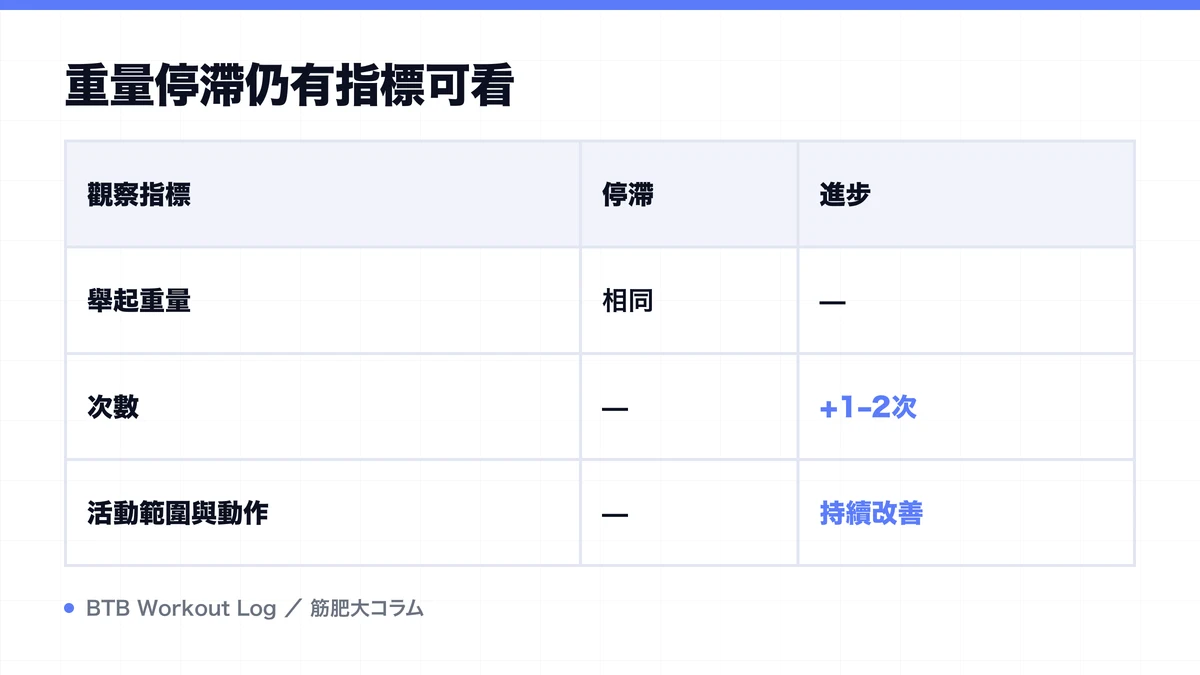
光是訓練重量沒有增加,不能判定肌肉沒有肥大。因為肌力除了受到肌肉量影響,也會受到動作技巧、神經系統適應、疲勞,以及測試次數區間影響。
不過,這也不代表可以忽略重量停滯期。你需要先釐清:在相同條件下,次數和餘力是否也都停住了。
重量與肌肉肥大何時真正相連
這個觀點廣泛流傳是有原因的。肌肉截面積是發力基礎之一,長期肌量增加確實提高發力潛能。同一動作、同一動作幅度、同一姿態下,數月內能舉起更重的重量,說明訓練產生了實質適應。
尤其初期訓練者,動作掌握和筋力提升快速,肌量變化也常同步發生,容易有「加鐵片身體也變」的經驗。而且重量數字清晰,比鏡子或周徑測量更容易日常追蹤。
這些都講得通。誤解始於把筋力等同於肌量本身,把重量停滯期直接判定為肌肉肥大零增長。重量是有用的替代指標,但不是直接測肌肥大。
舉起重量不只取決於肌肉大小
某個動作能舉多少kg,是多個因素綜合的結果。即使肌量不變,動作技術改善也能增加重量;反之肌量增加但這股力在特定動作中的練習不足,數字也難以體現。
- 動作技能:軌跡、轉換、腹式呼吸、關節協調順暢後,同等肌量能舉更重。
- 負荷特異性:高重量練習習慣1RM附近發力,高次數中心練習同肌量下1RM進展可能較小。
- 當日疲勞和準備狀態:前期疲勞積累、睡眠、動作順序、組間休息都影響當次發力。
- 測試條件:動作幅度、速度、器具、握法、姿態改變,同重量難度也不同。
因此1RM或頂組重量不是「肌肉大小」,而是包含肌量的綜合表現指標。反向也成立——光靠技能也能增重,所以「變強=等量肥大」也說不絕對。
筋力與肌肉肥大各自變化的研究案例
Schoenfeld等人2017年的薈萃分析比較低負荷與高負荷訓練,結果顯示肌肉肥大適應程度相近,但1RM筋力增長高負荷更優。一般來說,肌量適應相近不代表最大肌力變化相同(高重量和高次數的應用)。
但這不表示「輕重量隨便動就行」。薈萃分析中的對比以每組做到臨時筋力耗盡為前提。實踐中未必總要做到極限,但負荷越輕越需確保充分努力度,才不會偏離研究條件。
Moesgaard等人2022年薈萃分析同樣在訓練量相同前提下,發現週期化方案對1RM筋力更有利,但肌肉肥大無明顯差異。總的說,最大肌力變化和肌量變化往往不同步。
這些是群體平均,不能單用重量否定或證實個人肌肉肥大。它們指出的是筋力與肌肉肥大相關但適應方向不同的邊界。
加不了鐵片也能有進展
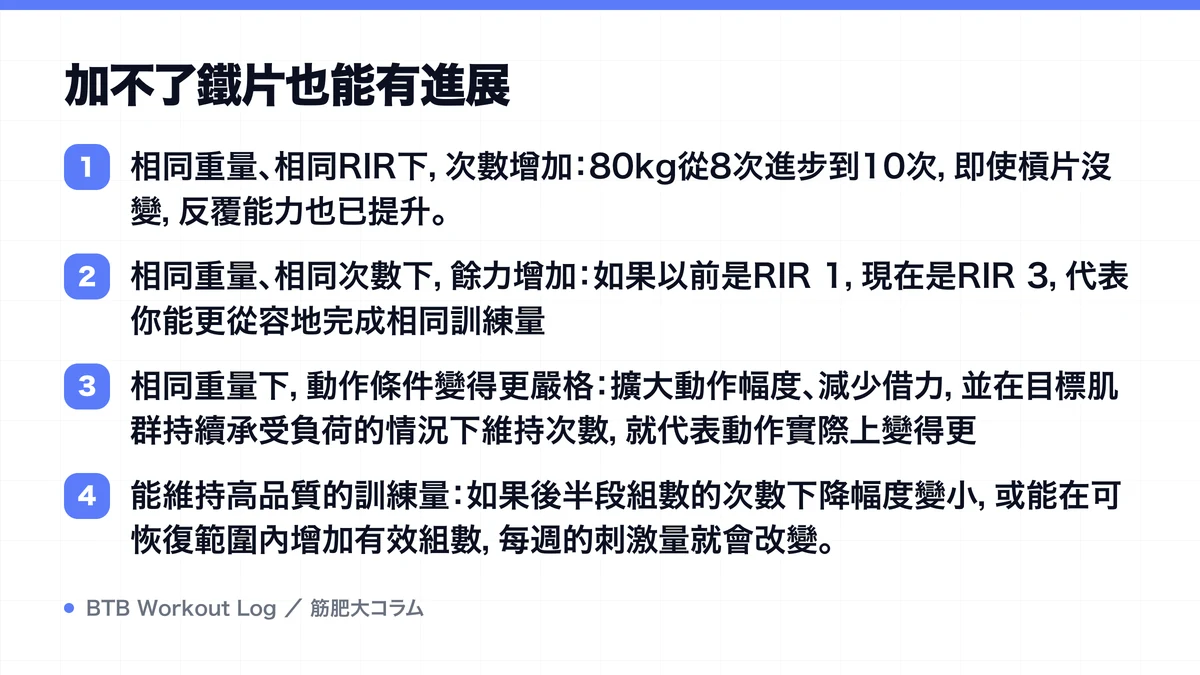
漸進超負荷不只是每次訓練都增加槓片。即使重量不變,只要比較條件一致,並出現以下變化,就代表你的表現能力或訓練刺激可能仍在進步。
- 相同重量、相同RIR下,次數增加:80kg從8次進步到10次,即使槓片沒變,反覆能力也已提升。
- 相同重量、相同次數下,餘力增加:如果以前是RIR 1,現在是RIR 3,代表你能更從容地完成相同訓練量。RIR是對「還能再做幾次」的自我估計(RIR的使用方法)。
- 相同重量下,動作條件變得更嚴格:擴大動作幅度、減少借力,並在目標肌群持續承受負荷的情況下維持次數,就代表動作實際上變得更難。
- 能維持高品質的訓練量:如果後半段組數的次數下降幅度變小,或能在可恢復範圍內增加有效組數,每週的刺激量就會改變。
反過來說,如果是靠縮短動作幅度、增加借力或延長休息來提高次數,就會混入條件改變的影響。要把次數增加視為進步,前提是盡可能統一動作姿勢、動作幅度、休息時間與RIR。
Log combinations that tell you if you're really stalled on肌肉肥大
肌肉肥大progress isn't one number—you layer different metrics together. Skip single-session swings and look at multiple sessions of the same lift or trends across a whole training block to cut through the noise.
First, lock down your conditions
Not just the exercise name, but equipment, seat position, grip, 動作幅度, tempo, exercise order, and rest between sets. Then compare weight × reps alongside RIR. Even if the weight doesn't change, if reps or RIR improve, you're not stalled yet. Conversely, if weight went up but reps crashed and form shifted, that's not necessarily肌肉肥大 progress.
Then check weekly stimulus and恢復
Count weekly hard sets for the target muscle, RIR on each set, frequency, and how much later sets drop off. If performance collapsed across multiple lifts and fatigue and sleep are rough, suspect recovery trouble before stimulus shortage. If needed, take a Deload week, retest under the same conditions, and separate fatigue-induced plateaus from real ones.
Body metrics are supporting evidence only
Weekly average bodyweight, circumference measured the same way, and photos under matching light and posture all help. But bodyweight shifts with water and gut contents, and circumference moves with measurement spot and the pump. Don't treat small short-term changes as definite muscle gain—look for the trend to keep going the same direction as your training log shows.
Use reps and volume progression under consistent conditions, not weight alone. Weight might plateau while reps or 動作幅度 improves. BTB Workout Log exists to keep that detail in view.
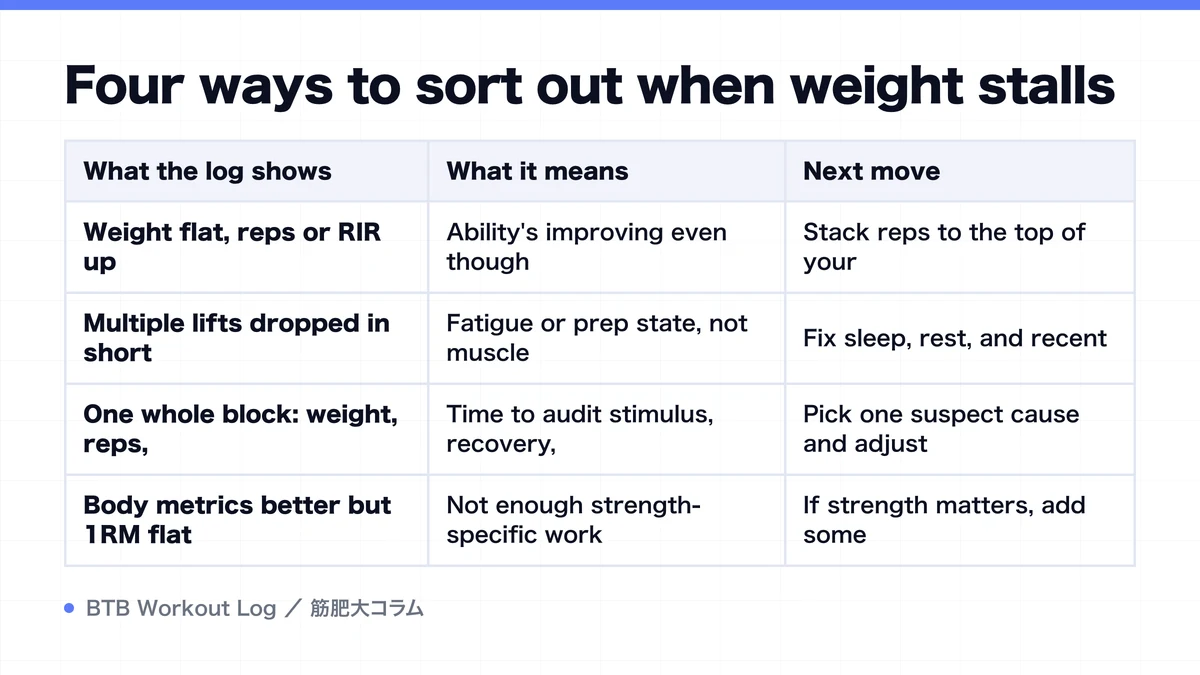
Four ways to sort out when weight stalls
| What the log shows | What it means | Next move |
|---|---|---|
| Weight flat, reps or RIR up | Ability's improving even though the bar isn't heavier | Stack reps to the top of your range, then add weight in small jumps |
| Multiple lifts dropped in short time | Fatigue or prep state, not muscle loss | Fix sleep, rest, and recent intensity, then retest |
| One whole block: weight, reps, RIR all flat | Time to audit stimulus, recovery, or nutrition | Pick one suspect cause and adjust one variable like set count |
| Body metrics better but 1RM flat | Not enough strength-specific work for max strength | If strength matters, add some low-rep heavy lifting |
The worst move is changing exercise, sets, frequency, and diet all at once the moment weight stops. Then you never know what worked, and you lose hard-won skill. Hold your conditions steady, look for patterns, and only adjust variables for the actual bottleneck.
Weight matters, but it's only one piece of the puzzle. "Weight didn't go up" does not mean "no肌肉肥大." When you track weight, reps, RIR, form conditions, weekly stimulus volume, 恢復, and body changes all together, you can tell whether a plateau is one you should ride out or one that needs fixing.
常見問題
- How many weeks can weight stay flat before I call it a肌肉肥大停滯期?
- There's no universal week count. Beyond beginner stage, gains slow down. With matching form, 動作幅度, rest, and RIR, wait to see reps stay flat too, and that pattern repeat across multiple sessions or carry through a whole training block before you call it stalled.
- If weight stays the same but reps go up, does that prove I'm building肌肉肥大?
- It's not direct proof of 肌肉肥大, but an increase in reps at the same load and RIR is a strong indicator that your work capacity has improved. Factor in body weight trends, circumference measurements, weekly volume, and recovery status to get the full picture.
- Should I test my 1RM regularly even when training for 肌肉肥大?
- Not necessary. 1RM testing is heavily influenced by technique familiarity and fatigue. Tracking weight, reps, and RIR within your normal 次數範圍 under consistent conditions gives you a clearer window into your 肌肉肥大 progress over time.
重點整理
- Lifting weight depends on muscle mass, but also skill, movement specificity, and fatigue state
- Research shows that higher loads drive larger 1RM gains even with similar 肌肉肥大
- Same weight but better reps or RIR under identical conditions signals real progress
- Cross-reference weight, reps, movement consistency, weekly stimulus, and body metrics before calling it