
啞鈴彎舉 vs 牧師椅彎舉,想練出粗壯肱二頭肌選哪個?
Both can be primary exercises for building bigger biceps. If you want to lock down your form and standardize rep quality, preacher curls are the easier pick; if you want to adjust wrist and elbow trajectory to your own mechanics, dumbbell curls fit better. There's no universal winner based on hypertrophy effect alone.
What matters to compare isn't the "feel" of the movement, but whether you can stack 硬組 sets while maintaining your target 動作幅度, whether you can add reps or weight over weeks, and whether your elbows and wrists stay healthy.
First, What to Compare: Match Training Conditions Before Exercise Names
The dumbbell curl described here is the standard form: standing upright, holding dumbbells in both hands with palms facing forward after supination. The preacher curl involves resting your upper arms on an inclined pad and flexing your elbows using dumbbells, an EZ bar, or a machine. Since dumbbells can actually be used on preacher equipment too, the comparison between the two isn't purely about "tool" versus "position" — it depends on which equipment you choose for the preacher variation, which affects load increments and how you handle side-to-side differences.
For 肌肉肥大 goals, evaluate across these five dimensions. 動作幅度 isn't about forcing joints to their absolute limits; use the range you can repeat pain-free as your benchmark. If you want to specifically examine 動作幅度 itself, treat that as a separate discussion in comparing full range versus partials.
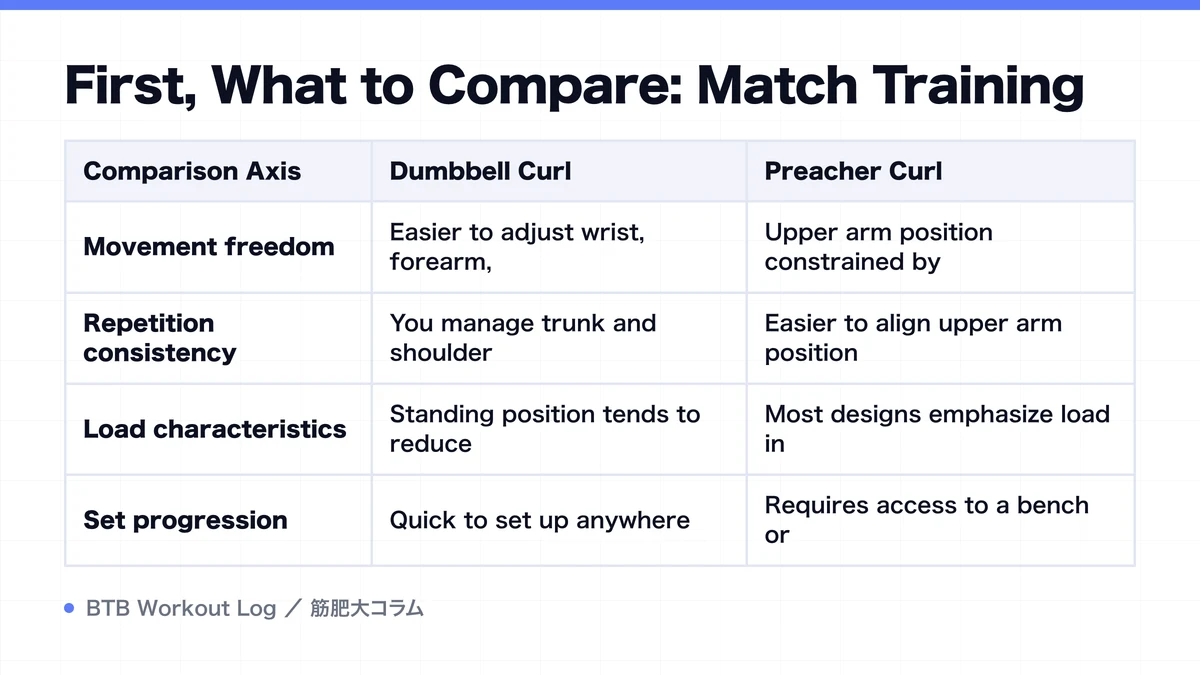
| Comparison Axis | Dumbbell Curl | Preacher Curl |
|---|---|---|
| Movement freedom | Easier to adjust wrist, forearm, and elbow path | Upper arm position constrained by the pad |
| Repetition consistency | You manage trunk and shoulder movement yourself | Easier to align upper arm position |
| Load characteristics | Standing position tends to reduce lower-range load | Most designs emphasize load in the lower to mid range |
| Set progression | Quick to set up anywhere | Requires access to a bench or machine |
| Individual differences | Easier to find your natural groove | Pad angle and body shape compatibility varies |
Bicep Stimulation Changes With Stability and Load Curve
Both exercises share elbow flexion as the main movement, engaging not just the biceps but also the brachialis and brachioradialis. The different names don't mean one exercise uses the biceps while the other doesn't. Looking across resistance training research, the load and rep ranges that drive 肌肉肥大 have considerable overlap. What matters more than the exercise name is maintaining sufficient effort and progressive overload consistently.
Dumbbells let you adjust your path
With dumbbell curls, you can tailor the forearm supination, elbow position, and individual arm paths to your build. It's easier to find positions that feel good on your wrists and elbows, and handling each arm independently is a real advantage. That said, arching your torso in the later reps, driving your shoulders forward, or shifting your elbows drastically will change how much load your biceps actually handle—even at the same weight and rep count. That freedom cuts both ways: it lets you find what works for you, but you have to own the consistency yourself.
Preacher curls fix your arm position
The preacher pad supports your upper arm, making it harder to use torso momentum or shoulder movement to grind out extra reps, so you can spot when the muscle actually hits its limit. With standing dumbbells, the external moment arm tends to shrink at the bottom, but preachers often keep more tension there and through mid-range depending on the pad angle and machine design. Still, load curves differ between 自由重量, cables, and 機械. You can't just say "preacher = always maximum load through long ranges."
Higher stability doesn't automatically mean better 肌肉肥大. Like the choice between 自由重量 and 機械, the value depends on whether you want to pile load on the target muscle in a stable setup, or keep the freedom to move how feels right.

Comparing Fatigue, Time, and Joint Stress
Both are single-joint movements, so systemic fatigue doesn't accumulate like with squats or rows. The difference lies in stability during the set, local muscle fatigue, and gym logistics. Preacher curls require less postural work and make it easier to accumulate hard sets for the biceps, but you have fewer escape routes—local failure comes suddenly. Dumbbells start quickly from standing, but maintaining form under fatigue demands attention.
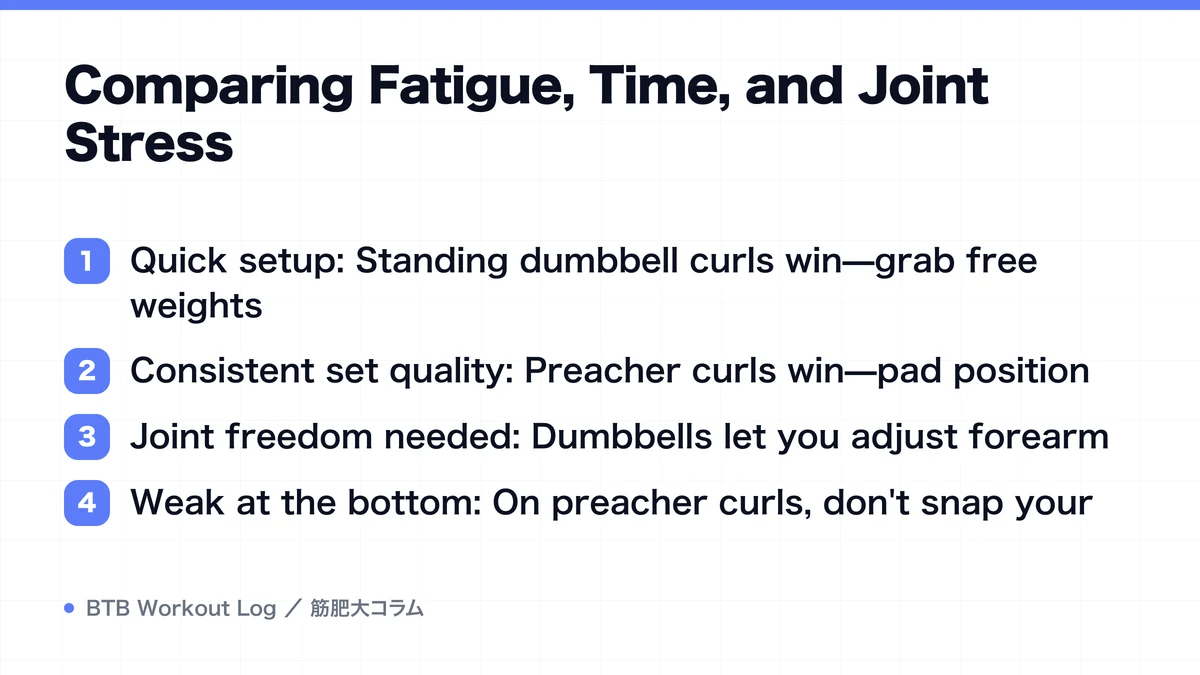
- Quick setup: Standing dumbbell curls win—grab free weights and go. Alternating left and right extends set time.
- Consistent set quality: Preacher curls win—pad position stays locked. If you wait for the machine during rush hour, your whole session loses efficiency.
- Joint freedom needed: Dumbbells let you adjust forearm angle and elbow width on the fly. Some lifters prefer the fixed grip of an EZ bar or machine.
- Weak at the bottom: On preacher curls, don't snap your elbows straight. Keep the range controlled and weight manageable. Don't count joint pain as hypertrophy stimulus.
Joint-friendliness isn't decided by exercise name alone. Pad height, grip, weight, rep tempo, and past elbow/wrist status all matter. If discomfort persists, don't call it a sign the exercise is working—swap the tool or path instead. If that doesn't fix it, drop the movement.
Load is measured by consistent progress under the same conditions, not raw numbers
Lifting heavier in a curl and actually increasing load on the biceps aren't the same thing. Momentum and shortened range bump the numbers without adding real stimulus. To compare fairly, lock in the tool, grip, pad height, range, and tempo—then check if weight or reps went up under identical conditions. Preacher curls are easier to standardize; dumbbells demand video notes or a simple form checklist to keep variables straight.
Intensity stays consistent using RIR—reps left before failure. If most sets hover around RIR 1–3, you can compare both movements on level ground. You don't need to go to failure every set; especially on preacher curls, repeating failed reps at the bottom where form breaks down doesn't help comparison.
If weight jumps are large, extend reps within your target range before moving to the next load. For example, 8–12 reps means you add weight only once all sets hit the upper end. Small muscle groups can tolerate big jump percentages, so mixing weight increases and rep increases keeps progressive overload steady.
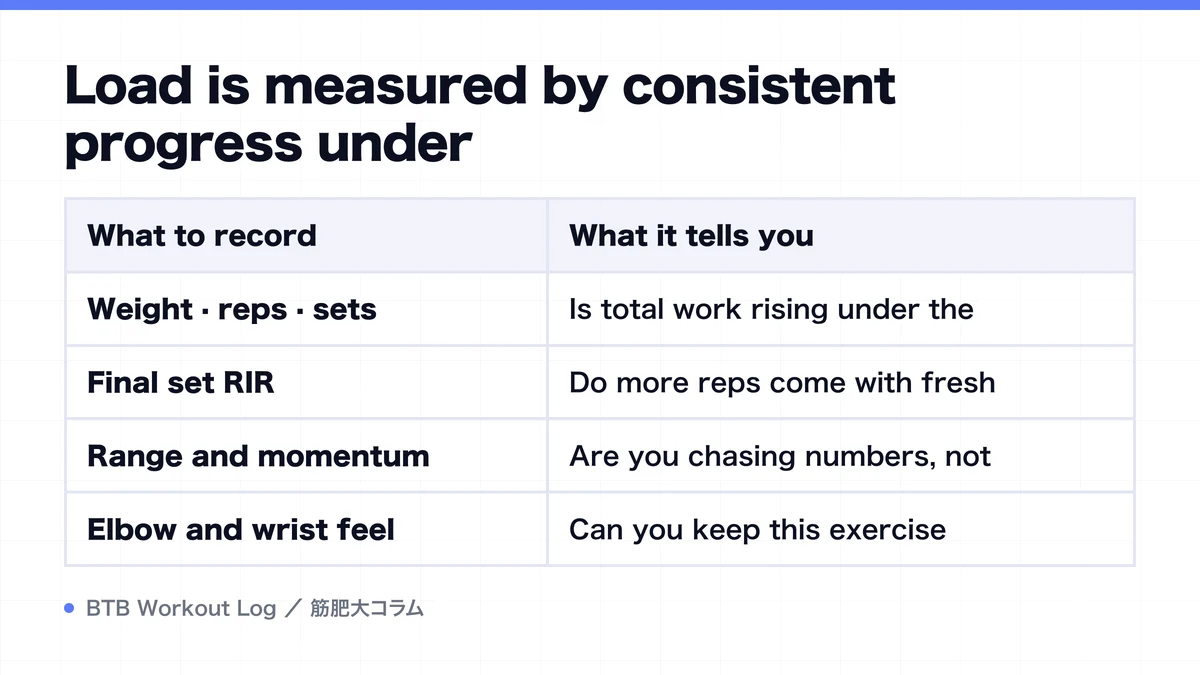
| What to record | What it tells you |
|---|---|
| Weight · reps · sets | Is total work rising under the same setup? |
| Final set RIR | Do more reps come with fresh strength? |
| Range and momentum | Are you chasing numbers, not progress? |
| Elbow and wrist feel | Can you keep this exercise long-term? |
When to pick each exercise
Preacher curls work best as your main move if momentum sneaks in during standing curls, you want a clear sense of when the biceps maxes out, or your machine lets you lock in the same pad setting every session. Even after a heavy back day when your core and grip are fried, the padded support lets you pile on direct sets.
Dumbbells work best as your main move if a fixed grip bothers your elbow or wrist, you need to adjust the path for side-to-side imbalances, or equipment is limited and you need to finish fast. If momentum creeps in during standing reps, try pressing your back to a wall, sitting down, or dropping the weight—you don't have to bail on dumbbells for preacher curls immediately.
If you do both, don't stack them thoughtlessly. Pick one as your main driver and allocate weekly hard sets to it, then use the other for a different rep range or a secondary exercise on another day. Since back pulls already work your elbow flexors, adding curls without tracking arm recovery and total weekly hard sets leads to low-quality volume.
Judge your main exercise in 4–6 weeks
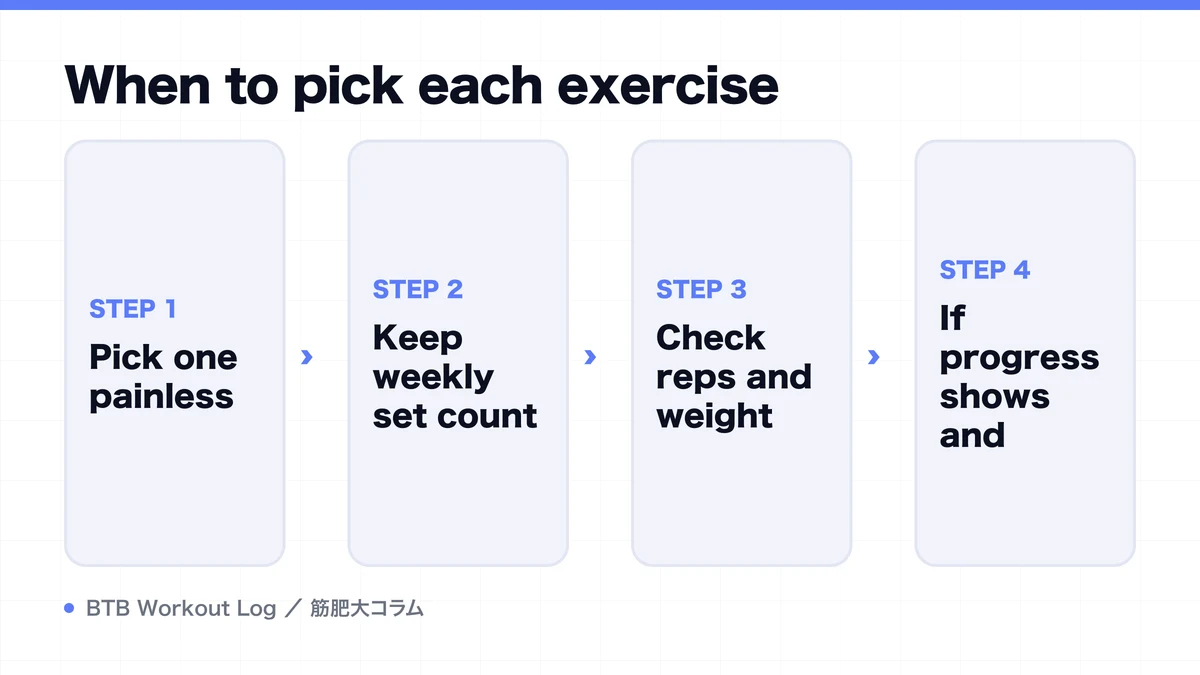
- Pick one painless candidate and lock in the tool and form conditions.
- Keep weekly set count and RIR stable and train this way for 4–6 weeks.
- Check reps and weight at the same range, feel at the joints, and recovery between sessions.
- If progress shows and joints feel stable, keep going. If you stall, review recovery and total volume before switching exercises.
Don't judge on one pump. Look at weight and rep trends across multiple weeks under fixed conditions.
常見問題
- Can I do dumbbell curls and preacher curls on the same day?
- Yes. Both center on elbow flexion, though, so adding sets doesn't automatically diversify the stimulus. Make one your main lift and the other a secondary exercise with a different rep target. Track total volume across your back work and recovery for the week, then keep only the sets you actually need.
- Are preacher curls hard on the elbow?
- The exercise itself isn't inherently dangerous. Problems arise when you drop hard into the bottom position, lock out with weight you can't control, or use a pad height that doesn't match your frame. Adjust your load and 動作幅度, and if discomfort persists, drop the movement.
- Which one should I pick if I want to build a peak on my biceps?
- Muscle shape is determined largely by your own anatomy—no single curl variation can sculpt it alone. If your goal is visual change, pick the one you can do pain-free and sustain, where you can steadily add weight or reps with consistent form.
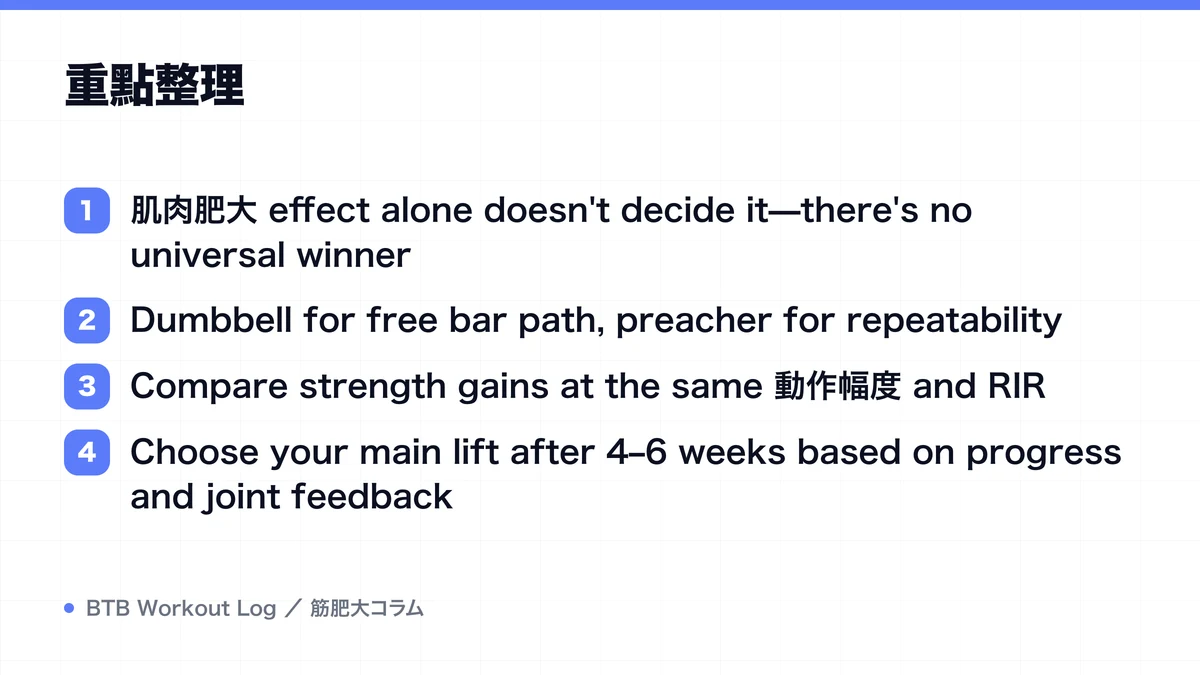
重點整理
- 肌肉肥大 effect alone doesn't decide it—there's no universal winner
- Dumbbell for free bar path, preacher for repeatability
- Compare strength gains at the same 動作幅度 and RIR
- Choose your main lift after 4–6 weeks based on progress and joint feedback
參考文獻
- Comparison Between Shoulder Flexed and Extended Positions in Elbow Flexion Resistance Training on Regional Hypertrophy and Maximum Strength: Preacher versus Bayesian Cable Curls
- Low- vs High-load Resistance Training for Strength and Hypertrophy: Meta-analysis
- Muscle Hypertrophy Is Independent of Load Across Upper and Lower Limbs When Effort Is Matched
- Training to Repetition Failure or Non-failure: Systematic Review and Meta-analysis
- Repetitions in Reserve Is a Reliable Tool for Prescribing Resistance Training Load