只做深蹲,整條腿都能變粗嗎?驗證容易被忽略的肌肉
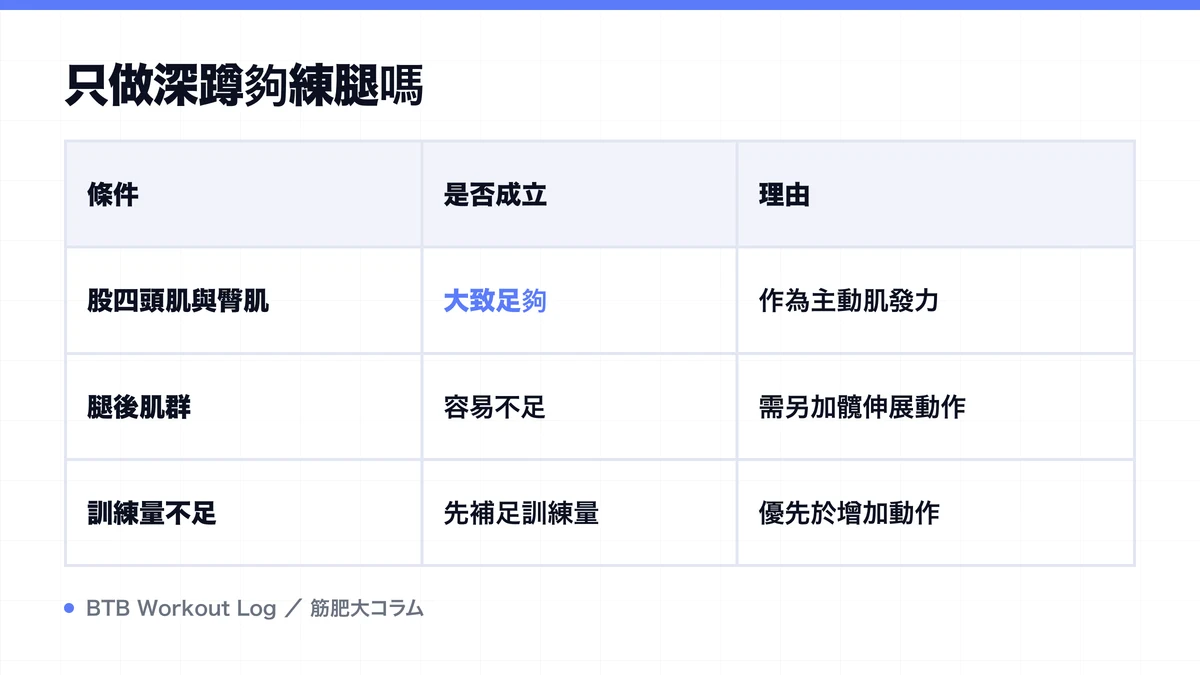
股四頭肌和臀部光靠深蹲就能發展,但要均勻增大包括腿後肌和小腿在內的「整個腿部」,通常會有不足的地方——這是我們檢驗的結果。
單一動作是否足夠取決於三點:深蹲是以哪塊肌肉作為限制因素、你是否能維持充足的動作幅度和努力強度,以及你對「整個腿部」的定義包含到哪裡。
首先明確「整個腿部」包含哪些肌肉
在判斷只做深蹲是否足夠之前,我們需要先區分檢驗對象。這裡的腿部肌肉是指股四頭肌、臀肌群、內收肌群、腿後肌、小腿三頭肌(小腿)。如果你只關心大腿前側和臀部,答案基本上是肯定的;但一旦涵蓋大腿後側和小腿,答案就不一樣了。
深蹲是一個多關節動作,同時伸展膝蓋和髖部,能用最少的動作數量刺激大肌群。但是,很多肌肉參與動作和所有肌肉都獲得相同程度的肌肉肥大刺激,這是兩回事。決定你組訓練何時結束的肌肉是股四頭肌、臀部、豎脊肌,還是呼吸和核心穩定性——這會大大改變最後的成果。這實質上是在問「複合動作就夠了嗎」這個普遍問題,但限縮在腿部訓練上。
因此,真正該檢驗的不是「深蹲有沒有練到腿」,而是「你是否為每個肌群都安排了足夠品質、能長期進度的組數」。
深蹲擅長的部位和容易遺漏的部位
標準的後槓深蹲中,股四頭肌(負責膝關節伸展)和臀肌、內收肌群(負責髖關節伸展)承擔主要工作。深度、軀幹角度、站距和個人骨骼會改變它們的比例配置,但這兩個區域通常是主角。如果你能保持動作品質、深入底部位置,並且股四頭肌或臀部先達到極限,那它們對這個部位來說就是有力的主動作。如果你想優先發展股四頭肌,可以參考「深蹲對比腿部推蹬機」的對比。
相比之下,腿後肌不只參與髖關節伸展,還參與膝關節屈曲——它是一個跨越兩個關節的肌肉。在深蹲中,髖和膝同時動作,所以腿後肌雖然有參與,但不會像專門做膝屈曲動作那樣承受負荷。不能光靠「有感覺」或「隔天有延遲肌肉痠痛」就判定它獲得了充分的肥大刺激。
小腿雖然協助穩定踝關節,但深蹲期間不會有大幅重複的跖屈動作。另外,股四頭肌中的股直肌也跨越髖關節,所以它受到的刺激可能與外側廣肌、內側廣肌等不同。深蹲重量在增加,不代表腿部所有肌群都以相同比例增長——原因就在這裡。
只做深蹲也能成立的五個條件
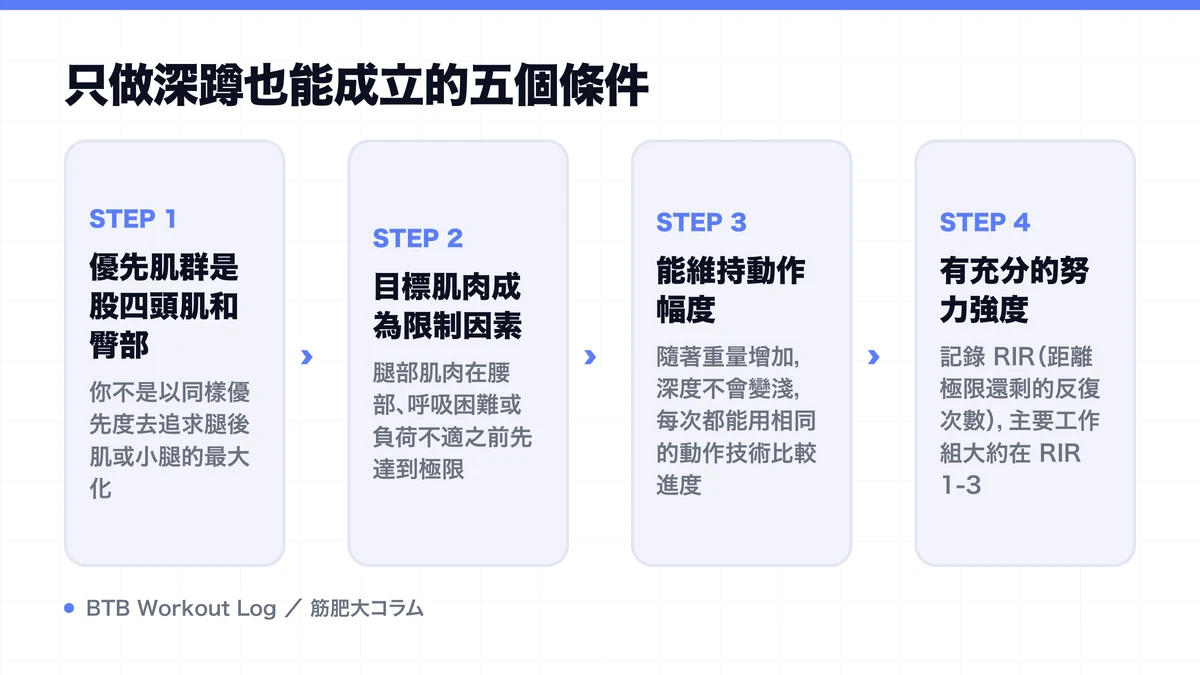
「只做深蹲」並非立刻就不合理。如果以下條件都能達成,在特定時期內作為腿部訓練方案是可行的。
- 優先肌群是股四頭肌和臀部:你不是以同樣優先度去追求腿後肌或小腿的最大化。
- 目標肌肉成為限制因素:腿部肌肉在腰部、呼吸困難或負荷不適之前先達到極限。
- 能維持動作幅度:隨著重量增加,深度不會變淺,每次都能用相同的動作技術比較進度。
- 有充分的努力強度:記錄 RIR(距離極限還剩的反復次數),主要工作組大約在 RIR 1-3 結束。詳細用法見「RIR 使用指南」。
- 能維持周內品質:與其一天內堆積太多組導致後期動作變形,不如必要時分散成一周兩次,保護目標肌肉的組數品質。
初學者或時間緊張的時期,減少動作數量能簡化技術學習和進度判定。但是,機械地用深蹲一個動作來達到通常的每週組數,不是推薦做法。因為整脊壓力和全身疲勞會先累積,後續組數可能無法對目標肌肉產生有效刺激。所需組數不是固定值,而是根據每組的努力強度、訓練頻率、恢復能力和訓練資歷來調整。
研究告訴我們的是「單一動作並非萬能」
Research on resistance training shows that muscle hypertrophy depends on multiple variables: load, frequency, total volume, effort level, and exercise selection. Higher weekly training volume generally correlates with greater muscle gain, but this doesn't mean that adding squat sets will develop all leg muscles equally. Volume must be measured as sets that actually reach the target muscle.
When effort level is constant, muscle hypertrophy can occur across a wide range of loads. You don't need to keep accessory work in the same heavy range as the squat. Leg curls or calf raises performed for moderate to high reps can work as options if they're not too far from failure and if load or reps progress over time.
We should also acknowledge the limits of research. Studies vary in exercise, population, measurement sites, and duration—none can answer the question "what if everyone did only squats and we measured all leg muscles with equal precision?" So we don't rely on theory alone to identify gaps. Instead, we combine progressive overload with observation of how each region actually responds.
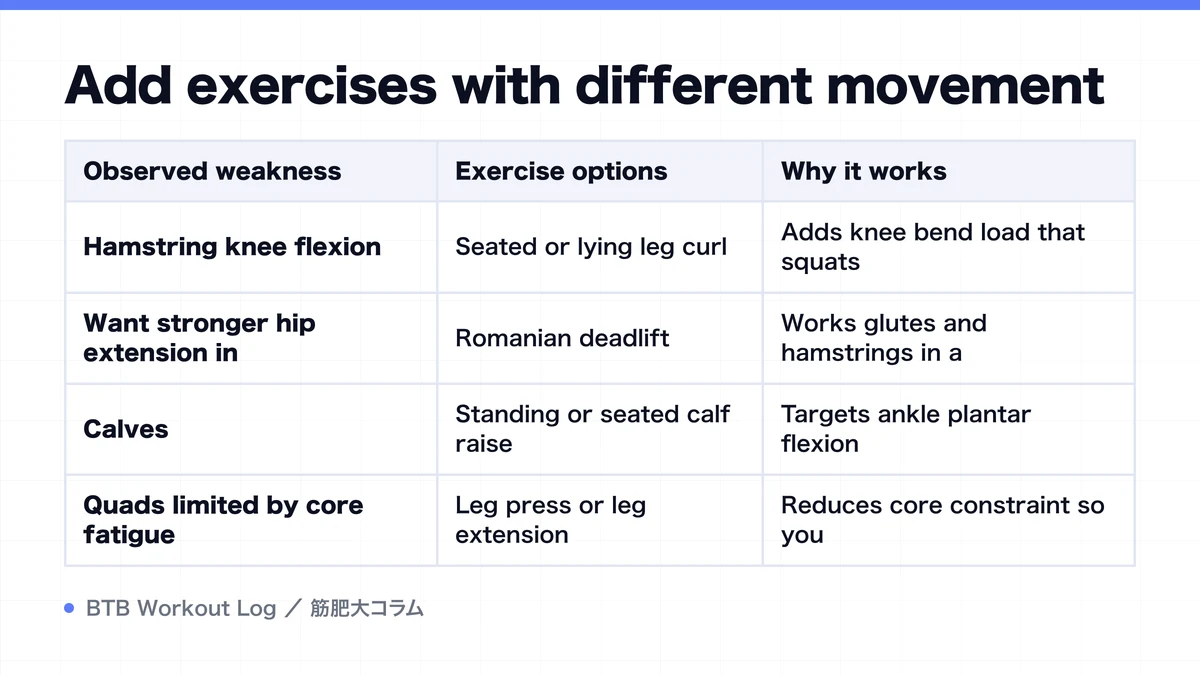
Add exercises with different movement patterns only to weak spots
What you add to the squat depends on which joint actions are missing—not on total exercise count. There's no reason to load your program with leg exercises from the start.
| Observed weakness | Exercise options | Why it works |
|---|---|---|
| Hamstring knee flexion | Seated or lying leg curl | Adds knee bend load that squats lack |
| Want stronger hip extension in the posterior chain | Romanian deadlift | Works glutes and hamstrings in a different stance than the squat |
| Calves | Standing or seated calf raise | Targets ankle plantar flexion dynamically |
| Quads limited by core fatigue before reaching failure | Leg press or leg extension | Reduces core constraint so you can add more knee extension volume |
A minimal setup—squat plus leg curl plus calf raise—cuts weak spots significantly. When prioritizing the posterior chain, add Romanian deadlifts. When quads lag behind, redirect some sets to leg press or leg extension. Add one exercise at a time and check over several weeks whether squat recovery and progress stay intact.
Don't judge progress by squat weight alone
Lock in your form for 8–12 weeks and track squat load, reps, RIR, and depth. At the same time, monitor the quad, glute, hamstring, and calf regions using limb circumference, photos under identical conditions, and initial performance on accessory exercises. If the squat goes up, priority areas show change, and you have no pain or recovery issues, you can continue. But if the squat climbs while the posterior chain and lower leg stall, or if lower back or breathing become the limiting factor every session, or if adding volume ruins your depth, then there's no reason to stick with one exercise alone.
Track your data not to prove "squats alone are enough," but to identify which areas need the smallest necessary adjustments.
常見問題
- Can high-bar squat develop the entire leg?
- High-bar makes it easier to stay upright and emphasize the quads, but it doesn't fully address hamstring knee flexion or calf plantar flexion. Changing bar position doesn't solve the fundamental problem that one exercise can't cover all leg functions.
- If I add only one exercise to the squat, what should it be?
- If the posterior thigh is lagging, leg curl is a top choice. If you want to build glute and hip extension strength, Romanian deadlift works well. If you're also prioritizing calves, you'll need a separate calf raise. Pick based on which region you need to prioritize.
- Is it okay for beginners to start with only squats?
- For the short window while you're learning technique, yes—that's practical. First, master the depth and RIR you can repeat, then build load or reps. But if whole-leg hypertrophy is your goal, once your movement is solid, adding leg curls and calf raises is the practical way to fill the stimulus gaps.
重點整理
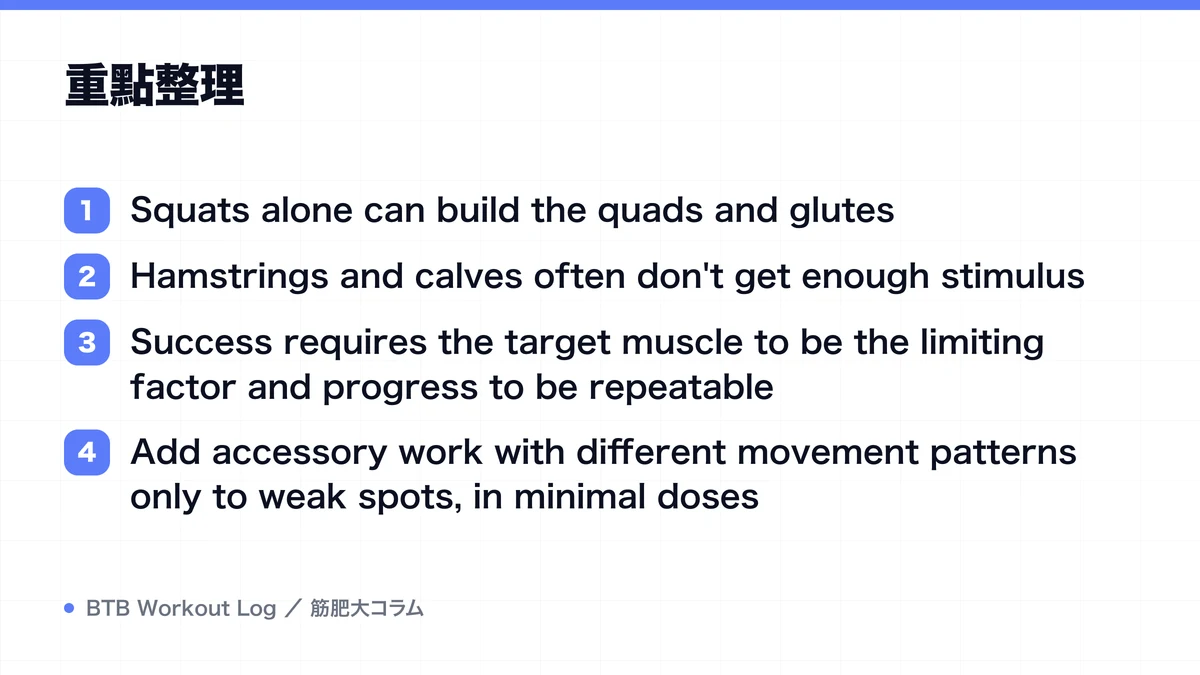
- Squats alone can build the quads and glutes
- Hamstrings and calves often don't get enough stimulus
- Success requires the target muscle to be the limiting factor and progress to be repeatable
- Add accessory work with different movement patterns only to weak spots, in minimal doses
參考文獻
- The Influence of Frequency, Intensity, Volume and Mode of Strength Training on Whole Muscle Cross-sectional Area in Humans
- Dose-response Relationship Between Weekly Resistance Training Volume and Muscle Mass
- Muscle Hypertrophy Is Independent of Load Across Upper and Lower Limbs When Effort Is Matched
- Low- vs High-load Resistance Training for Strength and Hypertrophy: Meta-analysis