
一直做「10次×3組」為什麼不長肌肉?肌肉肥大的正解不只一種
「10 reps × 3 sets」is a convenient starting point, but it's not the definitive formula for 肌肉肥大. The same 10 reps can vary in how far you are from failure, and the same 3 sets can differ in target muscle stimulus and weekly training volume.
You don't need to abandon numbers. When you track reps, RIR (how many reps you had left in the tank), 每週組數, and progress together, 3 × 10 shifts from a fixed rule into an adjustable template.
Why "10 Reps × 3 Sets" Became the Standard
10 reps represents a middle ground—not so heavy that form breaks down, not so many that you're grinding through an endless set. It's a rep range where most exercises feel manageable while you're still learning movement patterns. Three sets strikes a balance too: more volume than a single set, without eating up your entire session. For coaches, it's easy to explain. For lifters, it's easy to remember. That's why 3×10 became the default prescription in so many programs.
This practicality is real and worth acknowledging. The problem starts when a convenient starting point gets mistaken for a requirement. 3×10 tells you the rep count and the number of work sets. It doesn't tell you how heavy the weight actually was, whether your target muscle was working hard enough, how many total sets you did that week, or whether you've improved since last time.
So 3×10 works as a place to start, but it's not proof that your stimulus was appropriate. Separating the prescription from the assessment—treating them as different things—is how you stop assuming the rep range is fixed.
How Much Truth Is There to 10 Reps and 3 Sets?
如果動作穩定、易於對目標肌肉施加負荷,且能估算每組的RIR,十次左右完全足夠。即使三組,只要後面幾組仍能保持動作品質和輸出功率,就是合理的。實際上,在建立新動作的基準值時,與其每次改變條件,不如從3×10開始更容易進行比較。
然而,同樣是十次,意義差異很大。能做15次的重量只做10次,RIR約為5;但11次才會困難的重量,RIR約為1。再者,深蹲的十次和側平舉的十次,呼吸、關節壓力和局部肌肉疲勞並不相同。關於次數的細緻運用需分別考慮次數範圍和RIR的餘力判讀。
關於三組也是如此,能在第三組仍用目標肌肉反復動作的人,和從第二組就開始借助輔助肌群或反動的人,實質內容完全不同。與其死守數字,不如先確認每組是否保持相同的訓練目的更為重要。
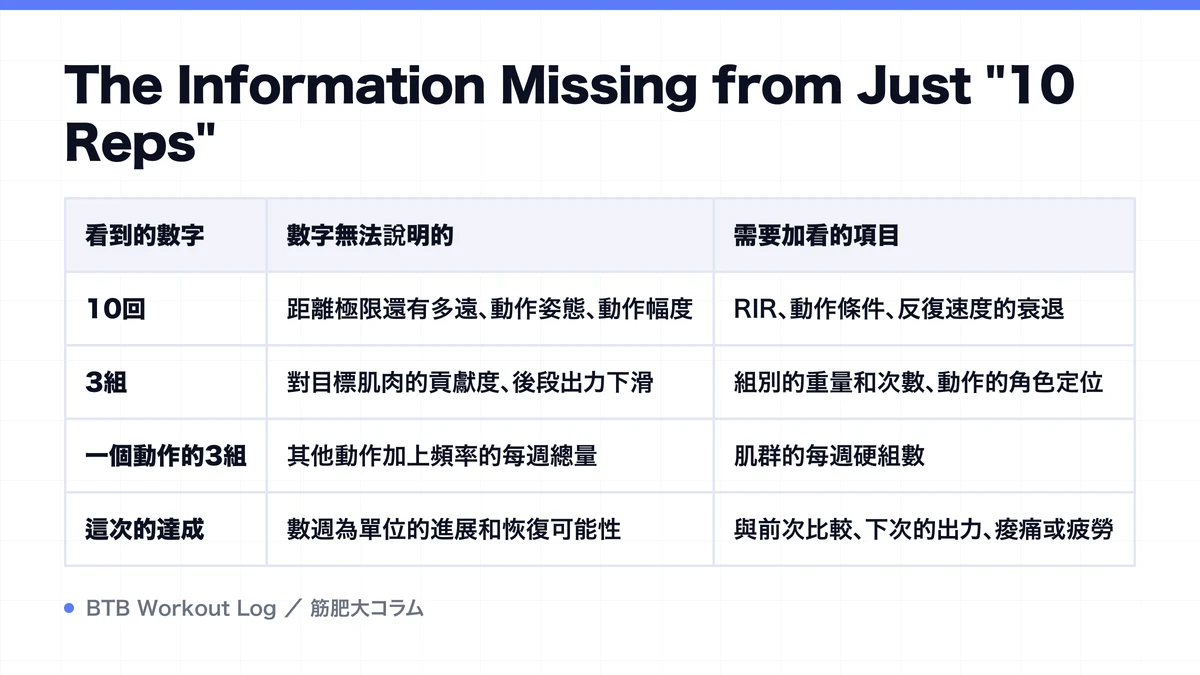
The Information Missing from Just "10 Reps" and "3 Sets"
| 看到的數字 | 數字無法說明的 | 需要加看的項目 |
|---|---|---|
| 10回 | 距離極限還有多遠、動作姿態、動作幅度 | RIR、動作條件、反復速度的衰退 |
| 3組 | 對目標肌肉的貢獻度、後段出力下滑 | 組別的重量和次數、動作的角色定位 |
| 一個動作的3組 | 其他動作加上頻率的每週總量 | 肌群的每週硬組數 |
| 這次的達成 | 數週為單位的進展和恢復可能性 | 與前次比較、下次的出力、痠痛或疲勞 |
舉例來說,胸日做3組臥推,但別的日子再做啞鈴臥推的話,胸部的每週量並不是3組。反過來說,臥推時上臂三頭肌先疲勞,對胸肌的貢獻較小,那麼帳面上的3組直接算成胸的3組也是粗糙的評估。每週組數應該按肌群來統計,並區分直接動作和間接參與的動作。
把暖身組混進工作組、動作幅度變短的反復也當作1次來計、休息不足導致後段次數崩潰。忽視這些條件差異的話,即使做到3×10也無法與前次比較。數字只有在相同條件下測量,才能成為判斷的依據。
Research Doesn't Support "Just 10 Reps × 3 Sets"
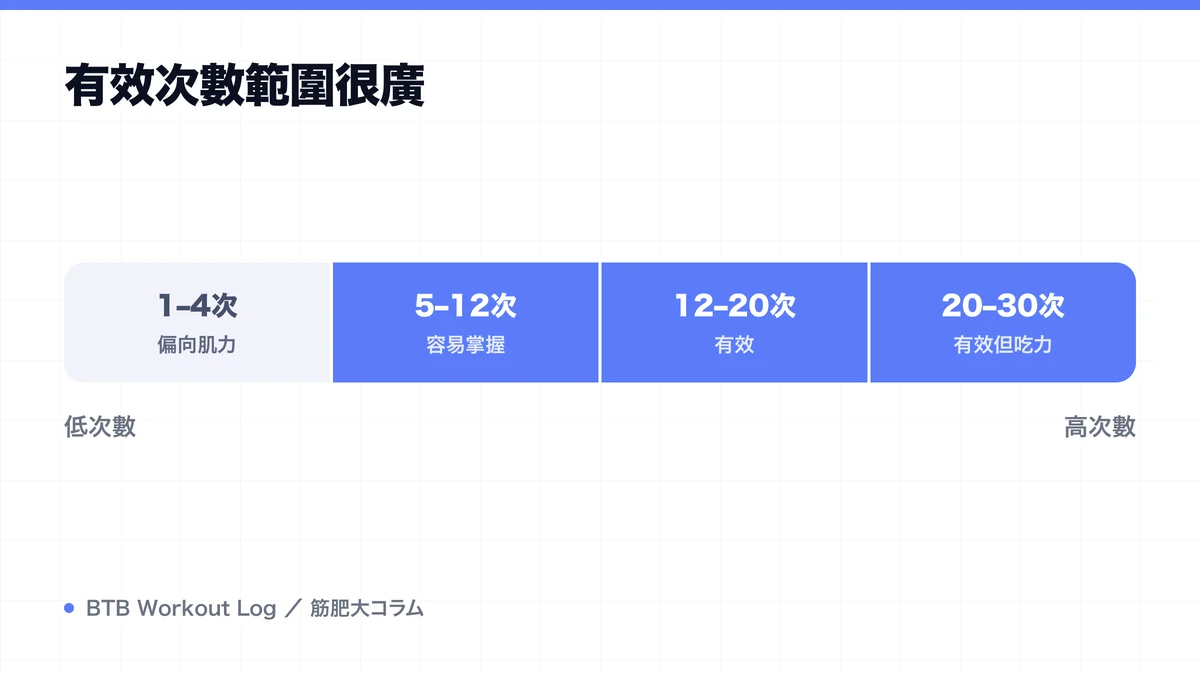
A 2017 meta-analysis by Schoenfell et al. compared low and high loads when sets were performed to muscular failure, and found that muscle hypertrophy changes were similar between them. Conversely, gains in maximum strength favored higher loads. This doesn't mean "any rep range works equally"—it shows that hypertrophy isn't limited to the 10-rep range alone. Whether your goal includes strength, and whether you can safely approach failure on a given lift, determines which load and rep range works best for you.
A separate meta-analysis examining weekly volume revealed a dose-response relationship: higher set counts per week generally produced greater hypertrophy gains. However, this doesn't mean "3 sets per exercise is too few" or "too many." The research measures total weekly volume, and whether 3 sets works depends on frequency, other exercises, training age, and recovery status combined. This is why we evaluate training volume on a weekly basis, not just per session.
A 2023 meta-analysis on proximity to failure found no clear evidence that taking every set to momentary muscular failure produces better hypertrophy than stopping short. Therefore, neither "stop at 10 reps" nor "take the 10th rep to failure" can be fixed rules. Study populations, exercises, volumes, and definitions of failure all vary, so converting average research findings into an unchanging prescription for an individual requires caution.
Why simple prescriptions feel like the right answer
3×10 has a strength: success or failure is instantly clear. Did you hit 10 reps? Did you fill three rows in your log? Yes or no. Meanwhile, RIR, target muscle contribution, weekly volume, and recovery require observation and interpretation—they don't reduce to a single tidy number. We naturally mistake the easiest thing to measure for the most important thing to manage.
Moreover, program templates present a conservative setup that most people can follow. 3×10 as an example is useful, but when that example gets repeated over and over, the assumption of individual adjustment gets erased. It's like a standard recipe: the starting quantities exist so you can begin cooking, not as a rigid rule that never changes despite different ingredients or heat sources.
What you should abandon isn't 3×10—it's the assumption that hitting the target numbers means your prescription is complete. If someone progresses on 3×10, they don't need to change it. If someone stalls, they don't need to alter reps, sets, and load all at once. It's more logical to keep the template as a comparable baseline and adjust the missing variables.
How to rebuild "3×10" in practice
1. Replace fixed reps with a rep range
First, establish a range you can consistently perform for each lift. As a starting point, try 6–10 reps for multi-joint movements where form control is critical, 8–15 reps for stable machine exercises, and 10–20 reps for single-joint movements. These aren't rankings—they're starting points. If you feel joint discomfort or systemic fatigue, pick a different range that targets the same muscle.
2. Add an RIR target to each set
Combine reps and reserve strength: "8–12 reps, RIR 1–3" instead of just "10 reps." You don't have to fail every set. Choose the weight that lets you hit your target RIR and maintain form. If RIR estimation feels shaky at first, don't chase precision—keep doing the same exercises and learn where your actual limit sits over time.
3. Organize set count by muscle group across the week
Don't isolate 3 sets of one exercise. Add up all sets for that muscle group across all exercises and the week's frequency. If you're already gaining weight or reps and recovering between sessions, there's no reason to add sets. After multiple weeks without progress—and you've checked sleep, nutrition, and movement quality, and later sets still stay solid—try adding just 1–2 weekly sets and watch how you respond.
4. Judge progress by session-to-session comparison
When you reach the upper end of your rep range using the same form, range of motion, rest, and RIR, increase weight slightly next time and start near the lower end. This approach makes progressive overload easy to spot. If later sets suddenly drop off in reps, check rest and weight selection before adding more sets. When you change from 3×10, move one variable at a time so you can trace the cause.
Your record isn't proof your prescription is correct—it's the evidence you need to decide whether to keep it or adjust it.
常見問題
- Should beginners start with 3 sets of 10 reps?
- Yes, it's fine. It's an easy setup for learning the movement and establishing a baseline weight and rep count. Just record your RIR and form at 10 reps. If you have too much slack or your movement breaks down, adjust your weight or rep range.
- Should I change my 3×10 if I'm still gaining weight or reps?
- No need to change. If you're progressing under the same movement conditions and target RIR, and you recover between sessions, that prescription is working for you now. Keeping your baseline stable as long as it's producing progress makes comparison easier than chasing general guidelines.
- Is it a problem if I can't hit 10 reps on all 3 sets?
- A slight dip in later sets is normal. Even 10, 9, 8 reps is fine as long as each set stays in your range and RIR target, and your form holds. If the drop is steep, check whether you need more rest, lighter weight, or recovery from the previous exercise.
重點整理
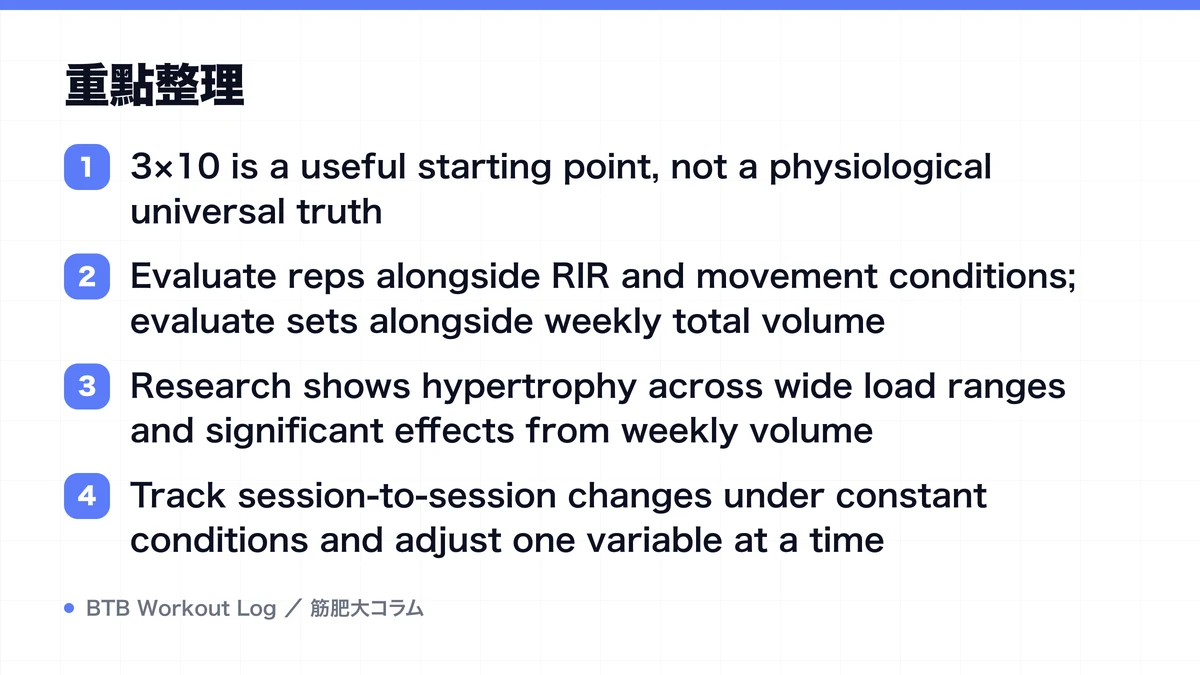
- 3×10 is a useful starting point, not a physiological universal truth
- Evaluate reps alongside RIR and movement conditions; evaluate sets alongside weekly total volume
- Research shows hypertrophy across wide load ranges and significant effects from weekly volume
- Track session-to-session changes under constant conditions and adjust one variable at a time