在拉長位置施加負荷,更容易讓肌肉肥大嗎?正受關注的「伸展位訓練」原理
當肌肉在伸展位置承受足夠的張力時,可以應用短位置難以獲得的力學條件,因此對肌肉肥大更有利。起作用的不是伸展感本身,而是長肌長下目標肌肉實際產生的力。
關節深度彎曲、肌肉伸展、該位置的負荷大小是三個獨立的條件。分開看待這三點,你就會明白該選擇哪個動作、移動到哪裡、應該記錄什麼。
「被伸展」和「承受負荷」不是同一回事
肌肉長度在這裡是指目標肌肉會隨關節位置拉長到什麼程度。例如,在踝關節背屈時,提踵動作的最低點會讓小腿肌處於較長的位置;頭上三頭肌伸展的最低點,則會拉長肱三頭肌長頭。但光是肌肉變長,還不足以解釋肌肉肥大刺激。
肌肉需要產生多少力量,不只取決於外部重量,也會受到重量作用線與關節之間距離的影響,也就是外力矩臂。即使在肌肉拉伸到最長的端點,如果重力或滑輪的方向幾乎不會對關節產生旋轉力矩,目標肌肉需要輸出的力量也很小。反過來說,就算使用的重量看起來不重,只要肌肉在較長的位置必須抵抗較大的關節扭矩,目標肌肉承受的張力就不能忽視。
因此,判斷時應依序確認:①關節位置是否讓目標肌肉拉長,②該區段是否仍有外部阻力,③能否維持姿勢並由目標肌肉對抗阻力。這和單純增加移動距離並不相同,詳細差異可參考動作幅度如何改變訓練刺激。
關節角度改變時,目標肌肉所需的張力也會改變
外部阻力試圖彎曲或伸展關節時,目標肌肉會產生相反方向的關節扭矩。所需扭矩在整個動作過程中並不恆定。關節角度、器材軌跡、滑輪方向、身體傾斜改變時,即使是同樣的10kg,難點也會移動。這就是每個動作的阻力曲線。
在長肌長位置施加負荷的動作,不是指最低點更深的動作,而是指即使在目標肌肉拉長的範圍內仍保持足夠所需扭矩的動作。例如羅馬尼亞硬拉中,髖關節彎曲的程度越大,槓鈴與髖關節的水平距離越大,腘繩肌等髖關節伸展肌在拉長狀態下承受阻力。相反,自由重量動作有時在端點會減小外部力臂,「最拉長的地方最費力」並不總是成立。
這裡的關鍵是不能從重量標註直接推斷肌肉張力。機械凸輪、滑輪位置、四肢長度、姿態都會改變所需扭矩。不只根據動作名稱判定,還要觀察在哪個關節角度減速、是否能無反彈地完成轉換、非目標肌肉是否先受限,才能實際判斷長位置的負荷。
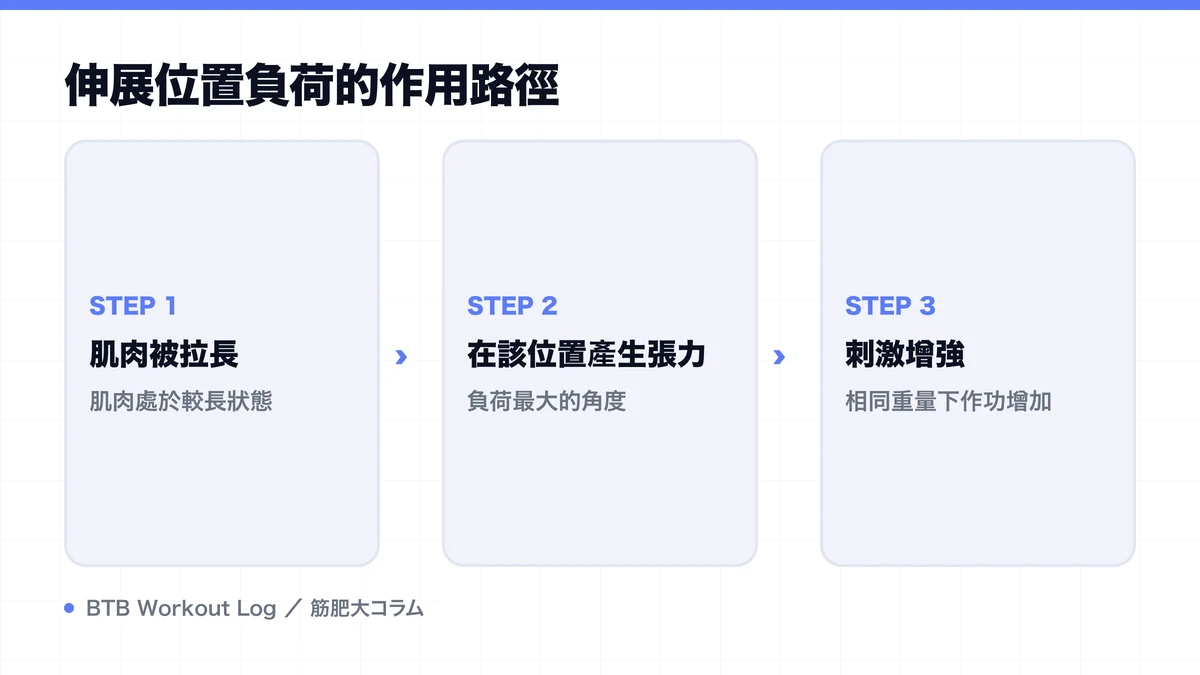
在長肌長位置,主動張力和被動張力的組合會改變
肌肉產生力時不僅涉及肌纖維收縮產生的主動張力,還涉及肌動蛋白和結締組織等彈性成分隨著肌肉拉長而產生的被動張力。兩者的比例因肌肉、關節角度、動作和個體而異,長位置不一定會使總張力均勻達到最大。儘管如此,能創造與短位置偏差動作不同的張力環境這一點很重要。
當肌肉在長位置對抗外部阻力時,拉長的肌纖維及其周圍結構在受力時收縮。此時產生的機械變形通過肌纖維內的感知機制轉化為與蛋白質合成和結構重組相關的信號。經過刺激後的恢復和營養供應,重複這個過程會導致肌纖維長期橫截面積增加,這就是肌肉肥大的基本因果鏈。
長肌長位置之所以可能更有利,不是因為成長路徑上有另外的開關,而是因為張力承受的位置和組織內的分佈會改變。被動張力對肌肉肥大的直接貢獻程度、肌肉間差異由什麼決定等問題仍待解明。因此不能簡單地說「拉得越長,成長越快」。
當能在長位置積累高品質反復時,對肌肉肥大最有利
For loaded stretch positions to be effective, you need to reach long muscle lengths and repeat sets through that range with sufficient effort. If you lighten the weight and end with lots of 餘力 remaining, tension stimulus becomes small even if you're using the long position. Conversely, if you grip the weight too heavy and bounce through end ranges, or let joints and assistance muscles do the limiting rather than the target muscle, you miss the point.
Adding long-position exercises also increases 每週組數, so you can't tell if the effect comes from the muscle length itself or just more volume. To test fairly, replace part of existing exercises first and keep 每週組數 stable—this makes cause and effect clearer. Choosing between full range and long-length partials isn't about picking a permanent winner; you decide based on your target muscle, resistance curve, and joint tolerance. The comparison guide in full range vs. partial range fundamentals helps here.
With exercises you're new to at long lengths, dial back load and reps for the first few sessions and watch for joint pain, output the next session, and range reproducibility—not just muscle soreness. Jumping into heavy loads at new muscle lengths hikes recovery cost, so exploring what you can control well within the same workload is safer and easier to compare than adding sets from day one.
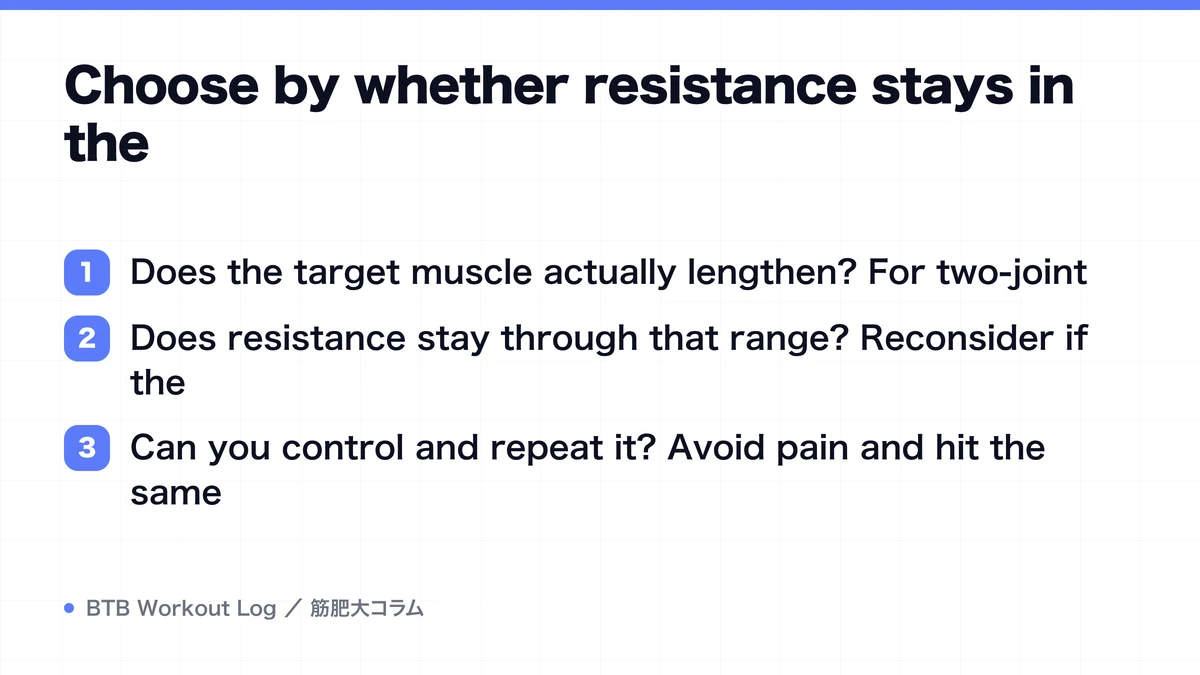
Choose by whether resistance stays in the long position, not by exercise name
Moving load toward long muscle lengths isn't just about deeper 動作幅度. You can shift joint position, body angle, cable height, or 機械 resistance curves. When picking candidates, confirm these three points together:
- Does the target muscle actually lengthen? For two-joint muscles, check both ends of the range, not just one joint.
- Does resistance stay through that range? Reconsider if the weight touches the stack at end range, cable goes slack, or gravity moment disappears.
- Can you control and repeat it? Avoid pain and hit the same end position and posture each set within a controllable 動作幅度.
Real examples: plantarflexion side of calf raises, long head of triceps in overhead work, hamstrings in hip-hinge patterns with bent hips. But check separately—being anatomically long and being loaded hard with that piece of equipment are different things. You don't need to chase the deepest joint angles; make controllable 動作幅度 your standard. Why reproducible full range is the starting point shows up in why full range is the foundation.
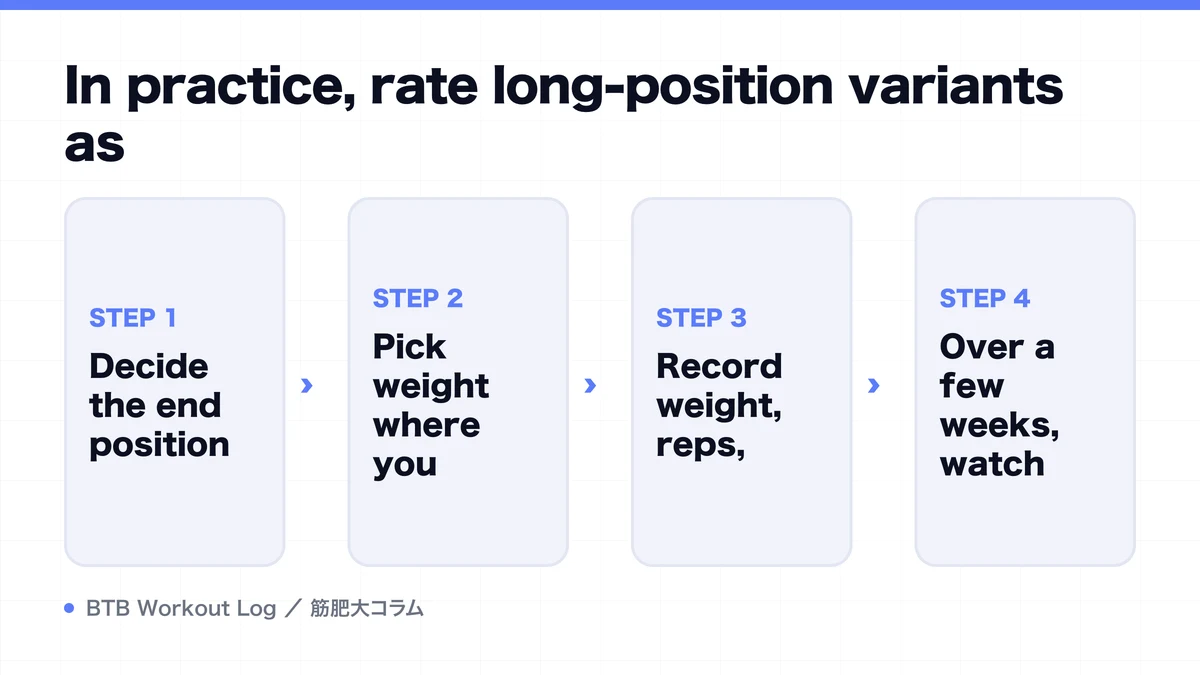
In practice, rate long-position variants as separate conditions
When you change 動作幅度 or body position, the same exercise name no longer means the same weight and reps. If weight drops after going deeper, that's not strength loss—you changed distance moved, resistance curve, and turnaround conditions. Don't force your old numbers; build new baseline weights for the new setup.
- Decide the end position where the target muscle is longest—one you can hit pain-free and consistent every rep.
- Pick weight where you can hit your target rep range without bouncing and keep RIR steady. RIR is reps left in reserve; RIR 1–3 is easiest to start with.
- Record weight, reps, sets, and RIR, plus your end-position and form standards.
- Over a few weeks, watch whether reps or weight climb under the same conditions, and whether joint symptoms or next session output stay good.
If progress continues and 恢復 stays solid, that exercise is sustainably using tension at long muscle lengths. If you stall, before deepening the stretch further, recheck whether resistance stays, your RIR, 每週組數, and exercise order. 漸進超負荷 only works when you're comparing identical conditions.
常見問題
- Does stronger stretch sensation mean better 肌肉肥大?
- Stretch sensation is a cue that you're in a long position, not the stimulus itself. Confirm the target muscle is producing force at that position with external load still there and no bounce. Pain or strong discomfort don't count as proof of effective stimulus.
- Should long-length partials come before full range?
- No fixed rule. Use reproducible full range as your baseline. Long-position partials become an option when an exercise has heavy resistance at length or when your program skews toward shorter ranges. Once you change 動作幅度, log weight, reps, and RIR as separate conditions.
- Should I raise 每週組數 when I add a stretch-position exercise?
- Start by swapping out part of an existing exercise—clearer cause and effect that way. If you grow 每週組數 at the same time, you can't separate the muscle-length effect from the volume effect. Check output and 恢復 for a few weeks, then adjust gradually if needed.
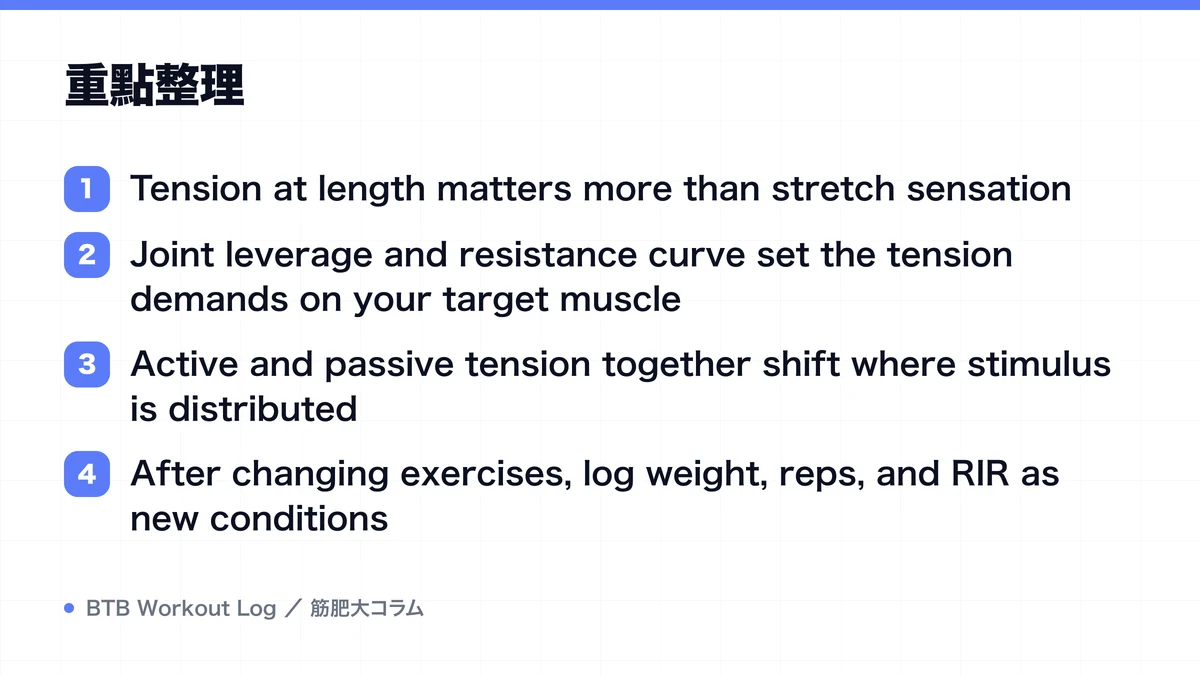
重點整理
- Tension at length matters more than stretch sensation
- Joint leverage and resistance curve set the tension demands on your target muscle
- Active and passive tension together shift where stimulus is distributed
- After changing exercises, log weight, reps, and RIR as new conditions
參考文獻
- The Mechanisms of Muscle Hypertrophy and Their Application to Resistance Training
- Mechanisms of Muscle Hypertrophy: Current Understanding and Future Directions
- The Influence of Frequency, Intensity, Volume and Mode of Strength Training on Whole Muscle Cross-sectional Area in Humans
- Low- vs High-load Resistance Training for Strength and Hypertrophy: Meta-analysis
- Muscle Hypertrophy Is Independent of Load Across Upper and Lower Limbs When Effort Is Matched