每周10组 vs 每周20组,哪个更利于肌肉肥大?翻倍练真的值得吗
控制其他变量的情况下,每周20组确实能进一步促进肌肉肥大,但不会是10组的两倍增长。如果10组已经有效果,继续保持就够了;如果增长停滞且恢复还有余力,再逐步加到20组才合理。
要比较的不只是组数本身,还要权衡新增组数带来的增益与疲劳、时间消耗、后期动作质量下降之间的得失。别把数字当死规定,而是在相同肌群、相同周期内去评估。
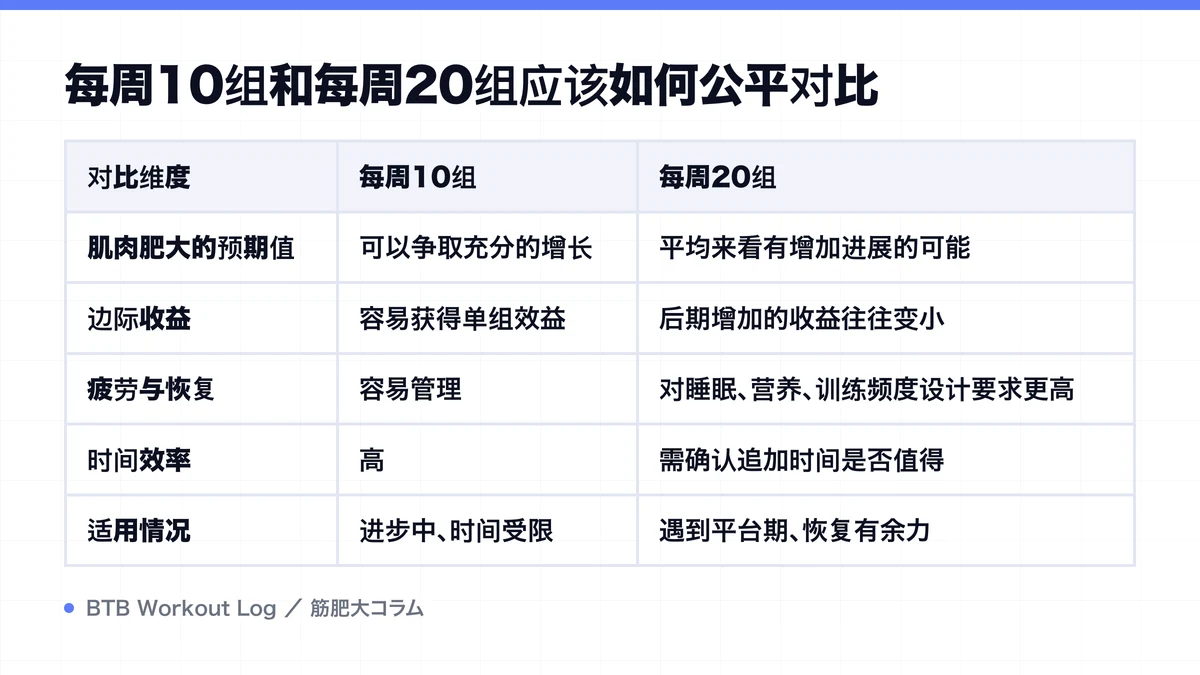
每周10组和每周20组应该如何公平对比
这里所说的组数是指单个肌群的每周有效组。有效组是指用充分的动作幅度针对目标肌肉,做到还能再做1~3次就达到极限的余力(RIR1~3)的组。热身组或动作练习中余力保留较大的组不计入。基础的计算方法已在每周组数的考虑方式中整理。
此外,我们还要区分直接刺激和间接刺激。比如胸部推举对大胸肌是直接刺激,但上臂三头肌也会受到负荷。间接刺激是全部按1组计算,还是按0.5组计算,总数会有所不同。无论哪种方式都可以,关键是在对比期间内计算方法要保持一致。Pell等人在2026年的元回归分析中,也采用了区分直接刺激和间接刺激的统计方法。
| 对比维度 | 每周10组 | 每周20组 |
|---|---|---|
| 肌肉肥大的预期值 | 可以争取充分的增长 | 平均来看有增加进展的可能 |
| 边际收益 | 容易获得单组效益 | 后期增加的收益往往变小 |
| 疲劳与恢复 | 容易管理 | 对睡眠、营养、训练频度设计要求更高 |
| 时间效率 | 高 | 需确认追加时间是否值得 |
| 适用情况 | 进步中、时间受限 | 遇到平台期、恢复有余力 |
换句话说,"10组对20组"的对比,只有在训练动作、动作形式、RIR、休息时间、训练频度基本相同的情况下,才具有实际意义。质量高的10组和后期动作变形、输出下降的20组相比,数字差异并不能反映刺激的真实差异。需要事先理解即使是相同的10组,内容也可能不同这一点。
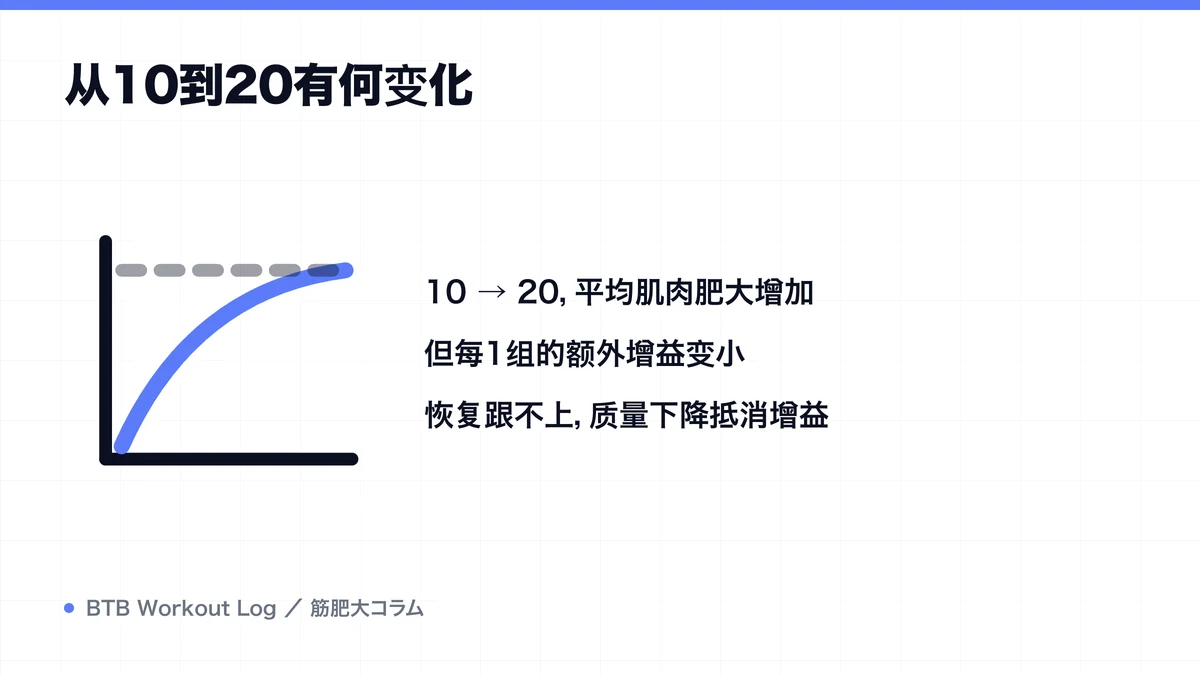
肌肉肥大的平均值中20组更有优势,但收益呈递减状态
周容量与肌肉肥大之间存在剂量反应关系,容量越大,平均肌肉肥大增幅也越大。Schoenfeld等人2017年的荟萃分析报告称,高每周组数相比低每周组数能带来更显著的肌肉增长。2019年针对有阻力训练经验者的研究也对比了多个容量条件,结果显示高容量条件在部分测量部位上更具优势。
但不能把这理解为"20组就是10组肌肉增长的2倍"。2026年的荟萃回归分析表明,虽然每周组数越多肌肉肥大的估计值越高,但增加每一组带来的收益逐渐递减。换句话说,从10组增加到11组的收益,和从19组增加到20组的收益,不能等量齐观。
研究的平均值无法直接指导个人的最优容量。因为受试者的训练经历、动作组成、组数计算方式、干预周期和测量部位(如肌肉厚度)都存在差异,即便是相同的高容量,个体反应也不一致。周20组既不是"上限",也不是"必须量",而是一种权衡选择——在追求平均增益的同时,承担更高的成本代价。
Adding 10 Extra Sets Increases Not Just Stimulus, But Fatigue and Time Commitment
The problem with 20 sets per week isn't just increased soreness. If rep count drops at the same weight in the second half of the session, secondary muscles fatigue before your target muscle, or local tension doesn't clear before the next session, the additional sets lose quality. Completing those sets anyway risks undermining next week's 渐进超负荷 progress.
Training time is a real constraint. Doubling from 10 to 20 sets for one muscle literally doubles that exercise's volume. Warm-ups are shared so total session time doesn't quite double, but you lose time to rest periods, equipment transitions, and logging. In a limited three-session-per-week schedule, adding 10 chest sets often means cutting priority exercises for back or legs. Maximizing a single muscle and building a complete full-body program are separate metrics.
If you choose 20 sets, split them across 2–4 sessions rather than one day; you'll hold output and quality higher. But increasing frequency itself isn't magic—it's a tool to distribute necessary volume while keeping quality intact. Comparing once versus twice per week frequency can help guide weekly distribution.
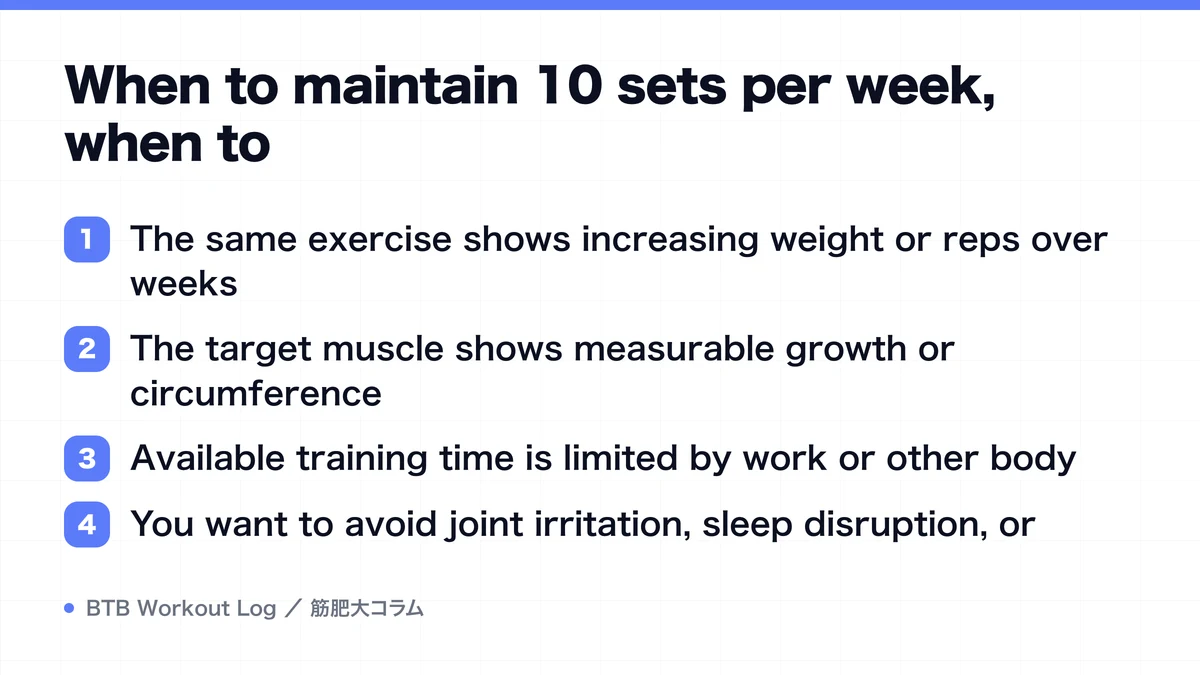
When to maintain 10 sets per week, when to consider 20
Conditions favoring 10 sets per week
- The same exercise shows increasing weight or reps over weeks
- The target muscle shows measurable growth or circumference gains over months
- Available training time is limited by work or other body parts
- You want to avoid joint irritation, sleep disruption, or declining output next session
In this state, not adding volume isn't conservative—it's correct. If 10 sets is driving progress, that volume works for you now. Focus instead on refining RIR across each set, exercise stability, and rest quality; extract maximum results from the volume you have. That's more time-efficient.
Conditions to consider moving toward 20 sets
- Progress on weight, reps, or measurements has plateaued despite ~10 sets for weeks
- Sleep, energy intake, and protein are stable with good 恢复 between sessions
- Adding volume across multiple days doesn't crowd priority lifts for other body parts
- You can log RIR and form consistently even after adding sets
Even meeting these conditions, don't jump straight from 10 to 20. Start by adding just 2 sets to one exercise, keep everything else unchanged for weeks, and observe. If it works, keep it; if fatigue rises with no progress, revert. Twenty is a checkpoint, not a goal.
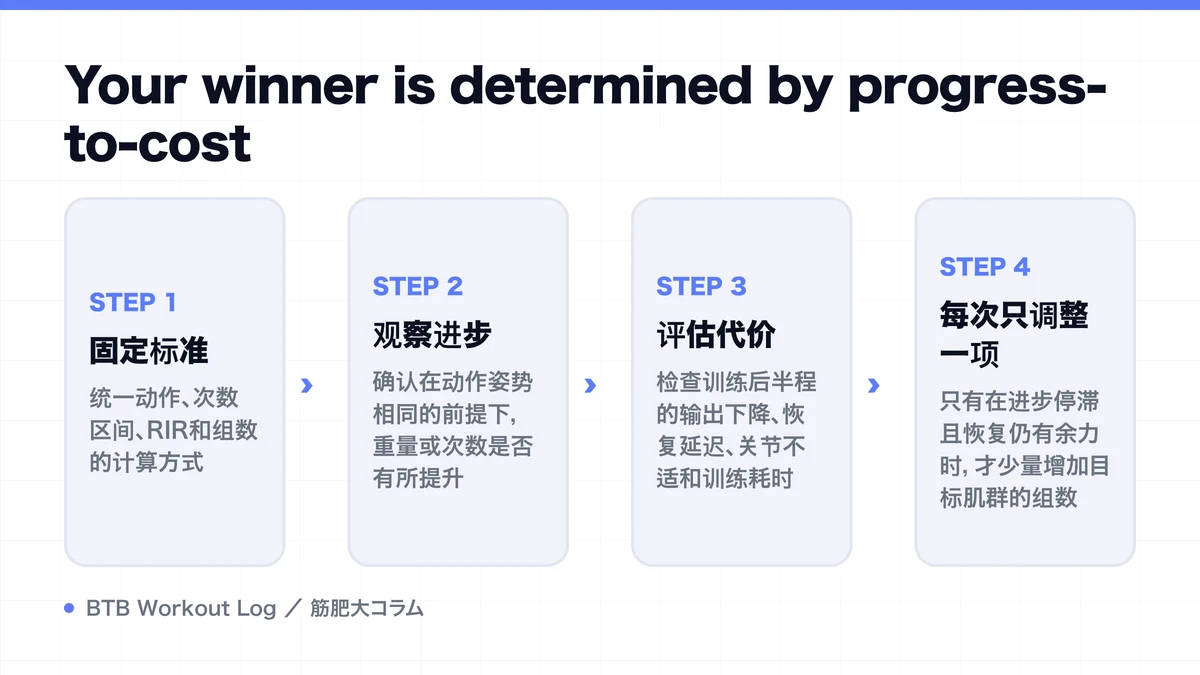
Your winner is determined by progress-to-cost ratio, not set count
判断训练量是否合适,不能只看每个部位的组数,还要在同一时期持续记录各动作的重量、次数和RIR,以及单次训练后半程的次数下降和下次训练前的恢复情况。肌肉肥大的变化短期内很难判断,因此不要因为某一次状态好坏就调整计划。先连续执行同一套计划数周,再观察整体趋势。每日总负荷量与每周组数的作用不同,参考训练量管理分别看待,会更容易理清。
- 固定标准:统一动作、次数区间、RIR和组数的计算方式。
- 观察进步:确认在动作姿势相同的前提下,重量或次数是否有所提升。
- 评估代价:检查训练后半程的输出下降、恢复延迟、关节不适和训练耗时。
- 每次只调整一项:只有在进步停滞且恢复仍有余力时,才少量增加目标肌群的组数。
训练记录不是用来证明20组合理,而是帮助你判断应该维持10组继续推进,还是尝试增加训练量。增加后持续观察数周,才能确定真正适合自己的训练量。BTB Workout Log 可以按肌群追踪每周有效组数。
增加训练量的前提,是不要一次翻倍。如果直接从每周10组加到20组,你将无法分辨结果变化究竟来自训练效果还是疲劳。更容易复现的做法是每2周增加2〜4组:只要重量和次数仍能持续超过上一次,就继续执行;一旦无法再超过,之前的训练量就是当前阶段的上限。
常见问题
- Will beginners build muscle faster with 20 sets per week than 10?
- Beginners respond to lower volume and often lack stable technique and 恢复 management. Start around 10 sets per week, verify progress in weight or reps, and add small amounts only if you plateau and still have 恢复 capacity. That makes it easier to judge whether extra sets actually help.
- Can I do all 20 sets for a muscle in one session?
- It's possible if you maintain output and form on the target muscle through all 20, but spreading 20 sets across 2–4 sessions keeps quality higher by design. If reps or RIR collapse significantly in later sets, split them across the week instead.
- Over how many weeks should I decide whether to add volume?
- Don't change after one or two bad sessions. Watch the same exercise with consistent RIR and counting over several weeks to spot a real trend. If weight or reps are climbing and 恢复 is solid, stay the course. Only add volume when progress genuinely stalls, nutrition and sleep are solid, and you have time and 恢复 headroom left.
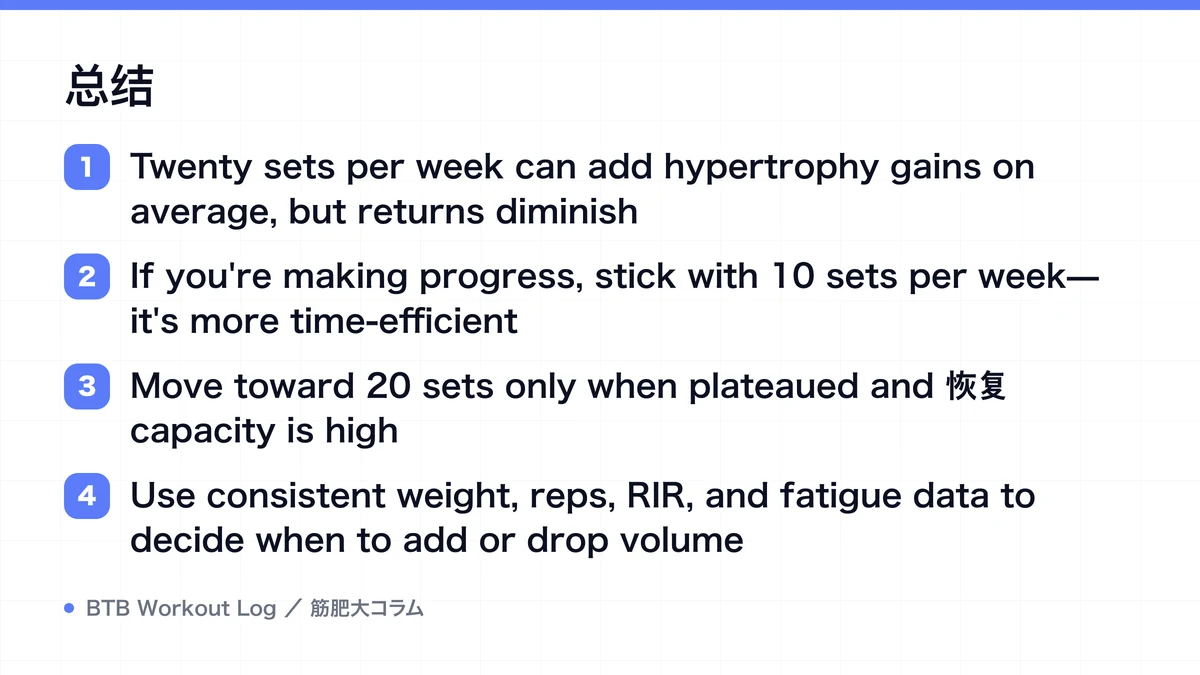
总结
- Twenty sets per week can add hypertrophy gains on average, but returns diminish
- If you're making progress, stick with 10 sets per week—it's more time-efficient
- Move toward 20 sets only when plateaued and 恢复 capacity is high
- Use consistent weight, reps, RIR, and fatigue data to decide when to add or drop volume
参考文献
- The Resistance Training Dose Response: Meta-Regressions Exploring the Effects of Weekly Volume and Frequency on Muscle Hypertrophy and Strength Gains
- Dose-response Relationship Between Weekly Resistance Training Volume and Muscle Mass
- Resistance Training Volume Enhances Muscle Hypertrophy in Trained Men