
组数加太多反而适得其反?越努力越练不大的肌肉肥大盲点
组数增加过多时,所增加的疲劳会超过额外刺激带来的收益,导致后面组数和下次训练质量下降,肌肉肥大的进度可能因此放缓。
问题不在于"组数多会让肌肉萎缩"。而是超出恢复能力的训练量会破坏重量、次数和动作的稳定性,最终减少整周内积累的有效刺激。
追加有效组的直观陷阱:"加更多就更有效"
肌肉肥大与每周组数之间存在平均的剂量反应关系。从组数不足的状态开始增加组数,通常能增加生长机会。这样的逻辑作为每周组数的概念是合理的。
但问题是,你不能把第1组和已经疲劳深重后的第10组都记作"1组"。对肌肉肥大有帮助的是那些动作幅度充分、负荷恰当、接近力竭的组数。如果只是为了完成数字、让目标肌肉逃离负荷、动作范围缩小,那么账面上的组数增加也改变不了这组训练的价值。
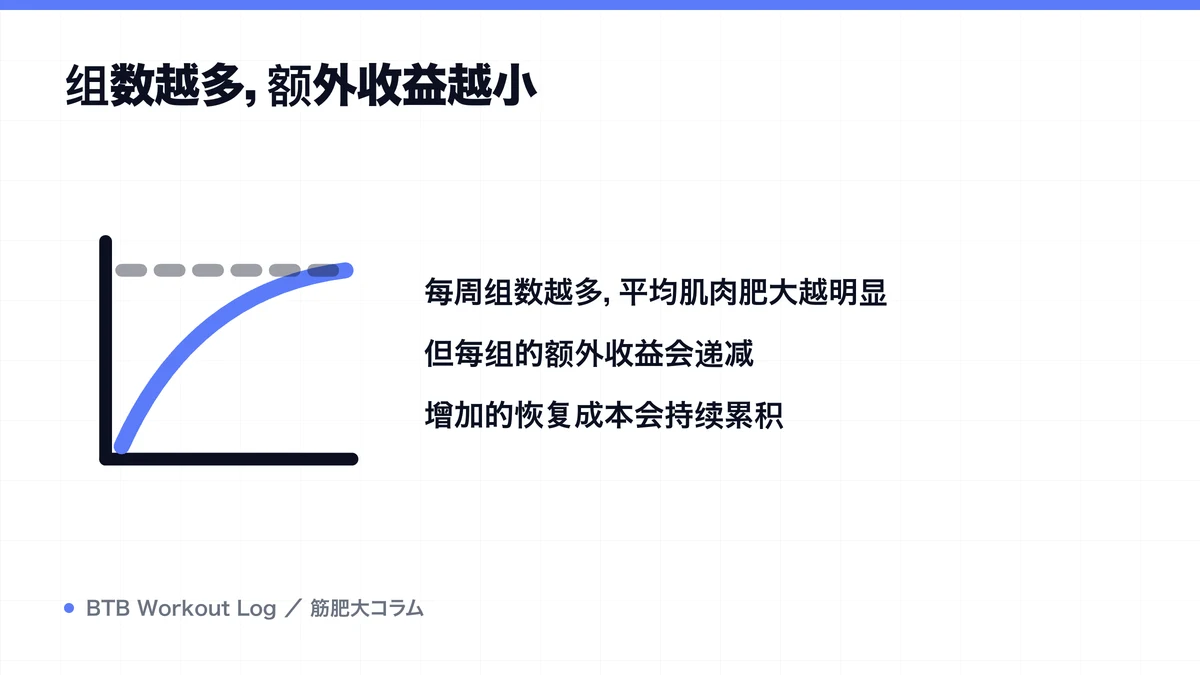
增加组数带来的收益不是恒定递增,而是初期收益最大,之后每增加一组带来的额外收益都在递减。与此同时,疲劳和耗时却在步步递增。当疲劳增长幅度超过收益增长幅度的那一刻,"多练"就开始变得不划算了。
在同一次训练中,增加的组数越多,输出越难维持
有效组堆积到后期,除了局部肌肉疲劳外,呼吸紊乱、握力和姿态维持能力下降、专注力消耗都会逐步加重。结果就是同样重量的次数掉了,同样目标次数下动作变形了,靠辅助肌拉而不是主动肌发力——这类变化都会接二连三地出现。
单靠看RIR(还能做几次的余力)来判断"接近极限就有效"是不够的。疲劳状态下RIR 1时,往往是因为全身喘不上气或辅助肌撑不住了,而不是目标肌肉张力用尽。RIR只有在重量、次数、动作幅度、动作质量都没有明显崩坏的前提下才有意义。
组间间隔过短会加快这种质量下降。与其按计划完成组数,不如为主要动作预留充足休息来维持输出水平,然后判断后期的次数下降是否还能接受。如果追加组必须大幅降重,或者预期外的肌肉先到极限,或者不缩小动作幅度就完不成,那这一组很可能只是在增加疲劳而不是刺激了。
真正的反效果是削减下一个高质量训练课
单次训练中输出略有下降不一定意味着计划失败。更关键的是能否在追加的训练量中恢复,并在下一次用同样的动作再现相同的重量和次数。
举个例子,如果增加了胸部的有效组数,几天后做卧推时胸、肩、三头肌的疲劳仍未消退,第一个有效组就低于上次的表现,那么追加的训练量实际上是以下一次的高质量刺激为代价的。即使按计划完成了每周20组,但后半部分质量下降,还影响了下一次的输出,也不一定比能正常恢复的14组更有优势。
这个问题在复合动作重叠时也会出现。如果只把卧推算作胸部的有效组,肩推只算作肩部的有效组,就会忽视三头肌和前三角肌承受的间接负荷。要按肌群分别统计周总量,同时区分直接有效组和间接刺激。如果集中在一天内会导致质量下降,可以在增加总量之前考虑用训练频度来分散负荷。
反过来说,单纯的肌肉酸痛、训练后的疲劳感不足以成为减量的理由。判断标准应该是持续到下一次的性能下降、跨越数周的平台期、关节或肌腱的不适、睡眠和动力恶化是否同时出现。如果疲劳堆积明显,就通过减少有效组或减载周来恢复。
研究并未将"越多越有利"与"无上限"混为一谈
Meta-analyses on weekly set volume show a trend where higher volume produces greater muscle hypertrophy than lower volume. A study comparing volume over 8 weeks in 34 trained men found that high-volume conditions had advantages in muscle thickness in some areas. Cutting sets out of fear of fatigue to the point of insufficient stimulus isn't rational either.
However, meta-regressions examining a broader research pool reveal that while hypertrophy gains increase with higher volume, the benefit per additional set diminishes over time. This doesn't mean researchers found a clear universal "maximum set count" that applies to everyone. Study populations, exercises, how sets are counted, proximity to failure, and intervention duration vary across research, and individual recovery capacity gets buried in averages.
What's actionable from the research isn't a fixed prescription that "more volume always wins," but rather that while there's value in increasing from too-low volume, gains don't scale proportionally with each added set. Your upper limit isn't determined by raw volume itself, but by whether that volume lets you sustain progress and recovery over several weeks.
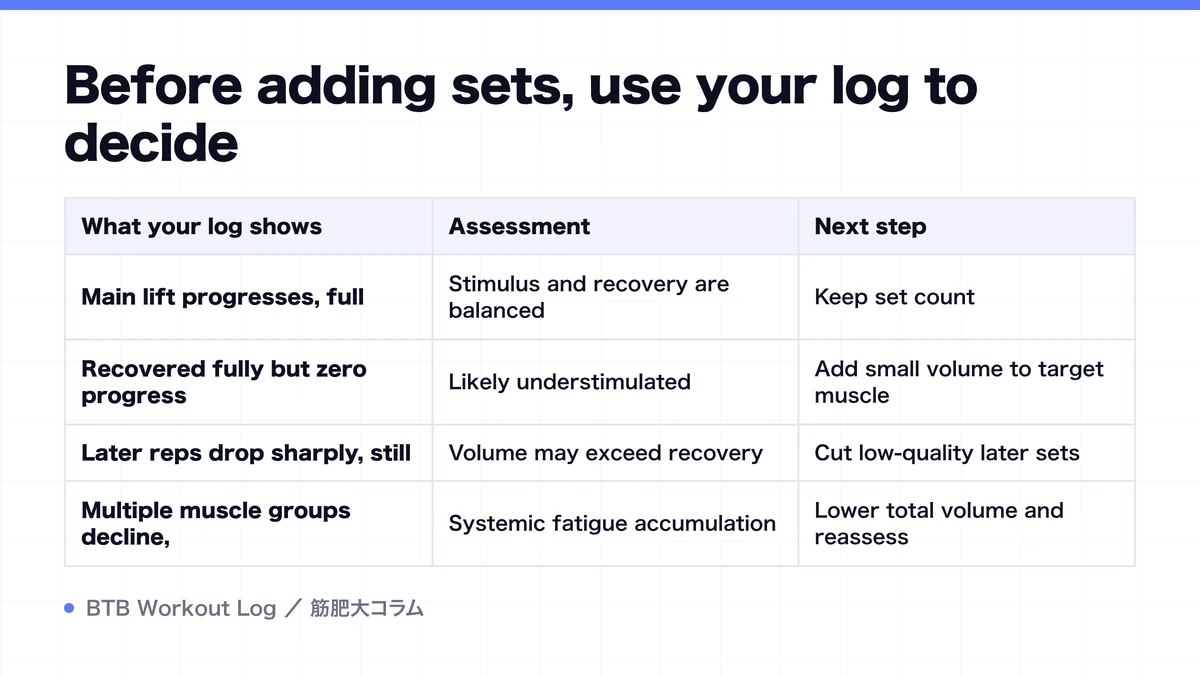
Before adding sets, use your log to decide whether to maintain, add, or cut volume
Adjust set count not reflexively when you plateau, but from the trend of several weeks at the same parameters. Start by checking whether weight or reps are increasing on your main lift for the target muscle. If they are, current volume is likely providing enough stimulus, and the case for adding sets remains weak.
| What your log shows | Assessment | Next step |
|---|---|---|
| Main lift progresses, full recovery by next session | Stimulus and recovery are balanced | Keep set count |
| Recovered fully but zero progress for multiple weeks | Likely understimulated | Add small volume to target muscle only |
| Later reps drop sharply, still low next session | Volume may exceed recovery capacity | Cut low-quality later sets |
| Multiple muscle groups decline, fatigue signs persist | Systemic fatigue accumulation | Lower total volume and reassess recovery |
When adding volume, don't change exercise selection, set count, and RIR all at once. Adjust weekly sets for the target muscle slightly, then track how main-lift weight and reps compare, how much performance drops in later sets, and how well you recover before the next session. You don't need to take every set to failure. Since increasing volume taken to failure changes recovery cost, avoid changing both set count and RIR simultaneously so you can isolate what's causing the effect.
This judgment requires actual weights, reps, and sets performed—not what you planned. Optimal set count is the amount that delivers quality stimulus you can recover from and continue progressing on, not the maximum possible.
“组数越多越好”究竟在什么范围内成立
“组数越多越好”只在一定范围内成立。如果某个部位每周只练几组,那么增加组数通常能带来更多肌肉肥大。关于剂量反应关系的研究也表明,在低训练量区间,增肌收益会随组数增加而上升。
问题出在训练量继续增加之后。训练量越高,每增加1组带来的额外收益就越小,但疲劳成本并不会随之降低。也就是说,“练得越多越有利”和“训练量没有上限”是两回事,研究只支持前者在一定范围内成立。而且,研究得出的最佳区间只是受试人群的平均值,并未涵盖个人恢复能力、训练动作和生活压力等差异。
组数容易被高估,还有一个原因:它最容易统计。每周组数可以清楚记录,但每组的训练质量和当时的恢复状态却无法用一个数字表示。因此,判断训练量是否合适,不能只看“做了多少组”,还要看目标肌群是否真正练到位,以及下次训练时主要动作的重量和次数能否维持。
常见问题
- How many sets before it becomes "too much"?
- There's no universal cutoff. Recovery capacity varies by exercise, RIR, frequency, indirect stimulus from other work, and training history. If later-set quality and your main-lift performance decline for multiple consecutive sessions, suspect current volume exceeds what you can handle.
- Should I reduce sets if I still have soreness?
- Don't decide based on soreness alone. Prioritize whether you can move through full range of motion and produce output as planned, and whether you can maintain the previous weight and reps. If sharp pain or joint discomfort appears alongside persistent performance drops, then consider cutting volume or taking time off.
- If I plateau, should I just add more sets?
- First check RIR, range of motion, rest intervals, frequency, nutrition, and sleep. Once those are stable and you're recovering from current volume but see zero progress for multiple weeks, add a small amount of sets to the target muscle only, then compare the results.
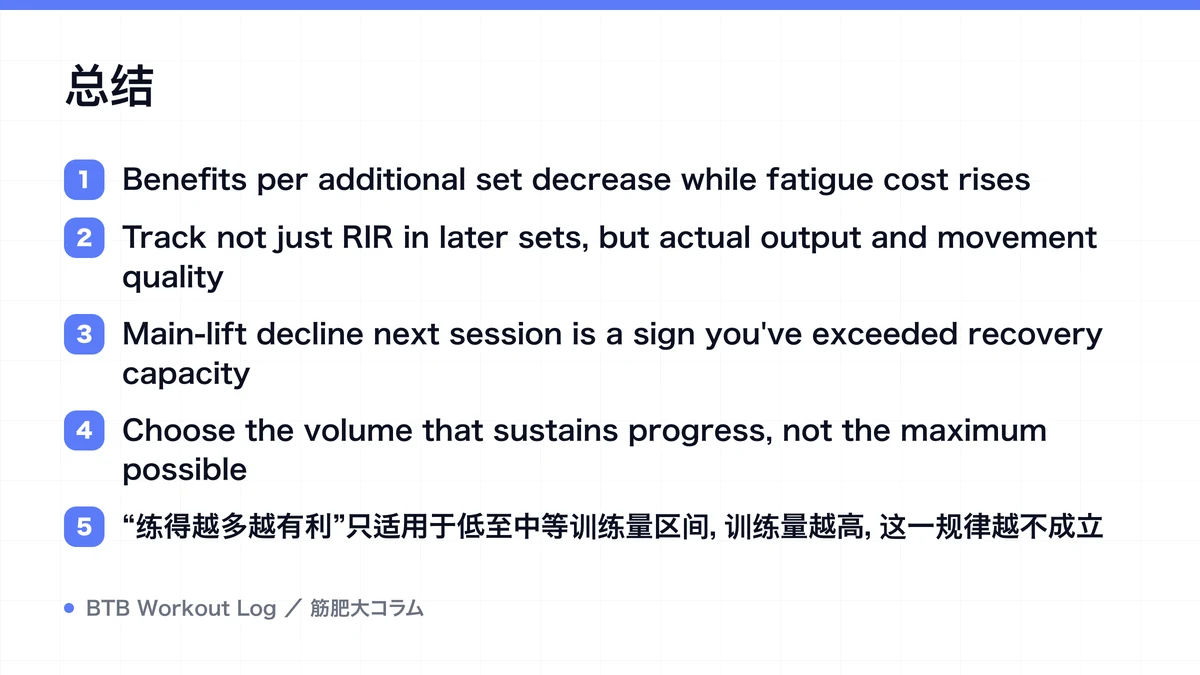
总结
- Benefits per additional set decrease while fatigue cost rises
- Track not just RIR in later sets, but actual output and movement quality
- Main-lift decline next session is a sign you've exceeded recovery capacity
- Choose the volume that sustains progress, not the maximum possible
- “练得越多越有利”只适用于低至中等训练量区间,训练量越高,这一规律越不成立
参考文献
- Dose-response Relationship Between Weekly Resistance Training Volume and Muscle Mass
- The Resistance Training Dose Response: Meta-Regressions Exploring the Effects of Weekly Volume and Frequency on Muscle Hypertrophy and Strength Gains
- Resistance Training Volume Enhances Muscle Hypertrophy in Trained Men
- Training to Repetition Failure or Non-failure: Systematic Review and Meta-analysis
- Proximity-to-Failure and Muscle Hypertrophy: Systematic Review with Meta-analysis