Esnetilmiş Pozisyonda Yük Vermek Kas Hipertrofisini Kolaylaştırır mı? Dikkat Çeken "Gerip Çalıştırma" Mekanizması
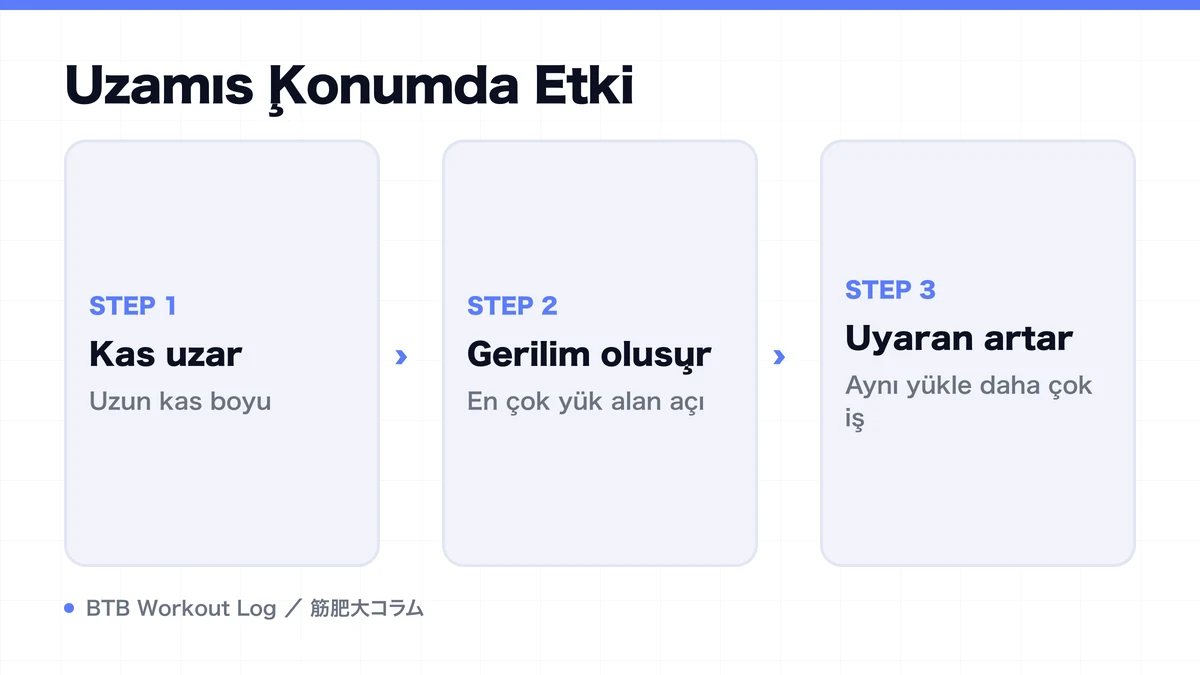
Kas uzamış konumda yeterli gerilme aldığında, kısa konumda elde edilmesi zor olan mekanik koşullar yaratılabilir ve bu kas hipertrofisine avantaj sağlayabilir. Etkili olan uzamış hissin kendisi değil, uzun kas uzunluğunda hedef kasın gerçekten güç çıkarmasıdır.
Eklemi derinlemesine bükme, kasın uzaması ve o konumda yükün yüksek olması ayrı koşullardır. Bu üçünü ayırt ettiğinizde, hangi egzersizi seçeceğiniz, ne kadar hareket edeceğiniz ve neyi kaydedeceğiniz ortaya çıkar.
"Uzamış" ile "Yük altında" aynı şey değildir
Kas uzunluğu, burada hedef kasın eklem konumuna bağlı olarak ne kadar uzadığını ifade eder. Örneğin, ayak bileğinin dorsifleksiyonda olduğu calf raise hareketinin alt noktasında baldır kasları; overhead triceps extension hareketinin alt noktasında ise tricepsin uzun başı uzar. Ancak kasın yalnızca uzun pozisyonda olması, kas hipertrofisi uyaranını açıklamak için yeterli değildir.
Kasın üretmesi gereken kuvvet sadece dış yüke değil, yükün etki çizgisi ile eklem arasındaki mesafeye, yani dış moment koluna da bağlıdır. Kasın en fazla uzadığı noktada bile yer çekimi veya kablonun yönü eklemi döndürmeye çalışan çok az kuvvet oluşturuyorsa hedef kasın üretmesi gereken kuvvet de düşük kalır. Buna karşılık, kullanılan ağırlık hafif görünse bile kas uzun pozisyondayken yüksek eklem torkuna karşı koyuyorsa hedef kasta kayda değer bir gerilim oluşur.
Bu yüzden sırasıyla şunları kontrol edin: ① Eklem konumu hedef kası uzatıyor mu? ② Bu bölümde dış direnç devam ediyor mu? ③ Pozisyonu bozmadan dirence hedef kasla karşı koyabiliyor musunuz? Bunun yalnızca hareket mesafesini artırmaktan farkını hareket açısının kas uyaranını nasıl değiştirdiği yazısında ayrıntılı olarak ele alıyoruz.
Eklem açısı değiştiğinde, hedef kasın gerek duyduğu gerilme değişir
Dış direnç eklem bükülmesi veya açılması için tork oluştururken, hedef kas zıt yönde eklem torkunu meydana getiri. Bu gerekli tork, hareket boyunca sabit değildir. Eklem açısı, aletin yörüngesi, kablonun yönü, vücut eğimi değişirse, aynı 10kg bile zorluk yerini değiştirir. Bu egzersiz başına direnç eğrisidir.
Uzun kas uzunluğu tarafında yük taşıyan egzersiz, alt noktayı derinleştiren egzersiz değil, hedef kasın uzun aralıkta da gerekli tork koruyan egzersizdir. Örneğin, Romen ölü kaldırışında, kalça öne eğildikçe barbell ile kalça arasında yatay mesafe oluşur, hamstring gibi kalça ekstansor kasları uzun durumda direnç karşısındadırlar. Öte yandan, serbest ağırlık egzersizlerde uç noktada harici moment küçülebilir, "en uzun yer en zor yer" her zaman doğru değildir.
Önemli olan, ağırlık gösteriminden kas gerilmesini doğrudan okunamayacağıdır. Makinenin kam profili, kablo konumu, kol bacak uzunluğu, form gerekli torkunu değiştir. Egzersiz adına göre karar vermek yerine, hangi eklem açısında yavaşlama olduğunu, reaksiyon olmadan geri dönüş yapılıp yapılamadığını, hedef kasın dışında başka yapının sınırlamadığını gözlemlemek, uzun konumdaki yükü pratik olarak ayırt edilmesini sağlar.
Uzun kas uzunluğunda, aktif ve pasif gerilme bileşimi değişir
Kas kuvvet üretirken, kas lifi kasılmasından doğan aktif gerilme kadar, uzunlaştıkça tiytin ve bağlayıcı dokular gibi elastik unsurlardan doğan pasif gerilme de etkin olur. Her ikisinin oranı kasa, eklem açısına, harekete ve kişiye göre değişir, uzun konumdaysa toplam gerilme kümülatif olarak maksimum olmaz. Buna rağmen, kısa konuma odaklanan hareketten farklı bir gerilme ortamı yaratılabilmesi önemlidir.
Uzun kas uzunluğunda dış direnç karşısında durduğunda, uzamış kas lifi ve çevresi yapılar kuvvet alırken kasılır. Burada oluşan mekanik deformasyonlar, kas lifi içinde algılama mekanizması aracılığıyla, protein sentezi ve yapı yeniden düzenlenmeyle ilgili sinyallere dönüştürülür. Uyaran sonrası toparlanma ve malzeme sağlanması araya girerek, bu işlemi tekrarlamak kas lifinin kesit alanının uzun dönemde artmasını sağlar, bu kas hipertrofisine kadar temel nedensel zincirdir.
Uzun kas uzunluğu tarafının avantajlı olması, bu büyüme yolunda başka bir anahtar olmasından değil, gerilme alınan konumun ve dokular içinde dağılımın değişmesinden kaynaklanır. Pasif gerilmenin kas hipertrofisine doğrudan ne kadar katkı yaptığı, kas başına farkı neyin belirlediği gibi çözülmemiş noktalar kalır. Bu nedenle "ne kadar uzatırsan, o kadar büyürsün" doğrusal açıklama yapılamaz.
Kas hipertrofisine avantajlı olan, uzun konumda yüksek kaliteli tekrar biriktirebilmektir
Stretched-position loading only works if you reach long muscle lengths and then repeat reps through that range with genuine effort. If you lighten the weight to the point where you finish with substantial tekrar rezervi left, the tension stimulus stays weak even though you're using the long position. On the flip side, if you hold tight to heavy weight and use momentum through the endpoint, or if joint mechanics and accessory muscles become the limiting factor instead of your target muscle, you've missed the goal.
Adding a long-length exercise also increases your haftalık set count, so you can't tell whether the effect comes from the muscle length itself or just from added volume. When testing it, replace part of your current work instead of adding on top, and keep your total haftalık set roughly the same—that way you'll actually know what changed. Whether to use full hareket açısı or long-length partials isn't settled in advance; it depends on your target muscle, the resistance curve of the tool, and what your joints tolerate. Comparing full-range work with partials gives you a framework for deciding.
When an exercise is new to your long-length position, start the first few sessions with modest weight or reps. Watch not just soreness the next day but also joint discomfort, your output on the next session, and whether you can reproduce the same hareket açısı. Sudden heavy loading at a new muscle length raises your toparlanma cost, so finding a range where you can do the same work with better control is safer and makes comparison cleaner than adding sets from day one.
Choose by resistance at the long position, not by exercise name
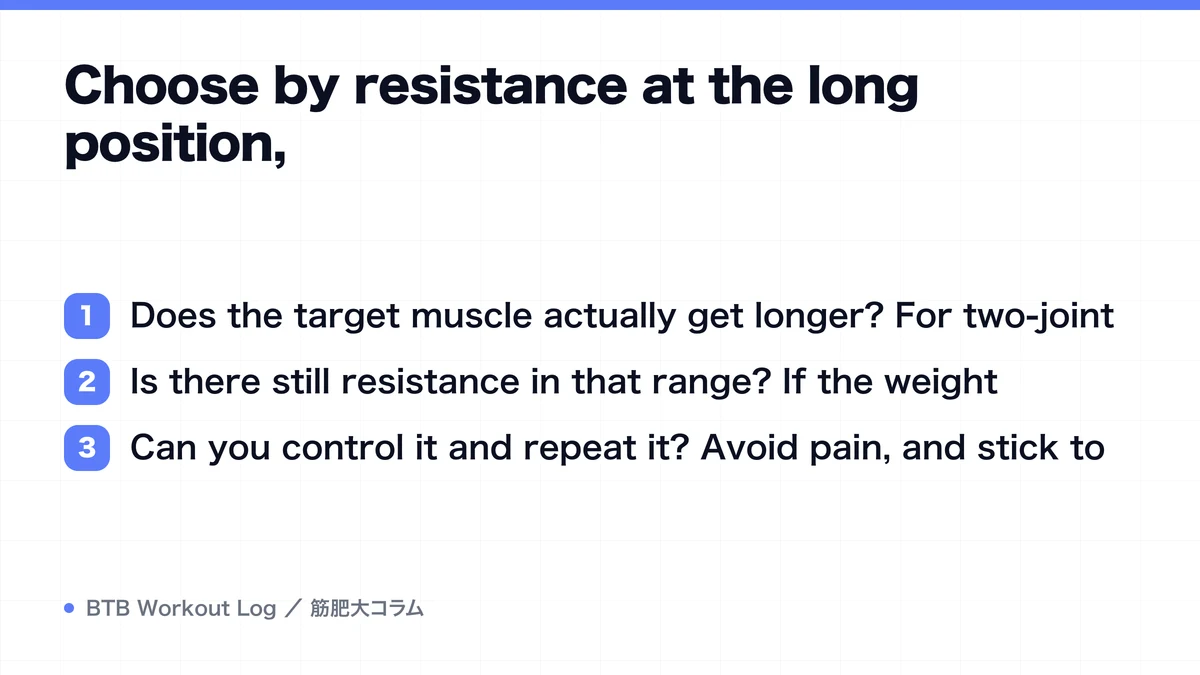
Loading at longer muscle lengths isn't only about deepening your hareket açısı. You can shift where the resistance lives by changing joint position, body angle, cable height, or the makine's resistance curve. When picking candidates, confirm these three points together:
- Does the target muscle actually get longer? For two-joint muscles, check both joints, not just one.
- Is there still resistance in that range? If the weight touches the stack, the cable goes slack, or gravity's moment arm disappears, reconsider.
- Can you control it and repeat it? Avoid pain, and stick to a hareket açısı you can reproduce with the same endpoint and posture each set.
Real examples include the dorsiflexion position in calf raises, the long head of the triceps in overhead work, or hamstrings in hinged movements with hip flexion. But being long from an anatomy standpoint and being heavily loaded by a given machine are separate checks. You don't need extreme joint angles; use reproducible hareket açısı as your standard. Why full-range work is the foundation explains why building a reproducible baseline matters first.
In practice, treat a changed muscle-length exercise as a separate condition
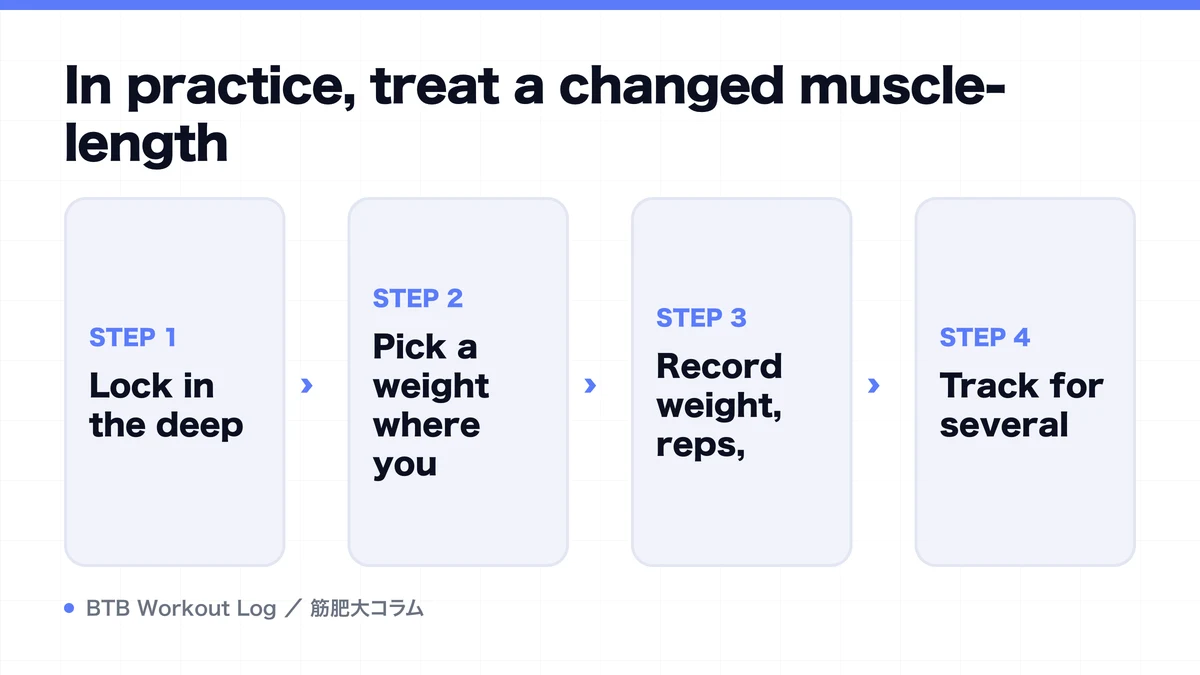
When you change hareket açısı or body position, the same exercise name loses its old weight and rep meaning. If the weight you can handle drops right after going deeper, that's not muscle weakness—it's just that travel distance, resistance curve, and turnaround mechanics changed. Don't force your old numbers; establish a new baseline weight under the fresh conditions.
- Lock in the deep endpoint where your target muscle is longest, using a position you can hit pain-free every rep.
- Pick a weight where you can hit your target rep range without bouncing and match your RIR across sets. RIR is your estimate of reps left in the tank; RIR 1–3 is usually a good starting point.
- Record weight, reps, sets, and RIR, plus your endpoint and form standards.
- Track for several weeks: are reps or weight climbing steadily, and are your joints and output staying healthy?
If progress keeps coming and toparlanma holds up, that exercise is sustainably loading tension at the long position. If it stalls, before you just go deeper, double-check whether resistance is actually there, review your RIR, your haftalık set total, and exercise order. Progresif yüklenme only tells you something when you compare identical conditions.
Sık Sorulanlar
- Does a stronger stretch feeling mean better kas hipertrofisi?
- That stretch feeling is a cue that you're in a long muscle position, but it isn't the stimulus itself. What matters is whether external resistance is still present and your target muscle is producing force without bouncing. Pain or sharp discomfort isn't reliable proof of good stimulus.
- Should long-position partials take priority over full hareket açısı?
- There's no single rule. Use reproducible full hareket açısı as your baseline, and pick long-position partials when an exercise has heavy resistance in the stretch or when your menu is skewed toward short ranges. Once you change hareket açısı, log weight, reps, and RIR as separate conditions.
- Can I add more sets when I introduce a stretch-position exercise?
- Replacing part of your current work is the clearer way to start. If you bump up both the exercise and your total haftalık set at once, you can't separate the muscle-length effect from the volume effect. Confirm your output and toparlanma over a few weeks, then adjust gradually if needed.
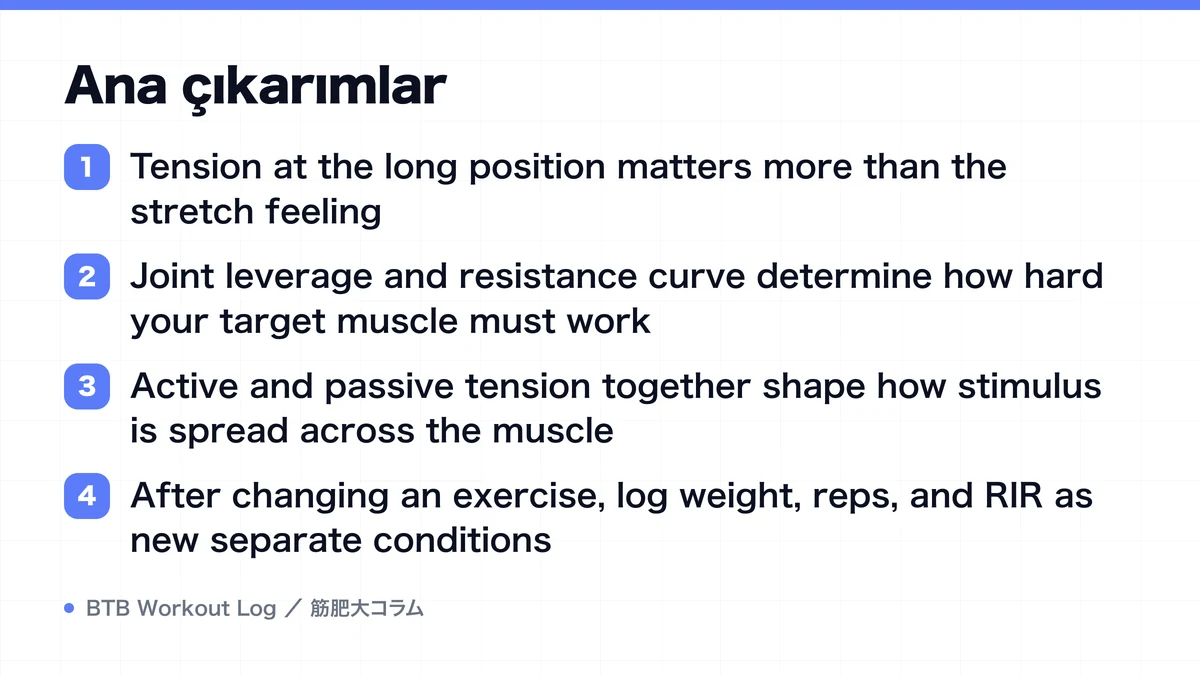
Ana çıkarımlar
- Tension at the long position matters more than the stretch feeling
- Joint leverage and resistance curve determine how hard your target muscle must work
- Active and passive tension together shape how stimulus is spread across the muscle
- After changing an exercise, log weight, reps, and RIR as new separate conditions
Kaynaklar
- The Mechanisms of Muscle Hypertrophy and Their Application to Resistance Training
- Mechanisms of Muscle Hypertrophy: Current Understanding and Future Directions
- The Influence of Frequency, Intensity, Volume and Mode of Strength Training on Whole Muscle Cross-sectional Area in Humans
- Low- vs High-load Resistance Training for Strength and Hypertrophy: Meta-analysis
- Muscle Hypertrophy Is Independent of Load Across Upper and Lower Limbs When Effort Is Matched