
背部訓練為什麼沒有「有練到」的感覺?練大看不見的肌肉的技巧
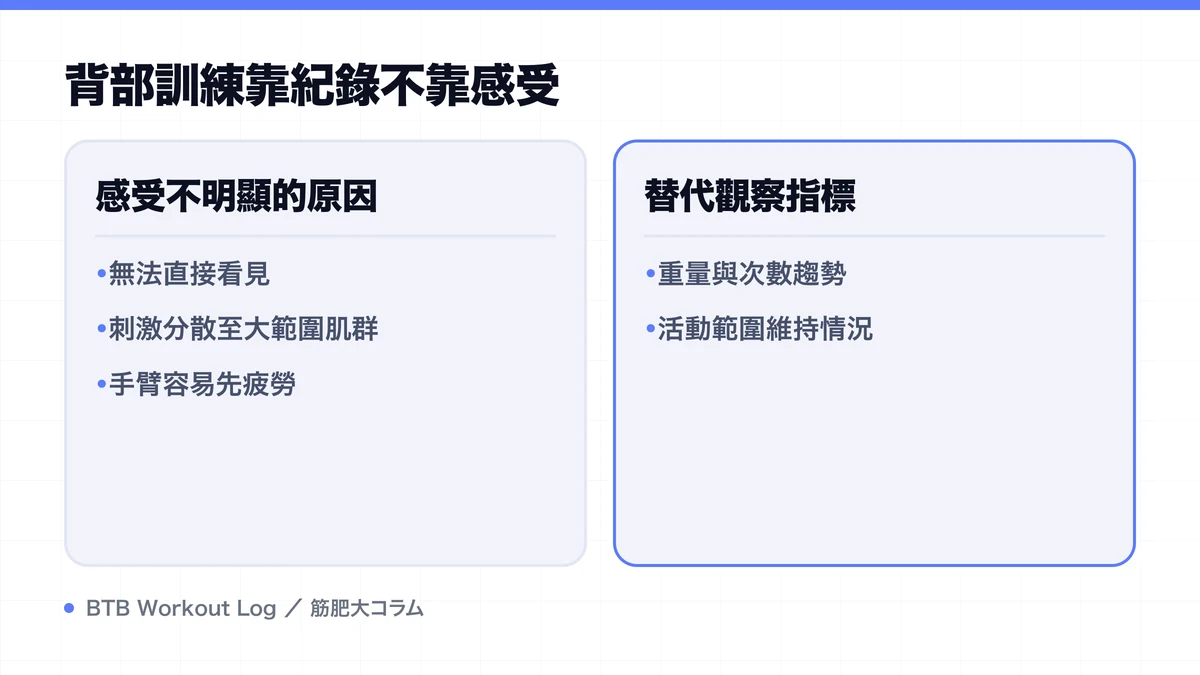
背部由多块肌肉组成,与手臂、前臂一起完成拉动动作,且自己很难看清楚肌肉的运动。因此刺激容易分散,导致「哪里受力」变得模糊不清。
感受力弱不等于没有刺激。收缩感可以作为调整动作的参考,动作的有效性应该通过可重复的动作和数周内的进展来判定。
背部难以产生强烈感受的3个原因
虽然统称为「背部」,但阔背肌、斜方肌、菱形肌、脊柱立肌的位置和功能各不相同。竖直拉动时阔背肌参与度较大,水平拉动时肩胛骨内收肌群的作用更强。背部训练动作分为竖直拉和水平拉,不仅是外观考量,动作功能本身就不同。如果期待整个背部产生一种强烈的收缩感,实际上肌肉在工作,反而会判断为「没有感受」。
其次,拉动类动作并不只依靠肩关节和肩胛骨。肘关节屈肌(肱二头肌)、握力(前臂)、姿态维持(核心)都会同时参与。前臂的充血感和肱二头肌的疲劳容易被感知,这种感受有时会掩盖背部肌肉的紧张。这不是臂肌参与本身有问题,而是复合动作的自然现象。问题出现在握力或肘屈肌比目标背部肌群先力竭,导致组数提前结束的情况。
背部还有个特点是很难用镜子直接看清楚,不像胸部或上臂那样能通过视觉确认肌肉收缩并实时调整。你只能通过手部的运动轨迹推测身体后侧的上臂和肩胛骨动作。多个肌群、多个关节、视觉信息不足,这些因素叠加在一起,背部的感受本来就容易含有噪音。从实际训练角度出发,应该这样理解。
「效果感」弱不代表训练失败
充血感和灼热感不是长期效果的决定因素
高次数动作产生的充血感和灼热感容易被感知,给人完成了训练的满足感。但那一刻的感受会因为次数、休息、动作陌生度而变化。自动将充血感强的动作高度评价,放弃感受平静的动作,这样做会错过可承受的负荷、动作幅度和长期进展。收缩感与肌肉肥大效果的关系,需要单独思考——效果感强的动作就一定更优秀吗——而不是混为一谈。
「收缩肩胛骨」不是所有背部动作的通用答案
阔背肌的主要功能是将上臂拉向体侧。而以斜方肌中部和菱形肌为目标的划船动作,肩胛骨后缩才是关键。不管是下拉还是划船,都用力收缩肩胛骨的话,反而会偏离训练目标。竖直拉用肘部向骨盆方向移动,水平拉则根据目标肌群调整肘的轨迹和肩胛骨的动作——根据目的灵活应对。
为了追求感受而不断降低重量也不对
学习动作形式时降低负荷是有效的,但并非越轻越好。关键是在保持目标动作幅度的前提下,逐步增加负荷到足以在组的后半部分产生充分刺激的程度。感受是用来探索「动作是否正确」的信息,不是拒绝增加负荷的理由。
利用感受,但不全部依赖感受
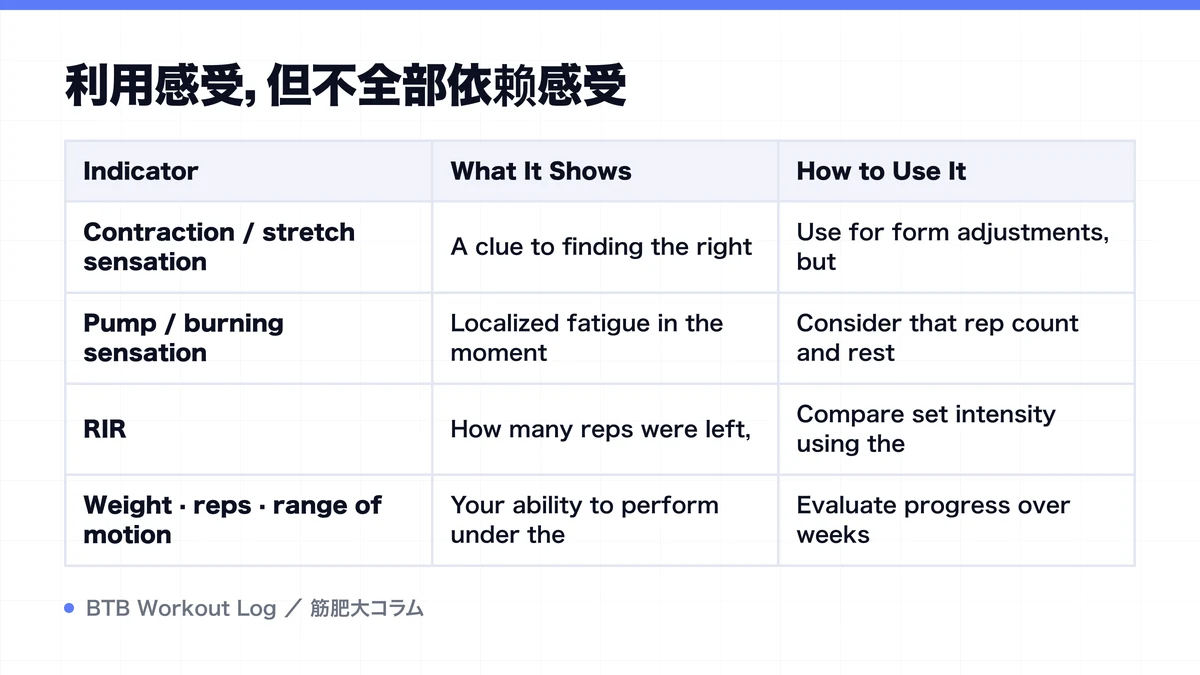
Even with traditional pulling exercises that target the lats, changing the movement or conditions can shift the pattern of muscle activation. But a single snapshot of muscle activity doesn't predict long-term muscle hypertrophy. You need a perspective that tracks load, volume, frequency, and range of motion over time. Rather than relying on one signal—"my lats felt contracted today"—check whether multiple indicators point in the same direction.
| Indicator | What It Shows | How to Use It |
|---|---|---|
| Contraction / stretch sensation | A clue to finding the right movement path | Use for form adjustments, but don't rely on it alone to pass or fail |
| Pump / burning sensation | Localized fatigue in the moment | Consider that rep count and rest periods affect this too |
| RIR | How many reps were left, indicating effort level | Compare set intensity using the same standard |
| Weight · reps · range of motion | Your ability to perform under the same conditions | Evaluate progress over weeks |
| Pain · numbness | A warning to consider stopping or modifying | Don't chase it as a sign the muscle is working |
RIR indicates "how many reps you had left." Even if your back sensation is weak, if you can hold form, reach your target range of motion, and hit your target RIR, you can compare effort. Conversely, strong sensation means little if your form or range shifts every session—making comparison with last time vague. Rather than eliminating feel entirely, combine your defined perception with numbers.
Steps to match back sensation to form
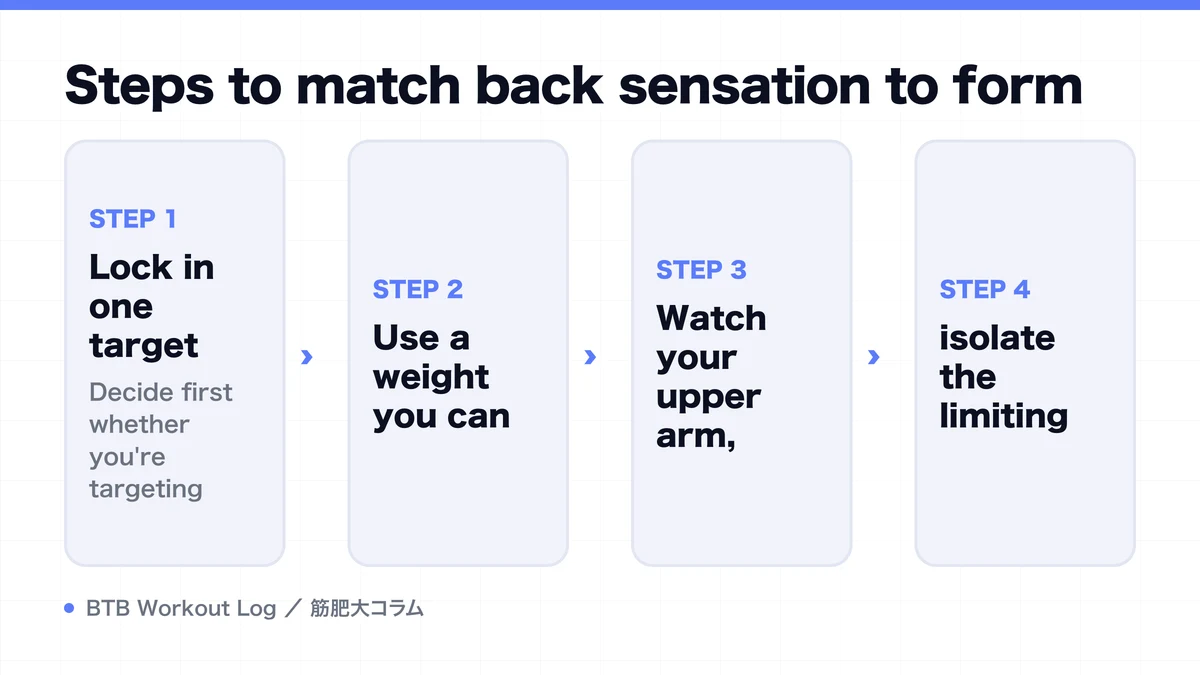
- Lock in one target: Decide first whether you're targeting the lats with a vertical pull or building thickness in the upper back with a horizontal pull. The choice between pull-ups and lat pulldowns is covered in lat pulldown vs. pull-up comparison; row selection is compared in barbell row vs. seated row comparison, separating purpose from stability.
- Use a weight you can control: If you're continuing reps with momentum or changing torso angle, drop the weight. Your baseline is a load where you can keep the start position, end point, and tempo consistent.
- Watch your upper arm, not your hands: On vertical pulls, drive your elbows toward your hips; on horizontal pulls, in your target direction. Think of your hands as the link between the tool and your body—don't focus only on gripping hard.
- isolate the limiting factor: If your forearms fail first each rep, try straps. If your lower back loses stability first, try a machine with a chest pad. Test one change at a time and compare what shifts.
- Run the same movement multiple times: Switching grip or exercises every session resets both motor learning and comparison. Repeat the same conditions pain-free and watch how sensation and numbers stabilize.
Filming from the side or rear is also effective. You can check whether you're overarching your chest, shortening range of motion only at the end, or favoring one side. Video doesn't directly measure muscle stimulus, but it gives you material to correct back movement you can't see.
Decide whether to keep or change an exercise based on progress over weeks
When evaluating a back exercise, first check whether you can repeat your target range of motion without pain, then whether you can push near your limit in the target movement—not grip or bicep strength. Once those conditions are locked in, look for weight or reps increasing at the same RIR. Even if sensation is mild, if numbers are climbing and form is solid, there's little reason to rush and swap exercises.
Conversely, strong pump aside, if weight and reps drop over weeks and range shortens too, reconsider. Check not just the exercise but your weekly back volume, recovery since last session, and RIR accuracy. Before adding sets to boost sensation, confirm you're repeating progressive overload in the sets you already have.
Because vertical and horizontal pulls have different roles, tracking records separately makes judgment easier. Use sensation for that session's form tweaks, and records for deciding whether to keep or change the exercise—divide the labor that way.
常見問題
- If my back doesn't feel like it's working but weight and reps are climbing, should I keep going?
- If there's no pain, you're holding your target range and form, and weight or reps rise at the same RIR, weak sensation alone isn't reason to change. Check video and symmetry too, and judge on multiple markers.
- My biceps tire out first on lat pulldowns. How do I fix it?
- Drop the weight first and drill the path of driving your elbows toward your hips instead of pulling with your hands. If grip fails first, straps are an option. If your arms keep hitting their limit every rep, try changing grip or range one at a time and compare.
- Should I use straps every session to feel my back better?
- Not essential. Straps help when grip fails before your back reaches its limit, but skip them if you can complete the movement unassisted. You can split it by goal—use nothing for warmups and only bring straps in for your top 硬組.
重點整理
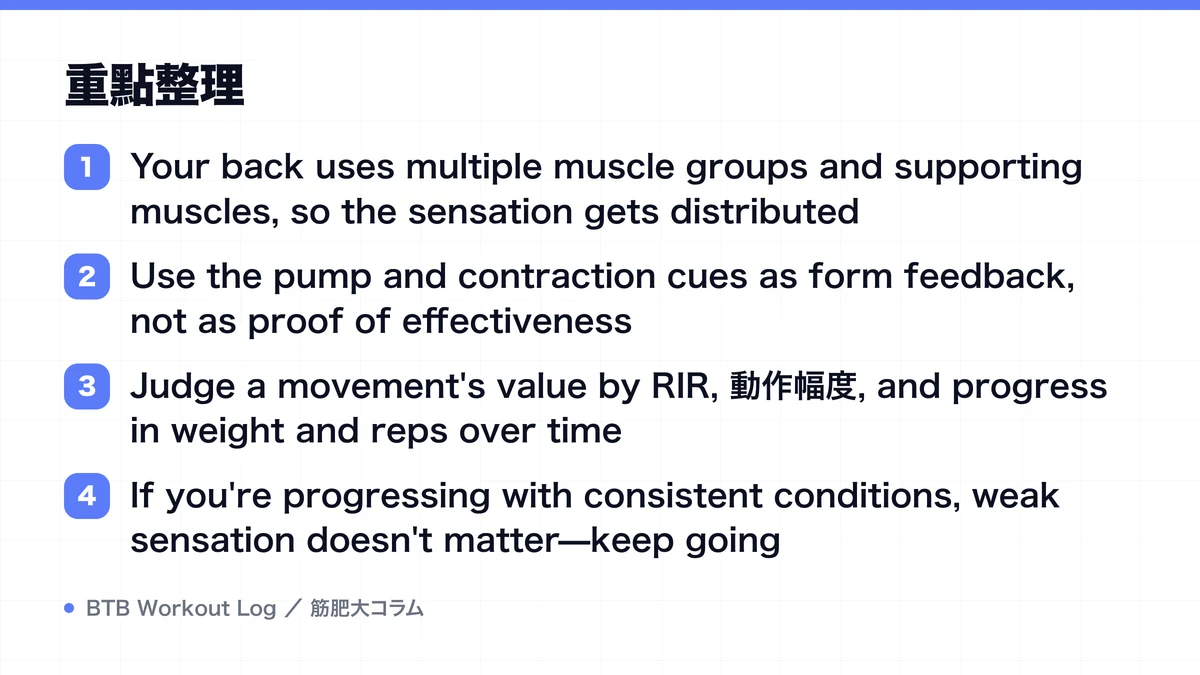
- Your back uses multiple muscle groups and supporting muscles, so the sensation gets distributed
- Use the pump and contraction cues as form feedback, not as proof of effectiveness
- Judge a movement's value by RIR, 動作幅度, and progress in weight and reps over time
- If you're progressing with consistent conditions, weak sensation doesn't matter—keep going
參考文獻
- Variations in Muscle Activation During Traditional Latissimus Dorsi Exercises
- The Mechanisms of Muscle Hypertrophy and Their Application to Resistance Training
- The Influence of Frequency, Intensity, Volume and Mode of Strength Training on Whole Muscle Cross-sectional Area in Humans
- Repetitions in Reserve Is a Reliable Tool for Prescribing Resistance Training Load