
滑輪下拉 vs 引體向上,想練出寬背選哪個?用背闊肌來比較
Looking purely at lat muscle肌肉肥大, there's no universal winner between lat pulldowns and pull-ups. What matters more is maintaining your target 動作幅度, stacking enough hard sets, and gradually increasing load—whichever exercise lets you do that consistently is the stronger choice for you.
Don't decide based on whether you can do pull-ups or not. Instead, compare both exercises under the same conditions: stimulus repeatability, fatigue, time investment, load adjustability, and how they feel on your joints.
The comparison isn't about exercise prestige—it's about stacking effective sets.
這兩個動作都屬於垂直拉,將位於頭頂上方的手拉向身體兩側。除了闊背肌,大圓肌、肱二頭肌等肘屈肌群,以及控制肩胛骨的肌群也會參與。引體向上需要拉起自身體重,看起來更難,但這不代表它對闊背肌的肌肉肥大刺激一定更強。
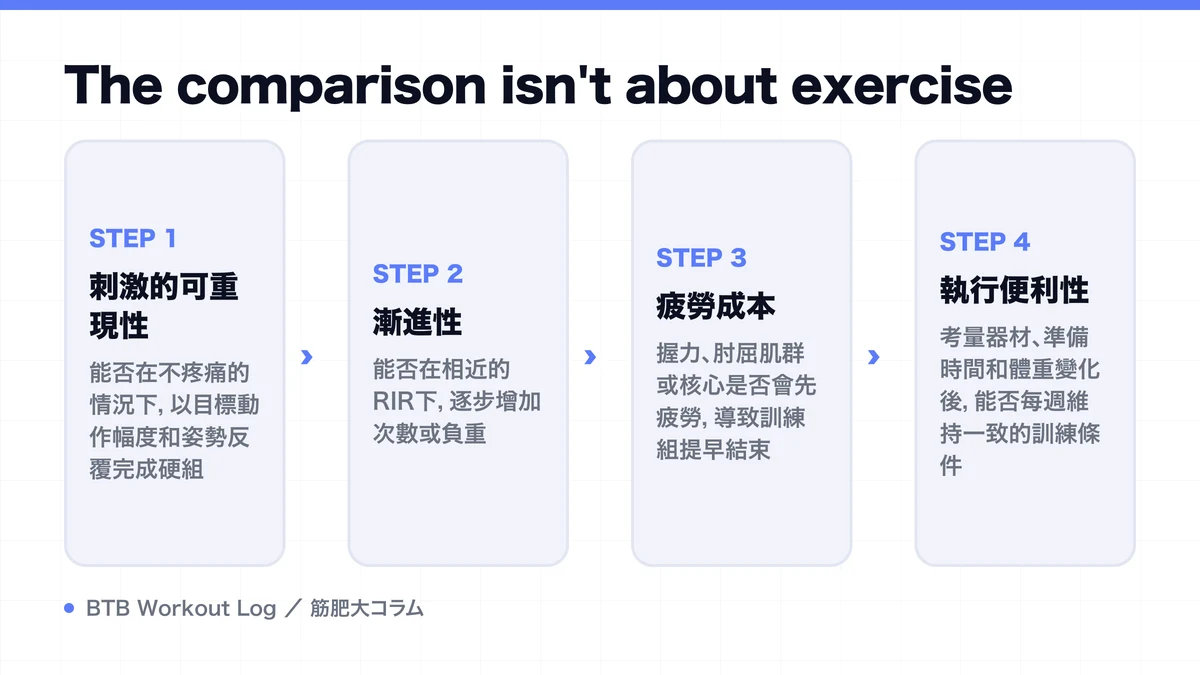
比較時應看以下4點。
- 刺激的可重現性:能否在不疼痛的情況下,以目標動作幅度和姿勢反覆完成硬組。
- 漸進性:能否在相近的RIR下,逐步增加次數或負重。
- 疲勞成本:握力、肘屈肌群或核心是否會先疲勞,導致訓練組提早結束。
- 執行便利性:考量器材、準備時間和體重變化後,能否每週維持一致的訓練條件。
RIR是對「還能再做幾下」的估計。例如RIR2,代表在維持姿勢的前提下,大約還能再做2下。比起動作名稱,更該優先確保自己能以相同的動作幅度和RIR,持續完成高品質的訓練組。
引體向上的完成次數也會受到體重影響。減脂期間次數增加,不一定全是闊背肌輸出提升所致;增肌期間次數下降,也不能立刻視為退步。不同下拉機台顯示的重量同樣無法直接比較,因此在評估期間,應固定該動作的訓練條件。
肌肉肥大效果是由動作幅度和努力程度決定,而不是單純比較勝負
Long-term comparisons of lat pulldowns and pull-ups directly measuring latissimus dorsi hypertrophy are limited. Rather than claiming one consistently builds bigger muscles, it's safer to judge based on their shared strength: both can load the lats effectively. In an EMG study of 12 healthy men with weight training experience, wide and reverse grip pulldowns alongside two variations of seated rows showed some differences in latissimus dorsi muscle activation. However, muscle activation is electrical activity in the moment—it's not the same as long-term 肌肉肥大.
In practice, maintain consistent 動作幅度 each rep: from arms fully extended overhead to elbows pulled down to your sides. When you start shrugging at the top or excessively arching your chest at the bottom to approximate a horizontal pull, the comparison between sessions becomes murky. Use 動作幅度 where your shoulders feel comfortable and your lats can be controlled from fully lengthened to fully shortened. This concept of 動作幅度 ties into comparing full range versus partial reps.
Load itself has no single answer. A meta-analysis of studies using both light and heavy loads trained to failure found no significant average difference in 肌肉肥大. Whether pull-ups mean lower reps and pulldowns mean higher reps doesn't determine superiority on its own. What matters is matching RIR at your target rep range and ensuring your lats get sufficient volume before form breaks down.

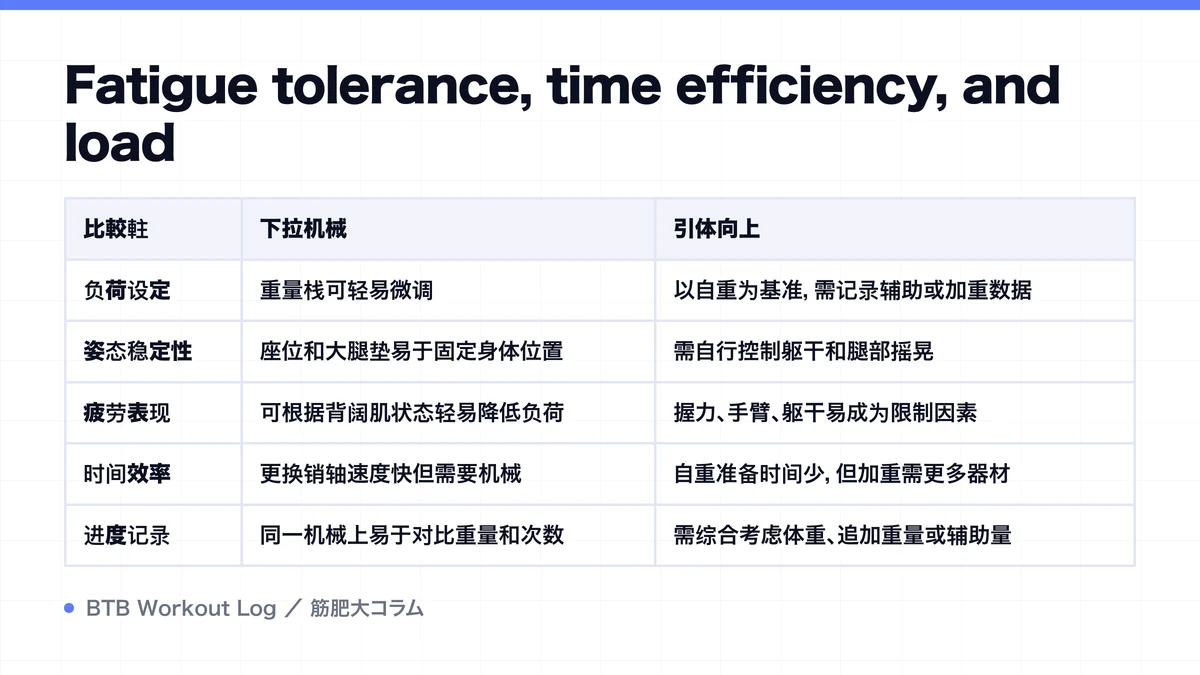
Fatigue tolerance, time efficiency, and load management each have different strengths
| 比較軴 | 下拉机械 | 引体向上 |
|---|---|---|
| 负荷设定 | 重量栈可轻易微调 | 以自重为基准,需记录辅助或加重数据 |
| 姿态稳定性 | 座位和大腿垫易于固定身体位置 | 需自行控制躯干和腿部摇晃 |
| 疲劳表现 | 可根据背阔肌状态轻易降低负荷 | 握力、手臂、躯干易成为限制因素 |
| 时间效率 | 更换销轴速度快但需要机械 | 自重准备时间少,但加重需更多器材 |
| 进度记录 | 同一机械上易于对比重量和次数 | 需综合考虑体重、追加重量或辅助量 |
疲劳并非"引体向上必然更大"的问题。对于已掌握引体向上、能稳定控制躯干的人来说,它是高效的主力动作。反之,若手臂或握力先出现力竭,用下拉机械降低负荷反而更易完成背阔肌组数。
无需每组都训练至力竭。没有明确证据表明力竭训练在肌肉肥大上优于非力竭训练。主力组控制在RIR1~3,后续组数的输出会更稳定。力竭方式的配置可参照力竭组与RIR对比进行调整。
When to prioritize which one
When Lat Pulldown Makes Sense as Your Main Exercise
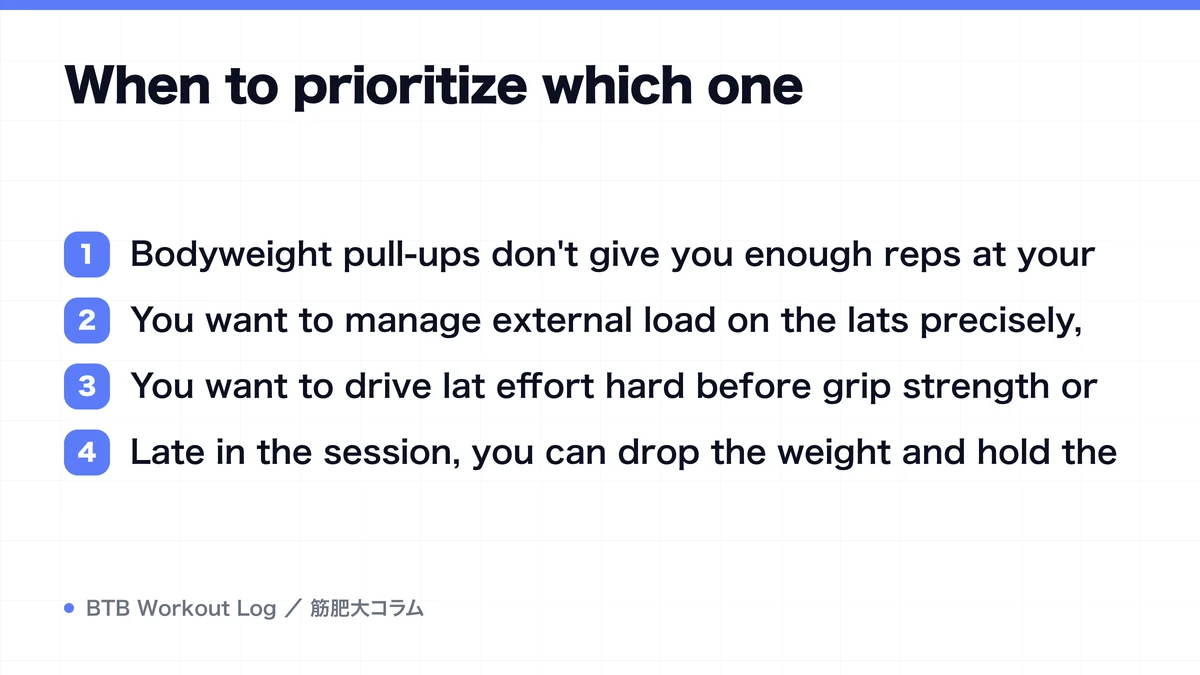
- Bodyweight pull-ups don't give you enough reps at your target range of motion.
- You want to manage external load on the lats precisely, independent of bodyweight fluctuations.
- You want to drive lat effort hard before grip strength or core stability becomes the limiter.
- Late in the session, you can drop the weight and hold the same rep range without degradation.
When Pull-ups Make Sense as Your Main Exercise
- You can hit solid reps with no momentum and reliably estimate RIR for each set.
- You can add small increments of load via dipping belt or similar tools.
- Beyond lat hypertrophy, you want to build relative strength—moving your bodyweight more effectively.
- You have reliable bar access and aren't held back by machine availability or crowds.
If you're running both, decide why you need the overlap. One solid approach: use weighted pull-ups for lower-to-moderate reps as your main lift, then add pulldown at slightly higher reps. Keep in mind that stacking only vertical pulls can skew your back's overall set distribution. Consider how horizontal pulling (rows) fits the picture—see barbell row vs. seated row for that breakdown, and check back hypertrophy programming for the full picture.
Lock in the conditions for 6 weeks and assess as your main lift
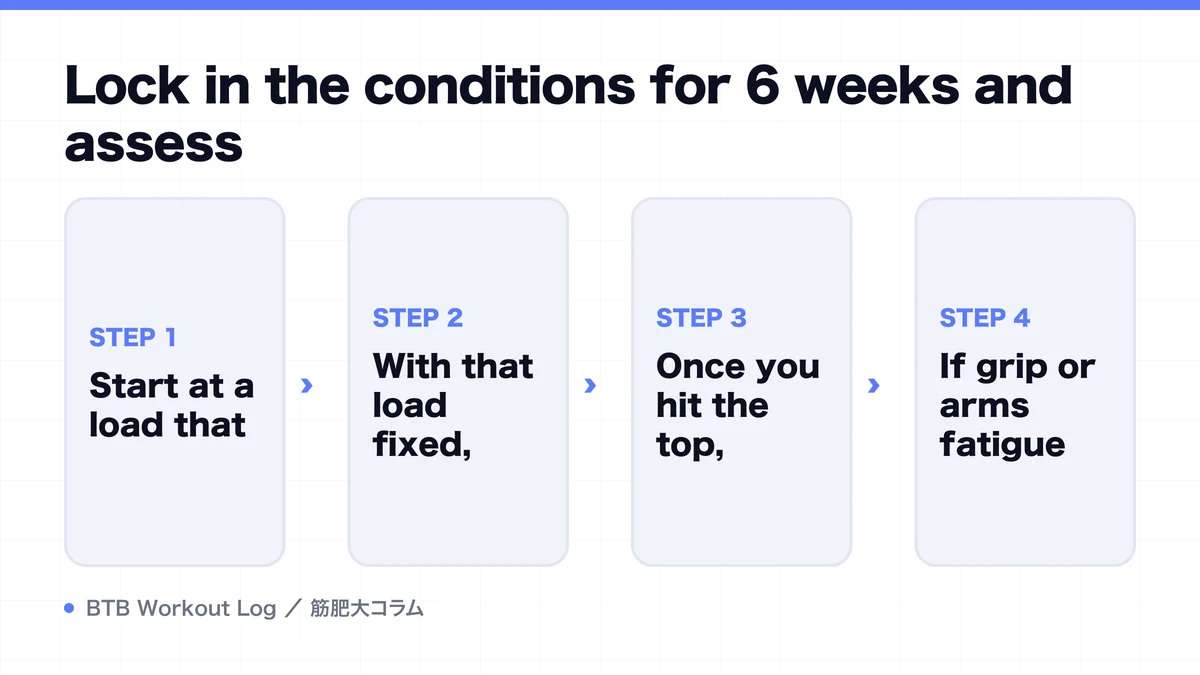
If you're unsure, pick one as your main exercise and run it for about 6 weeks with all variables fixed. Match your grip, range of motion, set count, and target RIR. Track weight and reps each session. For pull-ups, log bodyweight plus any added load; for assisted pull-ups, note the assist level too. With pulldown, machine changes alter what the displayed weight actually means, so stick to the same machine for apples-to-apples comparison.
- Start at a load that puts you at RIR 1–3 for your target rep range.
- With that load fixed, drive up the reps toward the top of your range—form stays the same, just more repetitions.
- Once you hit the top, increase load slightly and rebuild from the bottom of the range.
- If grip or arms fatigue before your lats, if joint discomfort climbs, or if your output doesn't bounce back by the next session, reassess your load or exercise choice.
This weight-versus-reps progression method lets you judge both exercises by the same standard. Don't chase the pump of one session—watch whether you're adding reps at the same RIR and range of motion over several weeks, and whether you can stack your planned hard sets within sustainable recovery. Training builds muscle, but your log shows whether those choices are actually working.
常見問題
- If I can't do a single pull-up, am I at a disadvantage for lat growth?
- Not necessarily. Lat pulldown or assisted pull-ups let you keep a full range of motion while adjusting load, so you can stack plenty of hard sets. Build your reps and load there first, then train unassisted pull-ups as a separate strength goal on its own timeline.
- Should I do both lat pulldown and pull-ups on the same day?
- Doing both is possible, but not required. If your main lift covers the vertical-pull volume you need for lat growth, you can redirect the extra sets to rows. If you use both, separate their roles—different rep ranges, different grips—to avoid repeating the same stimulus.
- Is a wider grip always better for lat hypertrophy?
- Wider grip doesn't automatically boost hypertrophy. Some lifters lose range of motion or load capacity at extreme widths. Pick a grip where your shoulders stay comfortable, you can drive your elbows toward your ribs through the same path every rep, then track progress to see what actually works for you.
重點整理
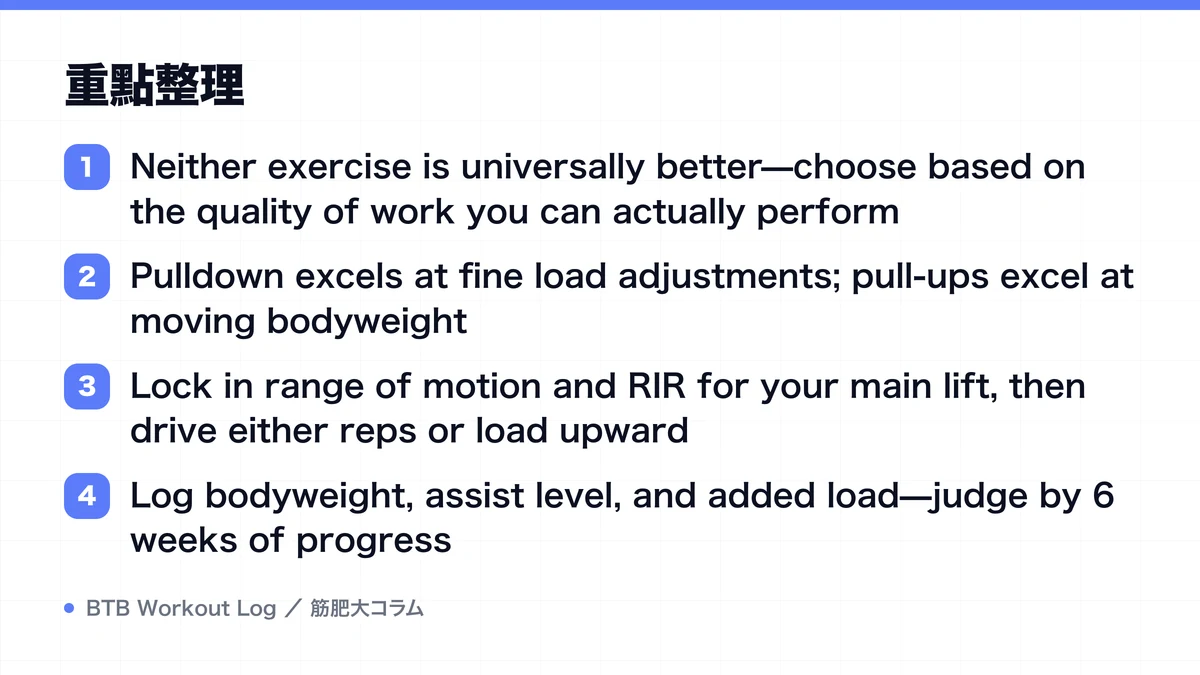
- Neither exercise is universally better—choose based on the quality of work you can actually perform
- Pulldown excels at fine load adjustments; pull-ups excel at moving bodyweight
- Lock in range of motion and RIR for your main lift, then drive either reps or load upward
- Log bodyweight, assist level, and added load—judge by 6 weeks of progress