
只練引體向上,背部也能變大嗎?自重訓練族該知道的極限
單靠引體向上也能練大背部,尤其是闊背肌。但若要背部全面均衡發展,則因人而異——有人只需這一個動作就夠,有人則會出現缺口。
關鍵不在動作數量的多少,而在於目標部位是否獲得足夠刺激,以及能否按同一標準持續進步。
「背部變大」與「背部全面充分」是兩個不同的問題
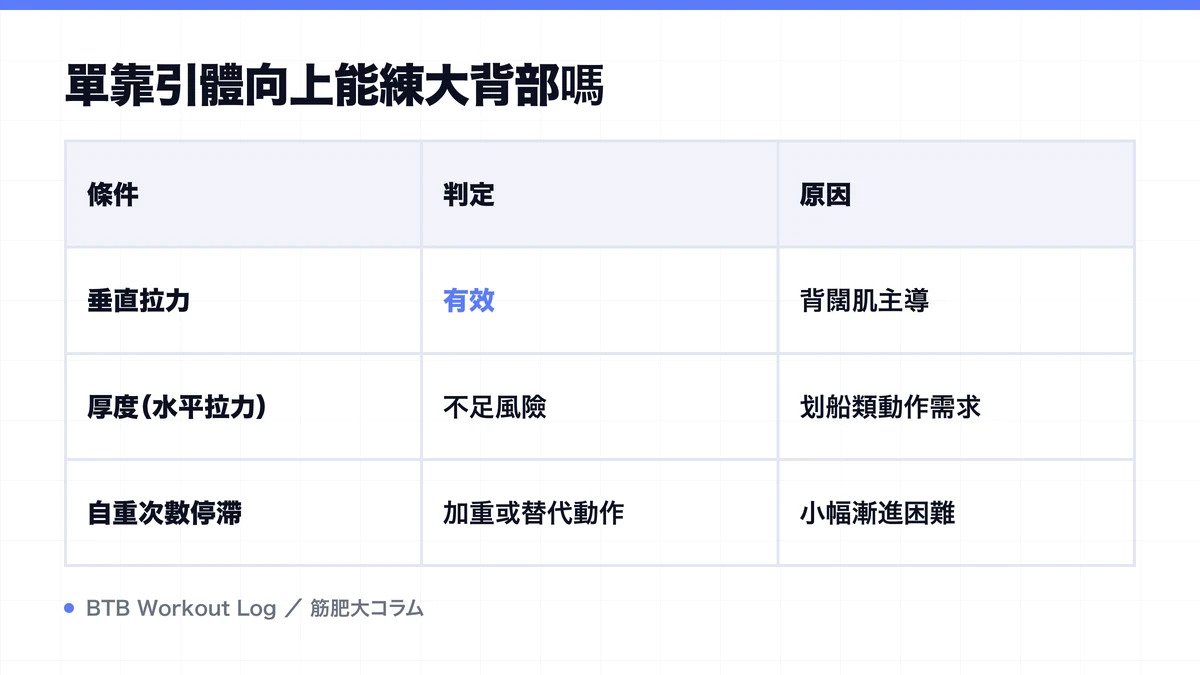
背部不只是闊背肌。闊背肌、大圓肌、斜方肌、菱形肌、後三角肌、豎脊肌等多層肌群共同創造背部的寬度、上背的厚度與肩胛骨周圍的立體感。引體向上作為垂直拉動作,以闊背肌為主要目標,但不是等比例鍛煉背部所有組織的動作。
因此判斷標準取決於目標。如果想增加闊背肌寬度、器械最小化、提升引體向上次數或負重,單靠引體向上完全可行。反之,若優先考慮斜方肌中段與菱形肌帶來的上背厚度,水平划船動作就不能省略。背部整體課程設計可參考背部肌肉肥大訓練菜單的同一標準來梳理。
值得注意的是,目前可查閱的研究文獻中,沒有長期對比單純引體向上組與多動作背部訓練組、測量各部位肌肥大的直接研究。「單靠引體向上就足夠」或「沒有划船動作就發展不了」的絕對論斷都應避免。最合理的做法是綜合抗阻訓練總體研究、背部動作的肌電活動,以及個人進步情況來判斷。
引體向上的主要刺激範圍與容易遺漏的部分
引體向上通過肩關節從上方向體側下拉,肘部彎曲將身體拉起。闊背肌與大圓肌容易被激活,肱二頭肌等肘屈曲肌群、握力、肩胛骨穩定肌群也參與其中。作為徒手多關節動作,若難度適當,單一動作也能對多個肌群施加巨大張力。
但參與動作與被充分刺激是兩回事。引體向上中肩胛骨雖在動,卻不像水平划船那樣外加阻力使肩胛骨後縮。背部動作的肌電圖研究已證實,握法與軌跡差異會改變肌活動模式。這不是證明單靠引體向上長期肌肥大的研究,也不能只靠肌電圖高低判斷未來肌肥大。但這提醒我們:固定拉動方向容易固化刺激分配。
背部感受度弱不應成為否定引體向上的理由。感受度只是參考,應優先看標準化動作下次數或負重是否進步,以及最後幾次重複的限制因素在哪裡。判斷方法可參考背部訓練感受度不足的原因。
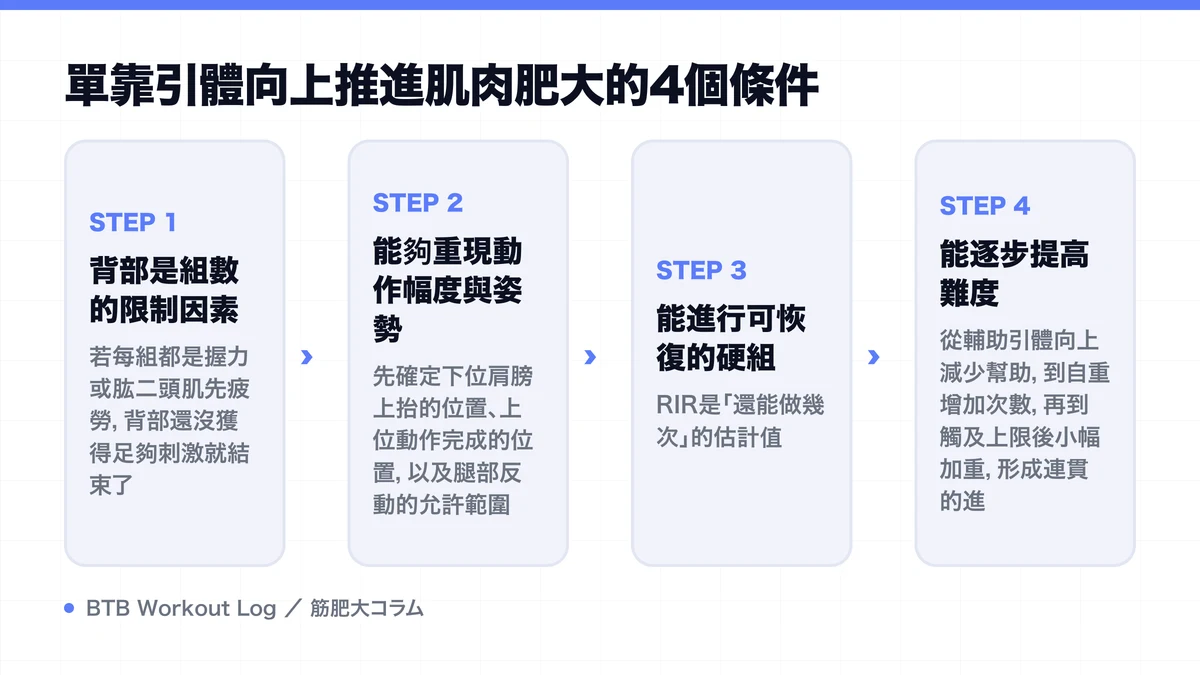
單靠引體向上推進肌肉肥大的4個條件
- 背部是組數的限制因素:若每組都是握力或肱二頭肌先疲勞,背部還沒獲得足夠刺激就結束了。別增加反動,改為調整輔助力度、握法或使用護帶,讓目標背部肌群能夠全力工作。
- 能夠重現動作幅度與姿勢:先確定下位肩膀上抬的位置、上位動作完成的位置,以及腿部反動的允許範圍。無需強行做肩膀狀態不允許的無支撐懸掛,但不能每週縮短標準只為增加次數。
- 能進行可恢復的硬組:RIR是「還能做幾次」的估計值。大多數組次應在RIR1-3的高努力度進行,每週分散訓練量。比起套用固定的「標準組數」,更好的做法是從當前量開始,根據表現與關節狀態調整。量的思路可查看每週組數。
- 能逐步提高難度:從輔助引體向上減少幫助,到自重增加次數,再到觸及上限後小幅加重,形成連貫的進階。不是每次都蠻幹,而是在可比較的條件下提升能力——這就是漸進超負荷。
體重波動期間也要特別注意,不只看附加重量。體重增加5kg時做出同樣次數,外掛的重量不變,但課題已變重。相反,減脂期間即使次數維持,總負荷可能下降。將體重、附加重量或輔助量、次數三項一起記錄。
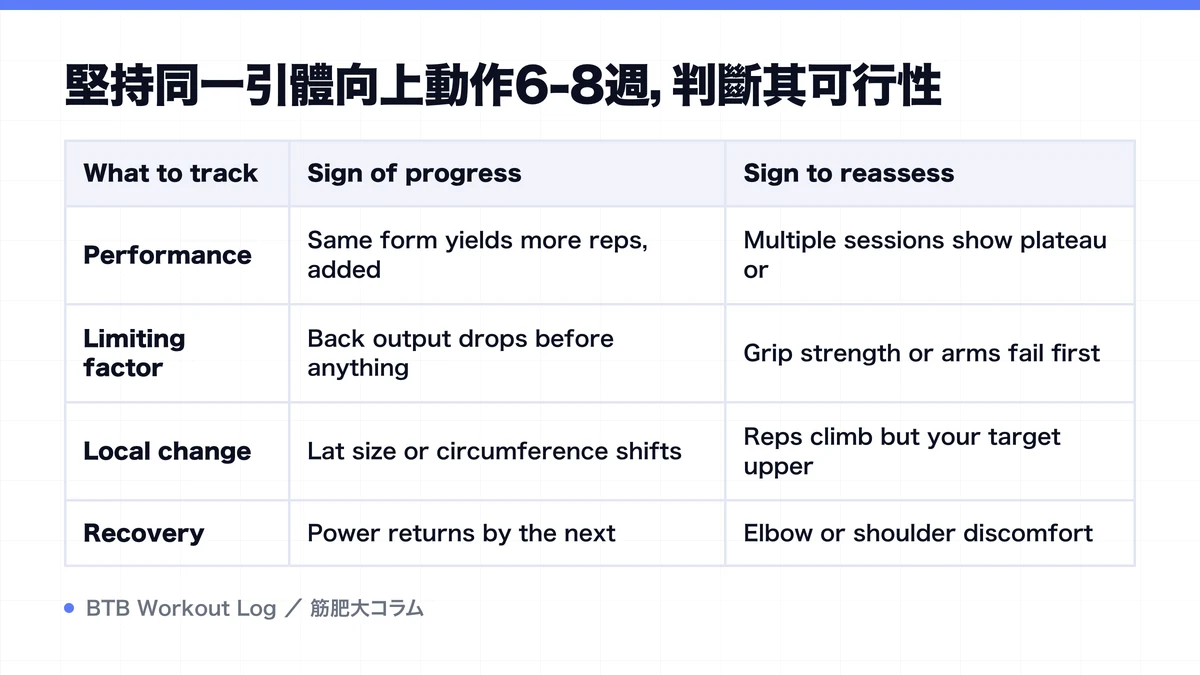
堅持同一引體向上動作6-8週,判斷其可行性
A single pump or sore muscles won't tell you if pull-ups alone are enough. Lock in your grip width, hand position, 動作幅度, and rebound pattern, then stick with the same pull-up variation for 6–8 weeks as your main lift. You can split sessions, but don't swap exercises week to week. Track these markers instead.
| What to track | Sign of progress | Sign to reassess |
|---|---|---|
| Performance | Same form yields more reps, added load, or higher total volume | Multiple sessions show plateau or decline across all metrics |
| Limiting factor | Back output drops before anything else; reps end there | Grip strength or arms fail first every session |
| Local change | Lat size or circumference shifts over weeks | Reps climb but your target upper back stays unchanged |
| Recovery | Power returns by the next session; no worsening joint symptoms | Elbow or shoulder discomfort accumulates; set quality decays |
Don't decide on one metric alone. Say reps plateau for a week—but bodyweight rises and form tightens. That's not failure. Conversely, if reps climb only because your 動作幅度 shrinks, that's not real overload. When plateau stretches on, check sleep, nutrition, and total weekly fatigue before blaming the exercise itself.
Use logging to make the call: compare 6–8 weeks before and after any change.
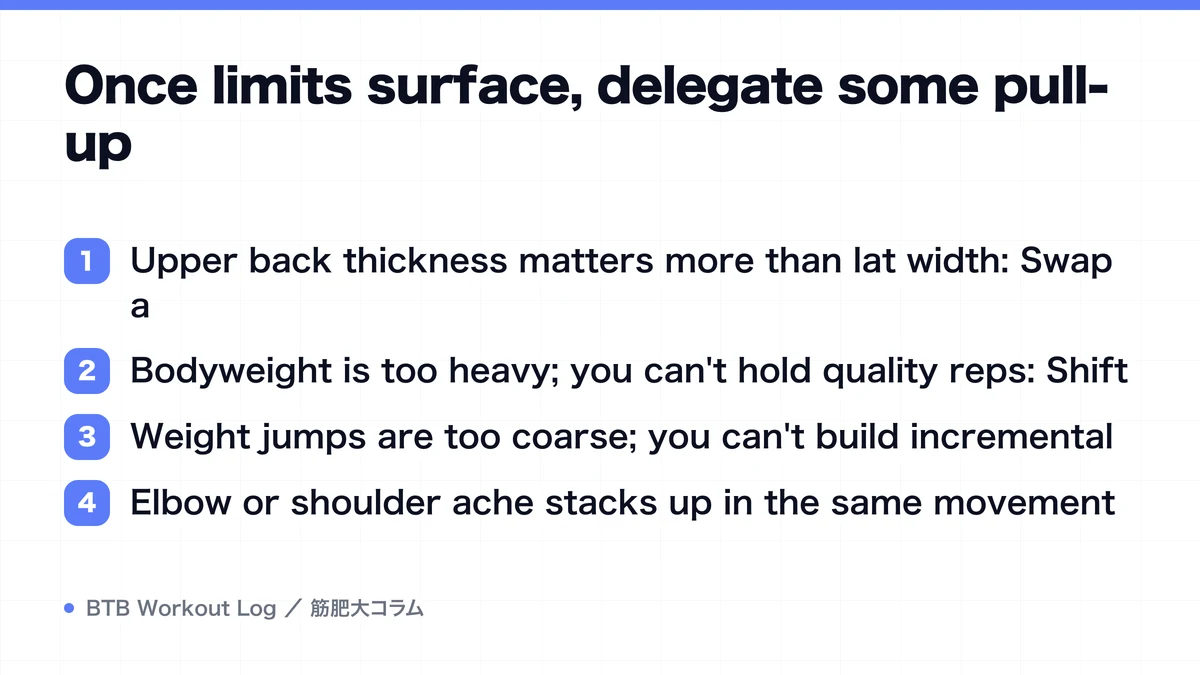
Once limits surface, delegate some pull-up volume to other roles
While pull-ups alone drive progress, you don't have to add more. Fewer exercises mean cleaner skill practice and easier tracking of what actually improved. Consider adding work only when your target area stops adapting the way you expect.
- Upper back thickness matters more than lat width: Swap a portion of your weekly pull-up sets for horizontal pulls—seated rows or chest-supported rows. Don't just pile volume on top; that blurs pure exercise selection from raw fatigue.
- Bodyweight is too heavy; you can't hold quality reps: Shift some volume to assisted pull-ups or lat pulldowns, where you can dial in the exact 動作幅度 and RIR you want. See lat pulldown vs. pull-ups for how to choose between them.
- Weight jumps are too coarse; you can't build incremental progress: Push reps first and use small plates. If that still doesn't fine-tune enough, some sets can move to cable work where load adjustment is granular.
- Elbow or shoulder ache stacks up in the same movement pattern: Don't grind through pain with more volume. Try neutral grip or hunt for a different bar angle you can tolerate. If symptoms persist, see a healthcare provider—don't rely on training judgment alone.
When adding rows, you're not locked into barbells. Your choice hinges on whether you're isolating upper back sets or want whole-body tension work too. Check barbell rows vs. seated rows for guidance.
The answer: pull-ups alone can build a bigger back if lats are your priority. For whole-back size, validate with records whether you're truly short. Stick to the minimal setup, track progress honestly, and only fill gaps you actually observe—that keeps your plan sound.
常見問題
- How many sets per week should I start with if it's only pull-ups?
- It depends on your current back volume and recovery capacity. As a starting point, aim for 6–8 硬組 per week, split across 2 sessions. If reps and added load climb in the same form and your elbows and shoulders stay clean, hold steady or add a little.
- Does a wide-grip pull-up work the back as well?
- Not necessarily; ultra-wide doesn't always win. If 動作幅度 shrinks or shoulder discomfort creeps in, set quality suffers. Start near shoulder width, find a grip width and hand angle you can repeat pain-free where your back becomes the bottleneck, then lock it in.
- Can I build a pull-up-only program if I can't do a single unassisted rep?
- Yes, if you log assist band or machine support and hit multiple reps in your target 動作幅度. That said, if assist increments feel too coarse or unstable, lat pulldowns let you dial load more finely and practice the same vertical pull pattern.
重點整理
- Pull-ups alone can drive lat-focused 肌肉肥大
- Building thickness across the whole back runs into a horizontal-pull gap
- Track 動作幅度, RIR, weekly sets, and load gains under identical conditions
- After 6–8 weeks of logging, fill only the gaps you see