매주 같은 메뉴는 나쁜 걸까? 지겨워지기 전에 알아둘 '바꾸지 않는 게 나은' 상황
매주 같은 메뉴를 반복하는 것 자체는 근비대의 방해가 아니다. 종목·순서·렙 범위를 일정하게 유지하면 능력 변화를 비교하기 쉬워지고, 필요한 점진적 과부하를 쌓아 올리기 좋아진다.
문제는 메뉴의 겉모양이 같은 것이 아니라, 무게도 반복수도 세트 질도 바뀌지 않으면서 신체 반응이 멈췄는데도 조정하지 않는 것이다.
"근육이 메뉴에 적응한다"는 얼마나 맞나
같은 자극을 계속 받으면 신체가 적응해 처음처럼 큰 반응이 일어나기 어려워진다. 이 직관에는 맞는 부분이 있다. 같은 무게, 같은 반복수, 같은 세트 수, 같은 가동 범위, 같은 RIR를 장기간 그대로 반복하면 자극의 상대적 강도는 내려가기 쉽다. RIR는 "앞으로 몇 회 더 할 수 있는가"를 보여주는 여력의 지표다. 이전에 RIR 1이던 무게가 RIR 4로 느껴진다면, 같은 세트라도 신체에는 가벼워진 것이다.
다만 여기서 "그래서 매주 종목을 바꿔야 한다"는 결론을 낼 수 없다. 신체가 적응하는 대상은 메뉴판의 종목명이 아니라 실제로 받은 부하다. 같은 스쿼트라도 자세와 가동 범위를 유지하면서 무게나 반복수가 늘면, 자극은 이전과 같지 않다. 반대로 종목명만 바꿔도 목표 근육에 걸리는 장력이나 주당 하드 세트 수가 거의 안 바뀌면, 의미 있는 진전이라 보기 어렵다.
트레이닝에 대한 "적응"에는 동작이 안정된다는 장점도 있다. 자세의 흔들림이 줄어들어 목표 근군에 부하를 싣기 쉬워지면, 세트 비교 정확도는 올라간다. 신선함이 줄어든 것과 효과가 없어진 것을 같게 취급하지 않는 것이 출발점이다.
같은 메뉴와 같은 자극은 별개다
고정 메뉴에서 남겨두는 것은 매주 비교에 필요한 "틀"이다. 종목, 실시 순서, 목표 렙 범위, 가동 범위, 휴식 시간을 대체로 맞추면, 무게나 반복수 변화를 읽기 쉬워진다. 그 틀 안에서 능력에 맞춰 부하를 높이는 것이 점진적 과부하다.
| 매주 상태 | 어떻게 해석할까 | 다음 판단 |
|---|---|---|
| 같은 종목에서 무게나 반복수가 늘어난다 | 틀은 같아도 능력과 자극은 진전되고 있다 | 메뉴를 유지한다 |
| 같은 무게·반복수를 더 큰 RIR로 수행할 수 있다 | 같은 일에 여유가 늘어나고 있다 | 목표 범위 내에서 부하를 높인다 |
| 수치는 같지만 가동 범위나 반동이 악화된다 | 겉보기로만 유지되고 비교 조건이 깨졌다 | 자세나 무게를 조정한다 |
| 여러 번 걸쳐 수치 저하와 회복 부진이 계속된다 | 피로, 훈련량, 영양 등을 확인해야 한다 | 원인을 파악한다 |
무게를 매번 늘리지 못해도, 반복수 증가나 같은 일을 더 여유 있게 수행하는 것은 진전이다. 매회 증량만을 과부하로 보는 오해를 버리면, 같은 메뉴 안에서도 작은 변화를 찾을 수 있다.
반대로 매주 다른 종목을 선택한다고 해서 자동으로 자극이 늘어나는 것은 아니다. 비교 기준이 계속 바뀌면, 무게 변화가 근력 향상 때문인지, 종목 난이도 차이 때문인지, 단순한 숙련 때문인지 구별하기 어려워진다. 고정하는 것은 정체가 아니라 진전을 측정하기 위한 실험 조건이 된다.
주기화 연구는 "매주 종목을 바꿔라"고 말하지 않는다
Periodization is often cited as the rationale for changing programs. Periodization means strategically varying load, reps, and sets over a defined cycle—not swapping every exercise weekly. You can periodize while keeping your main lifts intact, simply alternating between heavy phases and volume phases.
Systematic reviews and meta-analyses of equated training volume show periodization favors 1RM strength gains but doesn't consistently improve 근비대 outcomes. This doesn't mean variation is pointless, nor that fixed routines are always best. When designing a 근비대 program, weigh not just exercise novelty but also stimulus to the target muscle and sustainable recovery volume.
Periodization in research includes load and volume changes; actual programs, participant experience, and study duration all differ. So there's no universal rule on "change exercises every X weeks." As covered in fixed-routine versus exercise-rotation comparisons, what matters is not novelty but progress, fatigue, time efficiency, and individual response.
What you can adjust while keeping the same lift
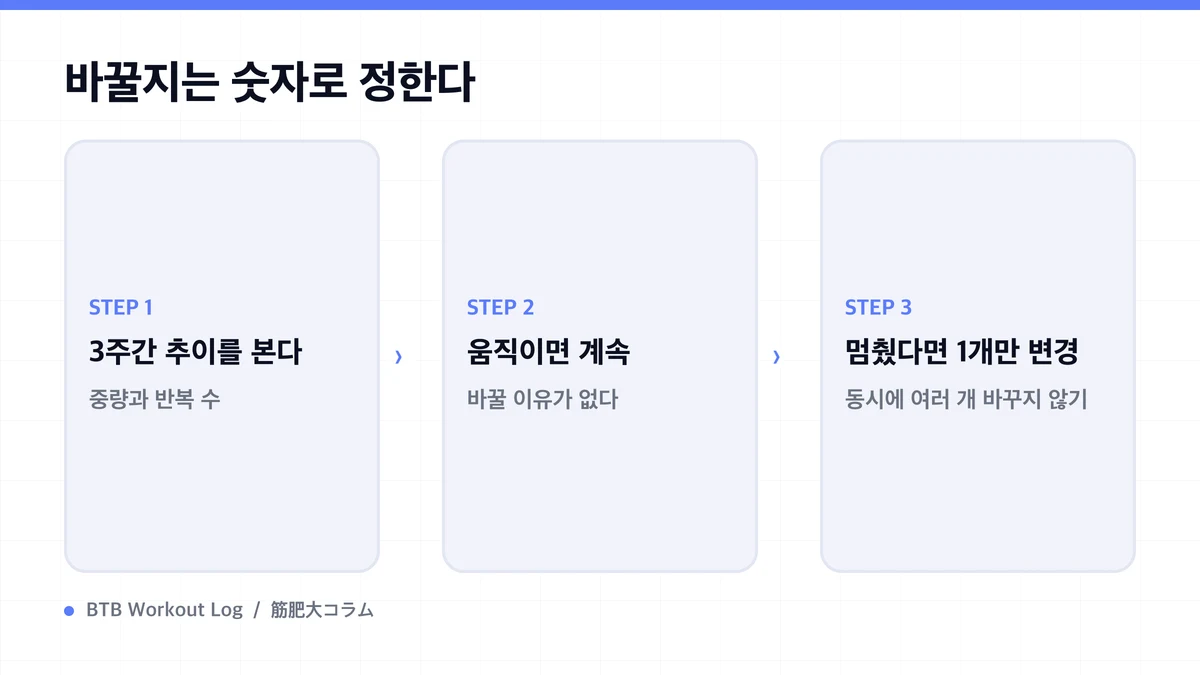
- Load and reps: Increase weight once you hit the upper end of your target 렙 범위.
- Set count: Scale only the muscle groups that need it, tracking 회복 and progress.
- RIR: Start with higher 여력, then taper toward your target intensity each week.
- Frequency distribution: Keep weekly volume steady while tweaking set quality per session.
So it's not fixed routine or variable routine. You can keep a structural baseline and systematically shift only the variables you need.
Why new exercises feel more effective
New exercises trigger soreness, pump, and local fatigue from unfamiliar movement patterns. That distinct sensation makes it seem like your fixed routine stopped working and the new exercise revived growth. But a strong immediate sensation and several weeks of actual 근비대 are not the same thing.
Changes during 정체 also fuel this illusion. When you swap exercises, you often simultaneously drop weight, reduce sets, use pain-free angles, or recover your motivation. Later numbers improve, but "new exercise" may not be why. The real drivers could be fatigue clearing or better tension on the target muscle.
That said, if boredom kills your focus and consistency, planned variation helps. Enjoyment is a real driver of adherence. The key is separating two goals: ditching tedium versus boosting 근비대 stimulus. Keeping them distinct sharpens your next call.
Separate reasons to keep lifts from reasons to switch them
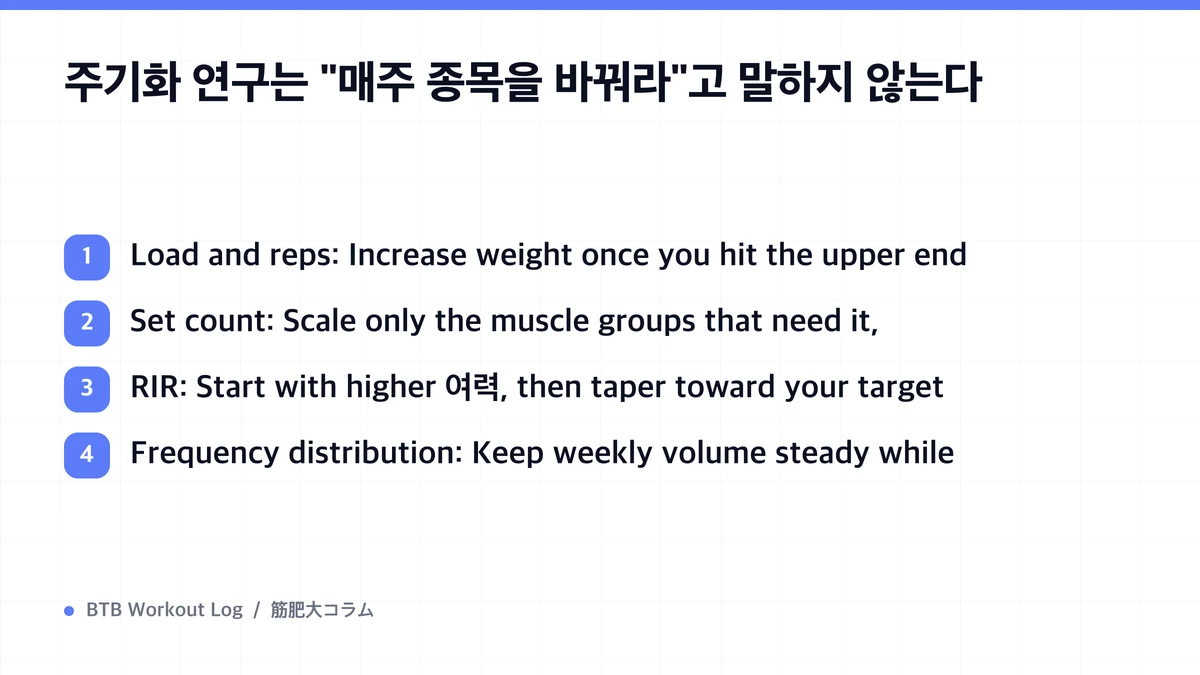
Don't swap exercises just because a deadline passed. Judge whether your current routine is still doing its job. A single off day doesn't warrant a full overhaul—sleep, nutrition, prior activity, and measurement error all bounce the same lift's numbers around.
| Keep it | Consider changing |
|---|---|
| Weight, reps, and 여력 trend up under the same conditions | Multiple sessions show 정체; other adjustments haven't helped |
| You're consistently loading the target muscle | Pain or discomfort persists despite form tweaks |
| You can 회복 the weekly volume and maintain quality next session | Overlapping roles tank your set quality late in the workout |
| It fits your setup and life without strain | Equipment, time, or motivation is the real barrier |
Before switching, name the problem in one sentence. "Weak upper chest trigger," "knee discomfort on squat," or "late-set quality drops." Specific targets narrow your options. If your only reason is "I might adapt," first check the trend in load, reps, RIR, and weekly volume.
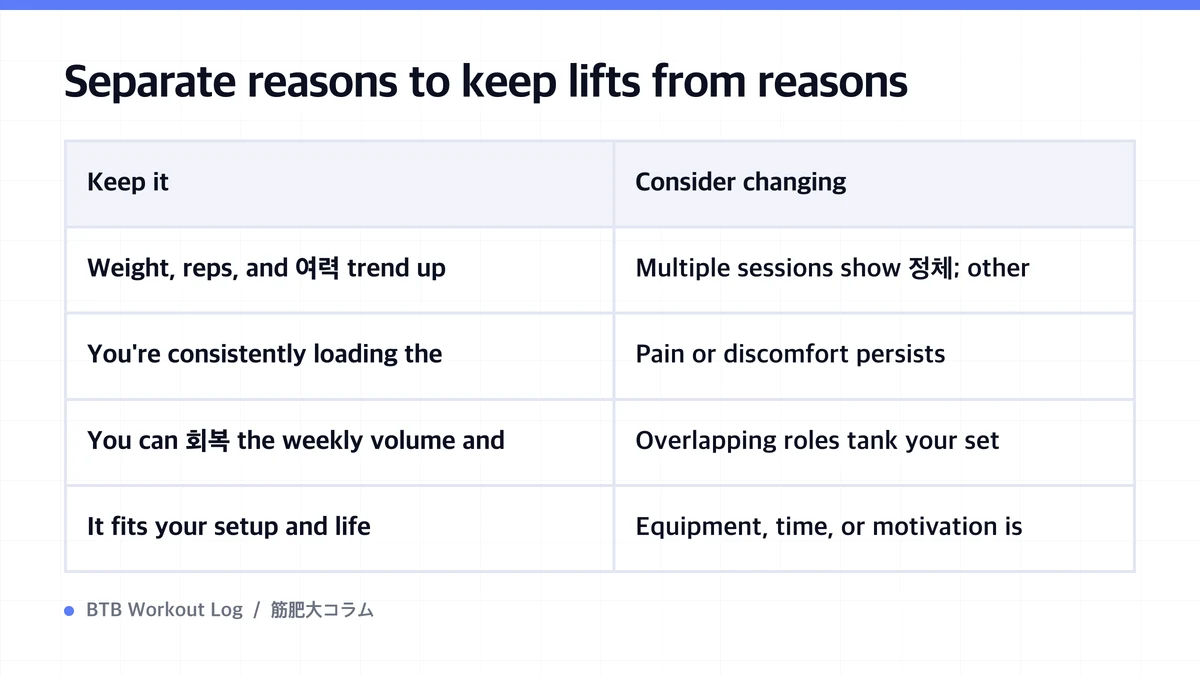
When you do change, go minimal. Swap one accessory while keeping your main lift; shift only the 렙 범위; trim just the set count. Changing everything at once hides what actually worked. The ideas in why too many exercises blur progress and exercise count versus 근비대 both hinge on preserving comparison points.
Use the same program as your growth metric
In practice, you lock in your main lifts and baseline conditions week to week, then compare by matching weight, reps, RIR, and 가동 범위 across sets. Say you're targeting 8–12 reps on a lift: you keep the same weight, accumulate reps, maintain your target RIR, and once you hit the upper limit, bump the weight modestly. After 증량, you rebuild from the lower end of that range. Your written program stays the same, but the stimulus tracks your actual capacity.
Flip side: if you see multiple sessions drop under the same conditions, don't switch exercises yet. First check your weekly set volume, sleep, nutrition, rest between sets, and RIR carryover. If every lift stalls together, it's a 회복 issue. If only one lift sticks, look at technique or exercise fit. A fixed standard is what lets you pinpoint where 정체 happens.
Using your records as decision data makes it easy to tell whether the same program is just coasting or genuinely climbing. Keep the same menu if the numbers move—that's all that matters. BTB Workout Log is where you keep that proof. Changing exercises is a tool, not evidence of growth. If you're making progress inside the same structure, keep it. Swap only the parts with real problems. Run it this way and stability and variation stop being enemies.
자주 묻는 질문
- How many weeks can I stick with the same routine?
- There's no fixed cutoff. Keep running it as long as weight or reps climb with the same form, 가동 범위, and RIR, there's no pain or 회복 lag, and it fits your life. Don't react to one rough session—look at the trend over multiple weeks before making a change.
- If muscles adapt to the stimulus, do I have to switch exercises to keep growing?
- Changing the exercise name isn't required. The same lift can deliver fresh stimulus if you push weight, reps, volume, or RIR upward as you get stronger. Only consider swapping it when numbers flatline and adjusting 회복 or load strategy doesn't budge it.
- If I hit a plateau, should I rebuild my entire routine?
- First split: is everything stalling or just one lift? Full stall points to 회복 or weekly volume; single lift points to technique or fit. Fix only the variable that's broken. A total overhaul blurs cause and effect.
정리
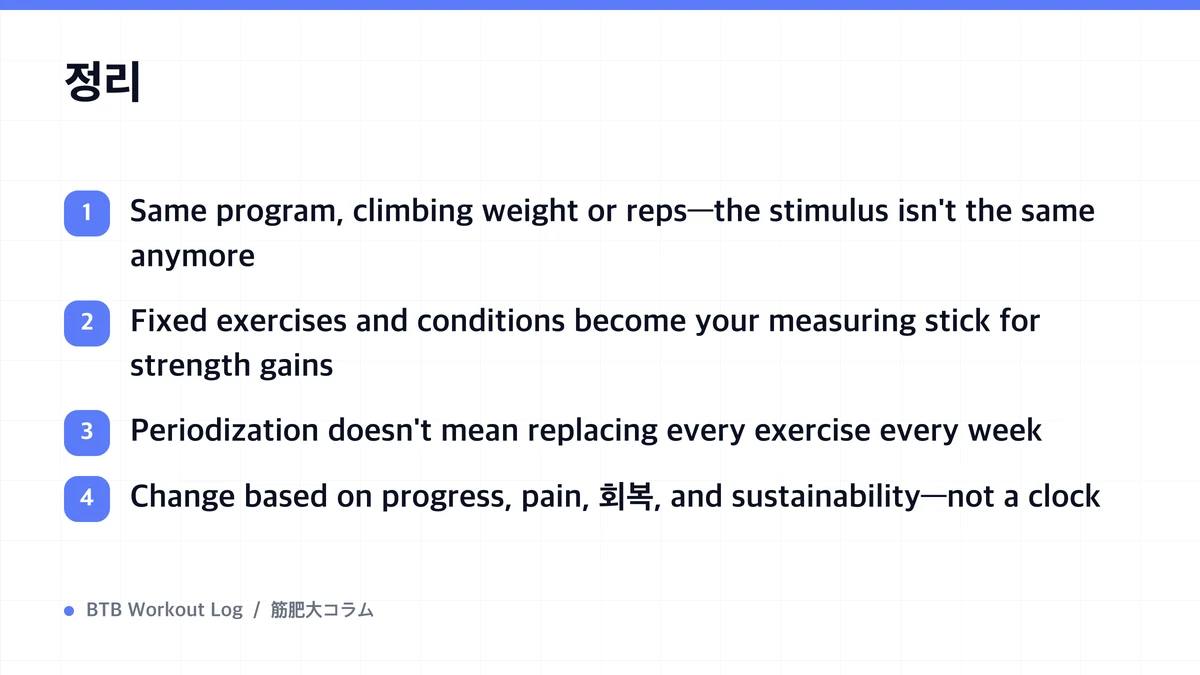
- Same program, climbing weight or reps—the stimulus isn't the same anymore
- Fixed exercises and conditions become your measuring stick for strength gains
- Periodization doesn't mean replacing every exercise every week
- Change based on progress, pain, 회복, and sustainability—not a clock
참고문헌
- ACSM Position Stand: Progression Models in Resistance Training for Healthy Adults
- Periodization, Strength and Muscle Hypertrophy: Systematic Review and Meta-analysis
- Linear vs Daily Undulating Periodized Training and Hypertrophy: Meta-analysis
- The Influence of Frequency, Intensity, Volume and Mode of Strength Training on Whole Muscle Cross-sectional Area in Humans