'무거울수록 근비대에 유리하다'고는 할 수 없다 | 고중량 신앙을 연구로 확인
무거운 무게는 근비대에 유용한 중요한 수단이지만, 무게가 무거울수록 근비대 자극이 커지는 것은 아닙니다. 충분한 노력도, 안정적인 동작, 회복 가능한 볼륨을 충족할 수 있는 범위 내에서 종목별로 다루기 좋은 무게를 선택하는 것이 더 합리적입니다.
최대 근력을 늘리는 것과 근육을 크게 하는 것을 구분하면, 무거운 무게가 도움이 되는 상황과 무게를 줄여서 목표 근육에 질 높은 세트를 쌓을 수 있는 상황이 보입니다.
무거운 무게가 항상 유리한가?
고중량에는 명확한 가치가 있습니다. 먼저 1RM에 가까운 무게를 들어올리는 능력, 즉 최대 근력을 늘리려면 무거운 무게를 실제로 다루는 연습이 유리합니다. 무거운 바벨을 안정적으로 다루는 기술과 강한 힘을 짧은 시간에 발휘하는 능력은 부하 특이성이 있어서 가벼운 세트만으로는 충분히 연습할 수 없습니다.
다음으로 고중량 세트에서는 첫 번째 반복부터 큰 힘이 필요합니다. 저부하 세트처럼 긴 반복을 거듭할 필요 없이 높은 노력도에 빠르게 도달할 수 있고, 세트 시간을 단축할 수 있습니다. 스쿼트, 벤치프레스, 로잉처럼 자세가 안정적이고 무거워져도 목표 근육에 부하를 유지할 수 있는 종목이라면 고중량은 최대 근력과 근비대를 동시에 노린 실용적인 선택입니다.
또한 장기적으로 이전보다 무거운 무게를 같은 횟수, 같은 RIR, 같은 가동 범위로 들어올릴 수 있게 되는 것은 유력한 진전의 하나입니다. RIR은 세트 종료 시 "추가로 몇 회 더 할 수 있는가"를 나타내며, RIR 2라면 한계까지 약 2회를 남긴 상태입니다. 조건을 맞춘 무게 증가는 트레이닝 능력이 향상되었을 가능성을 보여줍니다.
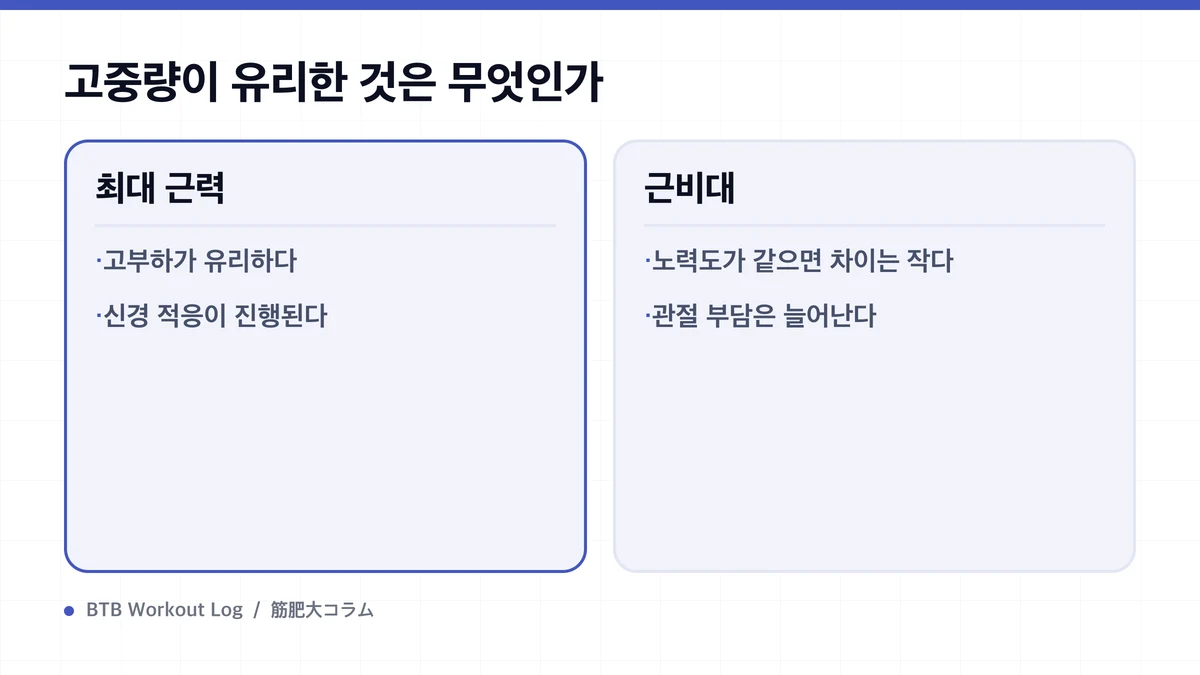
문제는 여기서 "최대 근력에는 고중량이 유리하다" "무게 증가는 진전이 될 수 있다"를 넘어 모든 종목에서 무거울수록 근비대된다고 일반화하는 것입니다. 고중량을 선택할 수 있다는 것과 항상 고중량을 선택해야 한다는 것은 같지 않습니다.
근비대 자극은 무게만으로 결정되지 않는다
근비대에서 중요한 것은 외부 무게 자체가 아니라, 활동 중인 근섬유가 충분한 장력을 받는 세트를 반복하고 그 자극에서 회복하는 것입니다. 고부하에서는 초기 단계부터 큰 힘이 필요합니다. 반면 저부하에서도 한계에 가까워질수록 처음에는 참여하지 않던 운동 단위들이 동원되고, 마지막 반복은 높은 노력도를 요합니다. 메커니즘과 성립 조건은 동일하지 않지만, 결국 넓은 범위의 부하에서 근비대가 일어날 수 있는 이유입니다.
이 부분은 고중량과 고반복 비교에서 다루는 핵심 논점입니다. 다만 "가벼워도 된다"를 "편하게 멈춰도 된다"로 바꿔 읽으면 안 됩니다. 부하가 낮을수록 한계까지의 반복 횟수가 많고, RIR을 크게 남기면 충분한 노력도에 도달하지 못할 가능성이 있습니다. 가벼운 무게로 근비대되는 이유는 무조건적인 저부하 우위가 아니라, 세트를 성립시키는 노력도를 포함한 이야기입니다.
반대로 무거운 것이 자동으로 좋은 세트가 되는 것은 아닙니다. 무게를 올린 결과 가동 범위가 줄어들고, 반동이 늘어나고, 목표 근육보다 보조 근육이나 자세 유지가 먼저 한계에 도달하고, 세트당 반복 횟수가 너무 적어 날마다 성적이 불안정해지는 등의 문제가 생깁니다. 3회만 가능한 무게로도 근비대는 일어날 수 있지만, 근비대를 위한 모든 세트를 그 영역으로 몰아줄 필요는 없습니다. 자세한 조건은 3회만 가능한 고중량 검증에서 따로 다룹니다.
무게는 자극을 만드는 변수 중 하나입니다. 반복 횟수, RIR, 가동 범위, 폼, 세트 수, 휴식, 빈도를 무시하고 kg만으로 세트의 가치를 순위 매길 수는 없습니다.
Research shows building muscle isn't a simple linear relationship with lifting heavier weight
A 2017 meta-analysis by Schoenfeld et al. grouped studies comparing low load (≤60% 1RM) versus high load (>60% 1RM), finding that muscle growth differences were minimal, while strength gains favored the heavier loads. Crucially, the reviewed studies used sets taken to momentary failure—not just matching reps with lighter weight. The takeaway is: "When effort is controlled, the usable load range for hypertrophy is wider than commonly assumed." This doesn't mean load and intensity don't matter; it means they're not the only factors.
Mitchell et al.'s 2012 study on single-leg knee extensions in young men found no difference in quadriceps growth after 10 weeks between 30% 1RM for 3 sets and 80% 1RM for 1 or 3 sets, both taken to failure. A 2025 study on bicep curls and knee extensions in healthy young men showed similar hypertrophy between 30–40% 1RM and 70–80% 1RM when both went to failure. Research across age groups consistently points in one direction: load alone doesn't determine growth.
That said, you can't transplant these average findings wholesale to every person and every exercise. Lab-controlled proximity to failure rarely translates exactly to daily training, and tolerance for the breathlessness and discomfort of high-rep, low-load work varies individually. Change the population, measurement site, lift, or duration, and responses shift.
What research refutes isn't heavy weight itself, but the oversimplification that "heavier always equals more growth." Even if average hypertrophy plateaus at similar levels, strength gains, time efficiency, joint stress, and set sustainability differ. In practice, you still choose based on your goal and the lift.
Why heavy weight looks like the report card for muscle growth
Load is the most visible metric. You know instantly whether you added plates. Muscle growth unfolds over weeks to months and can't be confirmed in a single session. This time lag makes short-term strength numbers easy to confuse with long-term hypertrophy itself.
The relationship between muscle size and strength reinforces the confusion. Bigger muscle provides more force capacity, but 1RM depends on more than mass: technique, neural adaptation, range of motion, and equipment familiarity all drive gains. Flip it: if rep ranges or exercises change, hypertrophy may progress without immediately boosting your 1RM in a given lift. Don't treat two correlated variables as if they're the same phenomenon.
Heavy weight also creates the psychological sensation of "real effort." Pre-set tension, strong bracing, and dropping bar speed feel like hard work. By contrast, a set with medium weight, locked-in form, and reps that drive the target muscle to its limit can look modest on paper. But the visual drama or sense of accomplishment doesn't directly measure stimulus to the working muscle.
Add the myth that every weight jump counts as progressive overload, and dropping load starts to feel like regression. In truth, if you changed the exercise, deepened range of motion, tightened form, or adjusted for fatigue, a lower kg doesn't mean you've gotten weaker.
In practice, choose a rep range you can repeat and progress—not the absolute heaviest weight you can lift
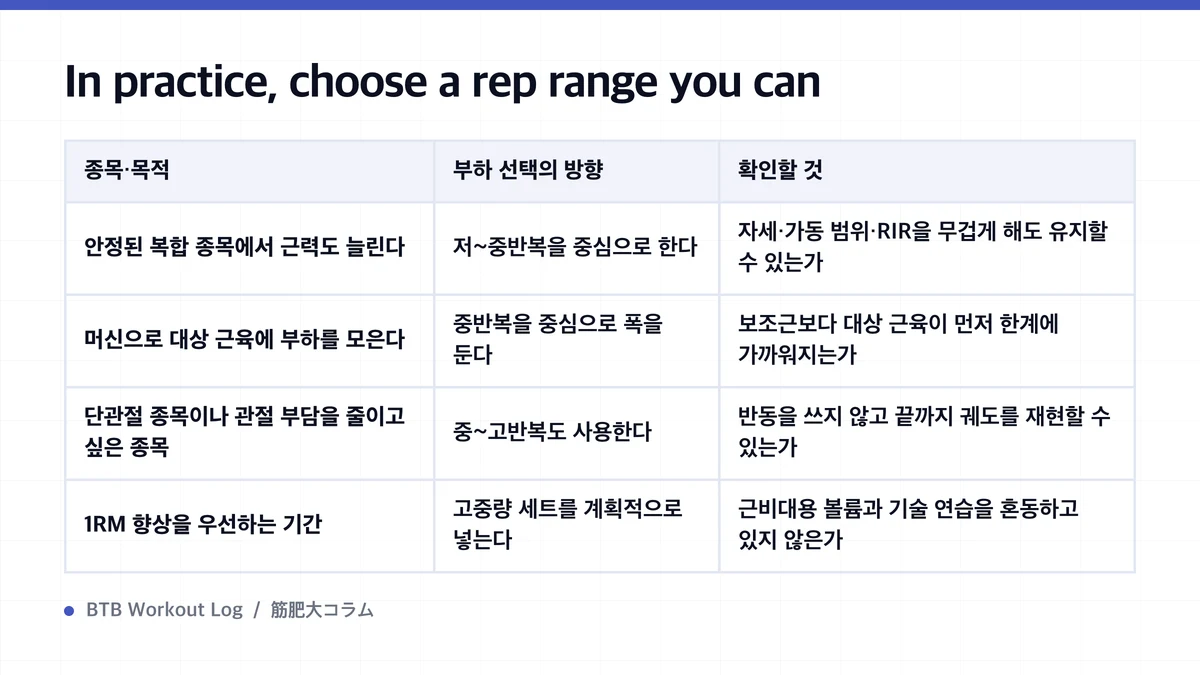
부하는 "몇 kg까지 들 수 있는가"가 아니라 목표 근육에서 높은 품질의 반복을 쌓고, 다음에도 진전을 시도할 수 있는가로 선택합니다. 먼저 종목별로 폼과 가동 범위가 안정되고 목표 RIR을 판단하기 쉬운 렙 범위를 찾습니다. 절대적인 정답은 아니지만, 다음과 같이 역할을 나누면 설계하기 쉬워집니다.
| 종목·목적 | 부하 선택의 방향 | 확인할 것 |
|---|---|---|
| 안정된 복합 종목에서 근력도 늘린다 | 저~중반복을 중심으로 한다 | 자세·가동 범위·RIR을 무겁게 해도 유지할 수 있는가 |
| 머신으로 대상 근육에 부하를 모은다 | 중반복을 중심으로 폭을 둔다 | 보조근보다 대상 근육이 먼저 한계에 가까워지는가 |
| 단관절 종목이나 관절 부담을 줄이고 싶은 종목 | 중~고반복도 사용한다 | 반동을 쓰지 않고 끝까지 궤도를 재현할 수 있는가 |
| 1RM 향상을 우선하는 기간 | 고중량 세트를 계획적으로 넣는다 | 근비대용 볼륨과 기술 연습을 혼동하고 있지 않은가 |
예를 들어 사이드 레이즈에서 무게를 올릴 때마다 반동과 승모근의 관여가 늘어난다면, 일단 무게를 낮추고 일정한 궤도로 반복을 쌓는 쪽이 비교하기 쉬워집니다. 반대로 체스트 프레스에서 15회 이상이 심폐적으로 힘들어 가슴이 한계에 가까워지기 전에 집중이 끊긴다면, 조금 무겁게 하고 횟수를 줄이는 선택이 있습니다. 고중량인지 저중량인지를 신조로 삼지 말고, 종목 안에서 일어나고 있는 제약에 맞춥니다.
무게를 올리는 조건도 미리 정합니다. 설정한 렙 범위의 상단에 같은 가동 범위, 폼, 휴식, 목표 RIR로 도달했다면, 다음에는 최소 단위로 올립니다. 증량 후에도 하한을 유지하지 못하면 원래대로 되돌리고 횟수를 늘립니다. 이것은 고중량을 피하는 방법이 아니라, 점진적 과부하를 동작 품질과 함께 진행하는 방법입니다.
Judge your load choice by the next sets and by week-to-week trends
A single top set won't tell you if the weight is appropriate. For the same exercise, assess weight, reps per set, RIR, 가동 범위, form breakdown, and rest intervals together. If only the first set at a heavier weight succeeds but subsequent set reps drop sharply and you can't sustain 하드 세트 across the week, the choice warrants reconsideration for 근비대 work.
Over 2–4 weeks, check three things. First, did you get more reps at the same weight and RIR? Second, after weight increases, did you maintain your target 렙 범위 and movement quality? Third, are joint discomfort or output drops before the next session increasing? If progress happens at both heavier and lighter settings, choose by preference, time availability, and exercise fit. If only one shows progress, that gap tells you what load suits you best.
Logging exists not to celebrate heavy weight, but to verify whether load changes delivered quality reps and sustained progress.
For exercises where you want to build 최대 근력 too, keep the heavy work. For exercises where target-muscle loading or joint stress becomes problematic, shift toward moderate-to-higher rep ranges. Stop treating every exercise with the same weight philosophy. Vary load by purpose and data—that's the practical way out of the "heavier is always better" trap.
자주 묻는 질문
- Is 5 reps or 12 reps better for 근비대?
- Both work for 근비대 if you maintain sufficient effort and movement quality. 5 reps tends to favor 최대 근력 gain too, while 12 reps makes hitting higher rep totals easier. Choose based on exercise stability, joint loading, how clearly you can judge RIR, and how many reps you can keep in following sets.
- Does light weight you can do for 30 reps build muscle as well as heavy weight?
- 근비대 can happen if you push near failure and keep the target muscle under tension throughout. However, high reps make you quit early from breathlessness or the burn, and RIR judgment gets harder. Average results being similar doesn't mean 30 easy reps achieves the same thing.
- If the weight I'm using keeps going up, is my load setting correct?
- That's strong progress, but weight alone doesn't confirm it. Verify the weight climbed at the same 가동 범위, form, rep count, and RIR. If momentum or helper-muscle involvement increased, stimulus to the target muscle may not have improved—so check subsequent sets and trends across several weeks too.
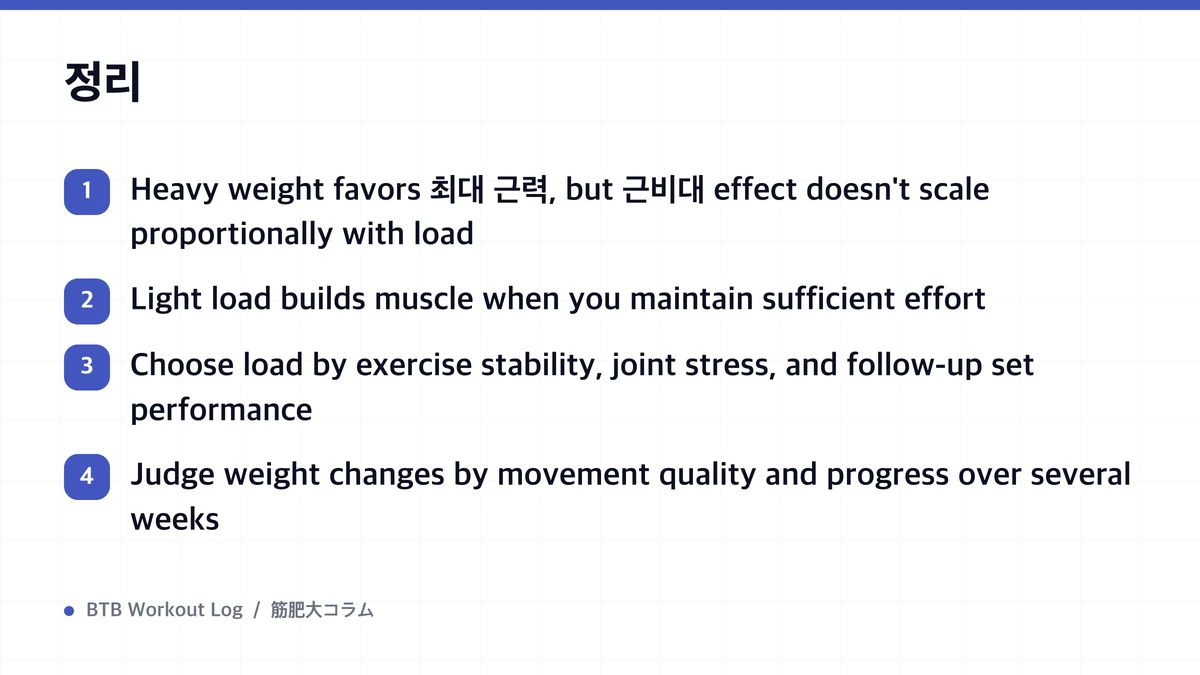
정리
- Heavy weight favors 최대 근력, but 근비대 effect doesn't scale proportionally with load
- Light load builds muscle when you maintain sufficient effort
- Choose load by exercise stability, joint stress, and follow-up set performance
- Judge weight changes by movement quality and progress over several weeks