側平舉該用重的還是輕的?想練出圓潤肩膀選哪個?三角肌中束的正解
側平舉以低至中等重量為主比較好上手,但如果能維持目標動作幅度和姿勢,高重量也能用。單從三角肌中束肌肉肥大來看,重量不是越重越有利。
該比較的不是啞鈴的數字,而是能否用三角肌中束完成組次、能否重複動作、能否把進度帶到下一次訓練。
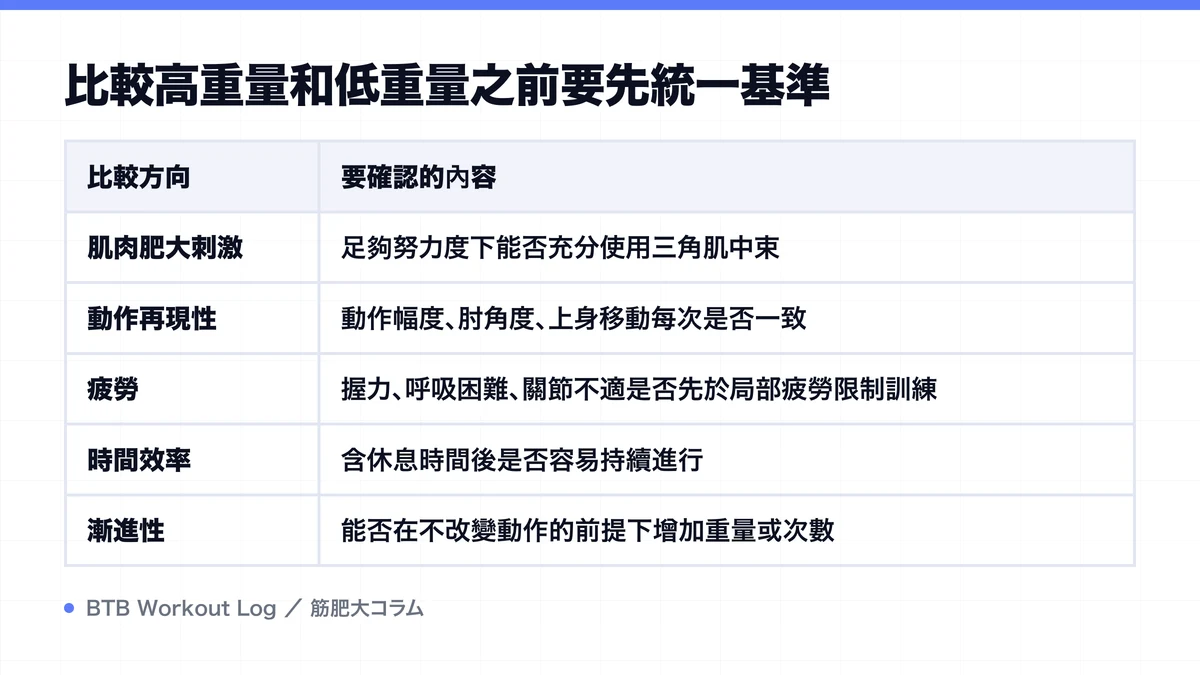
比較高重量和低重量之前要先統一基準
這裡說的高重量側約為8~12次時RIR1~3的負荷,低重量側為15~30次時RIR1~3的負荷。RIR是「還能做幾次」的餘力估計。邊界沒有絕對標準,應理解為同一個人做同一動作時的相對比較。
即使只改變重量,重的一側卻出現上身反動增加、肘彎曲變大、手臂上舉高度降低的情況,實際上就是在比較不同的動作。啞鈴、纜繩、機械的阻力方式都不同,所以要先固定器材和姿勢。然後從以下五個方面比較,選擇會更清楚。
| 比較方向 | 要確認的內容 |
|---|---|
| 肌肉肥大刺激 | 足夠努力度下能否充分使用三角肌中束 |
| 動作再現性 | 動作幅度、肘角度、上身移動每次是否一致 |
| 疲勞 | 握力、呼吸困難、關節不適是否先於局部疲勞限制訓練 |
| 時間效率 | 含休息時間後是否容易持續進行 |
| 漸進性 | 能否在不改變動作的前提下增加重量或次數 |
一般負荷比較的全貌可見高重量和高次數的運用,但側平舉動作幅度小、重量級別粗,判斷會比較困難。
肌肉肥大效果不只由重量決定
阻力訓練總體研究顯示,在努力度足夠的前提下,寬廣的負荷範圍都可能產生肌肉肥大。高負荷在提升最大肌力上較有優勢,但肌肉肥大幅度不一定總是更大。這項結論不是直接對側平舉的比較,所以不能說「什麼重量都一樣」。但以「啞鈴越重三角肌中束越大」為前提的根據並不充分。
低重量側成立的條件是不只做次數,還要充分接近目標肌的極限。20次就停止但還能再做10次的話,就不算是充分的硬組。反之高重量側要是三角肌中束疲勞前就無法不借力舉起,那組訓練的結束理由也需要檢視。兩者都應以按計畫動作保持在剩餘1~3次左右為起點。RIR的用法可查看RIR實踐指南。
因此從肌肉肥大效果看沒有明確的勝負。差異主要取決於實際執行面——本人能否將努力度真正投入到三角肌中束,而非研究上的平均效應。
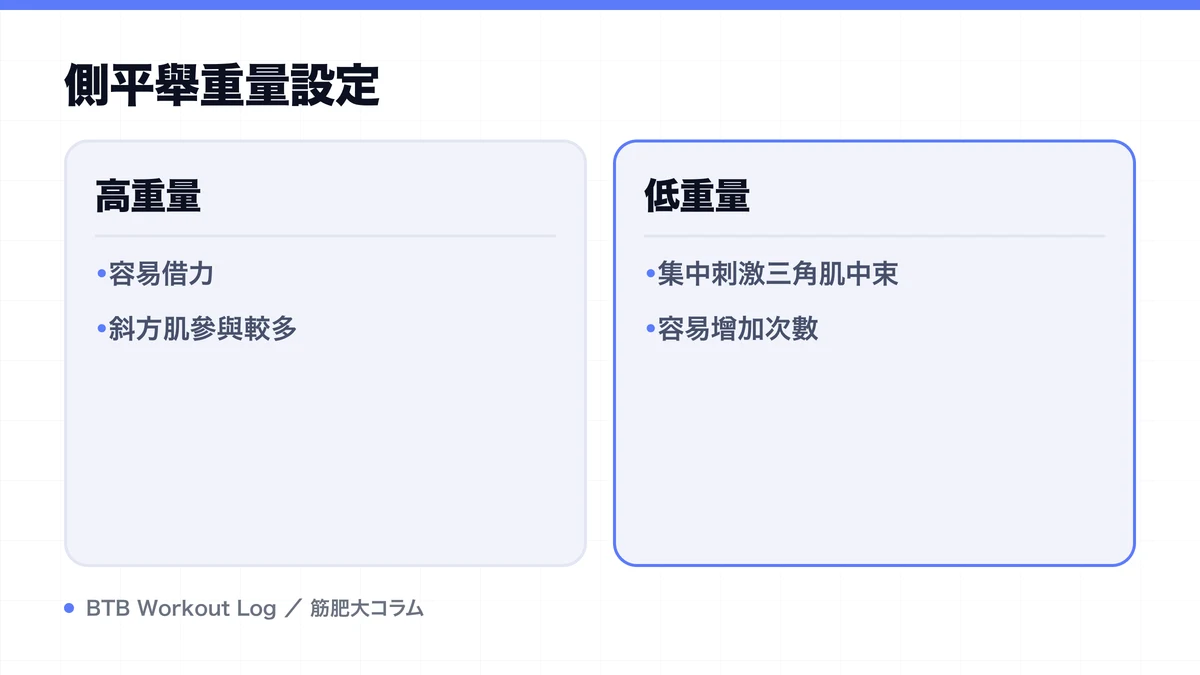
低重量側通常更容易鎖定三角肌中束
側平舉是肩關節外展的單關節動作,不像推舉那樣用多個大肌群推動大重量。肩部動作因種目而異會影響三角肌各部的活動,選擇側平舉的意義就在於反覆執行中束導向的動作,而非舉起重物。肩部整體訓練結構結合三角肌的分化鍛鍊思考會更清楚。
低重量側容易保持手臂上舉高度、肘彎曲幅度、上身傾斜、下降位置的一致性。即使組的後期也能維持這些標準的話,次數增加就能直觀看出進度。不過太輕的話容易先被灼熱感或注意力下降影響,超過30次的組會花很多時間。
高重量側能在短時間內產生大力量,但上升時馬上出現上身搖晃、聳肩、動作幅度縮小的話,就無法和前一次比較了。用反動做側平舉本身不一定要否定,但那樣的話應另外管理,別混入「嚴格式側平舉」的記錄序列,要作為獨立變式處理。高重量側的合格條件是最後幾次即使動作變慢,既定的動作標準也不能大幅改變。
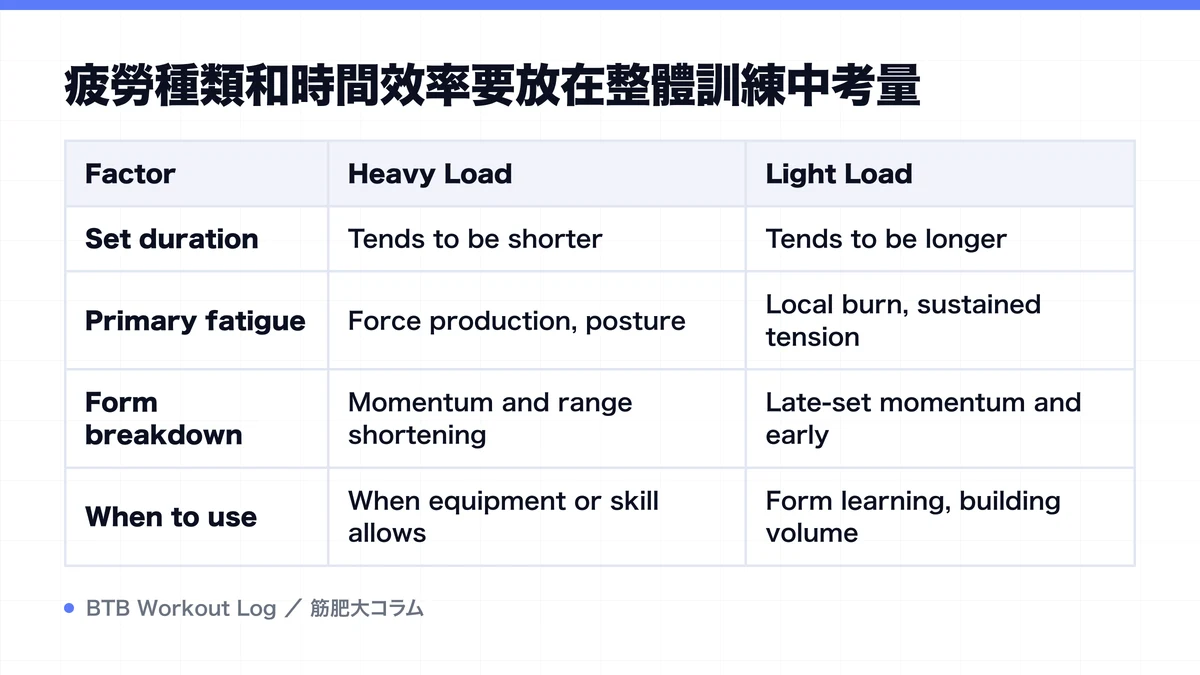
疲勞種類和時間效率要放在整體訓練中考量
| Factor | Heavy Load | Light Load |
|---|---|---|
| Set duration | Tends to be shorter | Tends to be longer |
| Primary fatigue | Force production, posture maintenance | Local burn, sustained tension |
| Form breakdown | Momentum and range shortening emerge easily | Late-set momentum and early termination |
| When to use | When equipment or skill allows intent to hold across lower rep counts | Form learning, building volume while monitoring joint feedback |
Heavy loads mean fewer reps, so a single set saves time. But if you need longer rest between sets to reset posture, or invalid sets pile up for form checks, your total session efficiency doesn't improve. Light loads also exact a cost: chasing 30 reps to failure every time burns time and comfort, which can wreck focus on subsequent exercises.
Fatigue advantage doesn't run one direction. Heavy load stress on joints and posture feels different from local light-load fatigue. Factor in recovery to the next session, carryover to pressing movements, and weekly hard set count. Before adding more lateral raises, check your weekly volume first—confirm whether you've only shifted load zones or actually increased total tonnage.
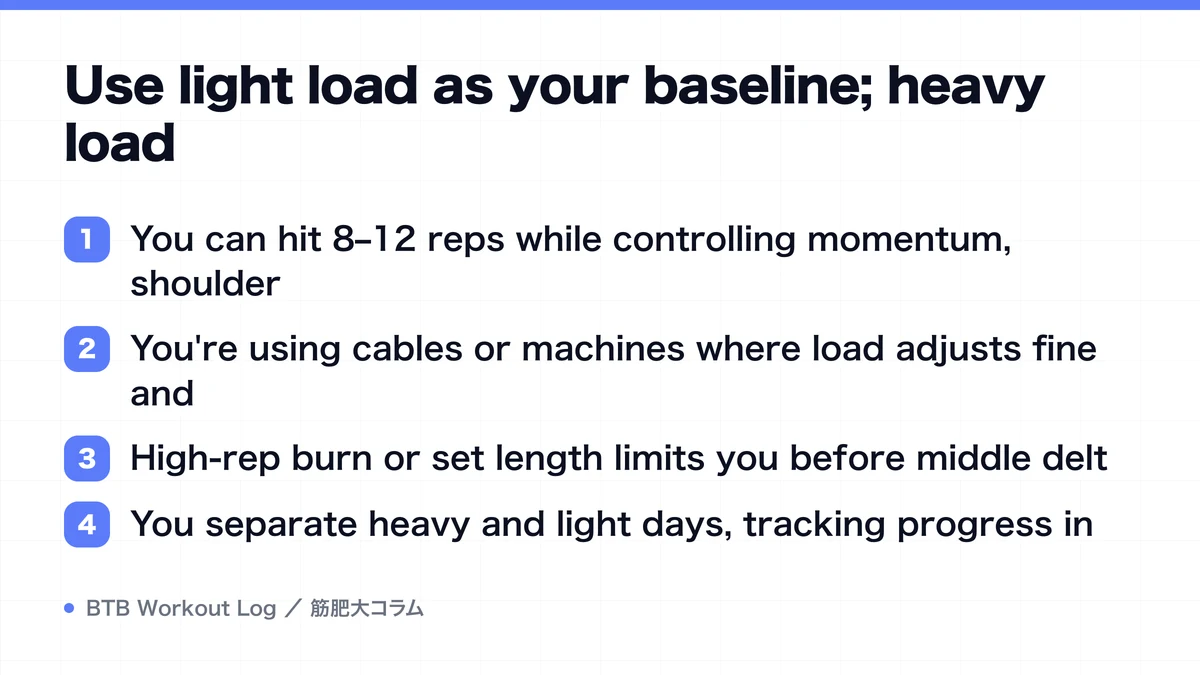
Use light load as your baseline; heavy load only when conditions allow
For dumbbell lateral raises, a load that lets you hold form for roughly 12–20 reps works best as a starting point. This isn't because light is the only answer, but because it's the easiest place to balance form and effort. Once you approach 20 reps while maintaining RIR and range of motion, go heavier and work back up from the lower end of that range. See rep range guidelines for the full protocol.
When heavy load makes sense
- You can hit 8–12 reps while controlling momentum, shoulder shrug, and range shortening
- You're using cables or machines where load adjusts fine and posture stays stable
- High-rep burn or set length limits you before middle delt fatigue does
- You separate heavy and light days, tracking progress in different rep ranges
When light load makes sense
- Heavier weight triggers trunk momentum or traps-dominant mechanics
- The jump to the next dumbbell is too large to hold your target rep count
- You want to layer sets at one load while staying injury-free and on a consistent arc
- You're cementing form and learning what middle delt drive feels like
Even when weight doesn't climb, adding reps at the same load and form counts as progressive overload. Log more than just weight and reps: note RIR, range-of-motion standards, and whether you used momentum.
常見問題
- What kg counts as heavy for lateral raises?
- It shifts with your size and equipment, so kg alone doesn't answer it. In this article, we define heavy as a load where your chosen form reaches RIR 1–3 at around 8–12 reps. If momentum or range shortening climbs, that weight falls outside the comparison.
- Can you build muscle on light lateral raises if you do 30+ reps?
- Yes, if you push close enough to true failure. But as reps climb, burn and time become the bottleneck first. If you need well over 30 reps to hit RIR 1–3, a small weight bump usually manages better.
- Is using momentum on heavy lateral raises pointless?
- Not necessarily pointless, but treat it as a separate variation, not strict form. Keep momentum and range identical each set, confirm your posture breaks before your middle delt gives out, and log it separately from your strict reps.
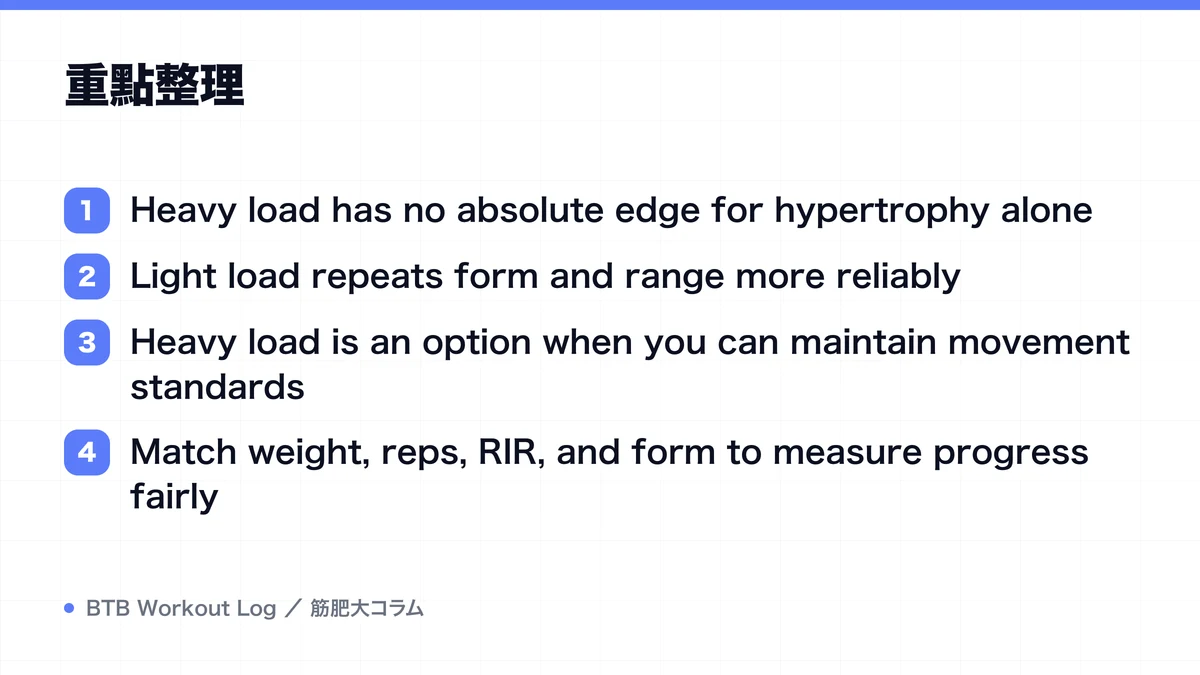
重點整理
- Heavy load has no absolute edge for hypertrophy alone
- Light load repeats form and range more reliably
- Heavy load is an option when you can maintain movement standards
- Match weight, reps, RIR, and form to measure progress fairly
參考文獻
- Low- vs High-load Resistance Training for Strength and Hypertrophy: Meta-analysis
- Different Shoulder Exercises Affect the Activation of Deltoid Portions
- Training to Repetition Failure or Non-failure: Systematic Review and Meta-analysis
- Proximity-to-Failure and Muscle Hypertrophy: Systematic Review with Meta-analysis