
动作种类加太多,为什么反而看不出进步|给那些很努力却没有成效感的人
增加过多动作会让同一动作在同一条件下重复的机会减少,重量、次数、RIR的变化也就难以分辨——究竟是真正的力量增长,还是仅仅因为动作或顺序不同。
多元刺激本身没有坏处。问题在于随意添加动作而不明确其角色,结果连评估进度的标准也跟着动摇了。
"从多个角度施加刺激就万无一失"的直觉误区
胸部训练可以选平台、上斜、下斜、飞鸟、器械、双杠屈体。选项越多,似乎就越能面面俱到。确实,选择符合关节状态的动作,或组合不同运动方向都有价值。但是,添加新动作的事实与观察到进步的事实根本不同。
肌肉肥大不会快到一眼能看出日均增长。所以通常做法是,用同一动作保持同样的动作幅度和姿态,看在相同余力下能推起的重量或完成的次数如何变化——这是进度的代理指标。如果每次训练都换动作,这把尺子也就每次都在更换。你可能会留下"今天效果不错"、"感觉很新鲜"的印象,但究竟有没有变强就说不清了。
换句话说,关键不在于动作多就直接导致肌肥大停滞。而是,你读取计划成果的分辨率下降了。需要区分的是:你是在追求刺激的全面性,还是在无意中把关键数据打散了。
进度来自"相同条件下与上次的对比"
单纯重量增加,但动作幅度变短、借力增多、只是因为极限冲刺的结果,这未必算得上肌肥大目标的进步。反之,重量相同但姿态、幅度和RIR相同的情况下次数增了,这才是有力的进步。RIR表示"还能做多少下",帮你保持组间的努力程度一致(见RIR使用指南)。
这种对比要成立,需要在一段时间内大致固定动作、器械、姿态、动作幅度、顺序、次数区间。如果这周用杠铃练,下周换哑铃,再下周上器械,数字差异里除了肌力还混进了学习新动作的效应、稳定性差异、不同器械的阻力特性。新动作的次数突然增加,不一定是肌肉短期增长,很可能是你很快适应了这个陌生动作。
渐进超负荷不是每周都往杠上加盘子。而是在相同条件下,循序渐进地提高次数、重量、组间质量。如果没有一个保持比对条件稳定的动作,你就没法判断:过负荷真的在进行,还是只是测量条件改变了。
动作越多,每个数据序列越稀薄
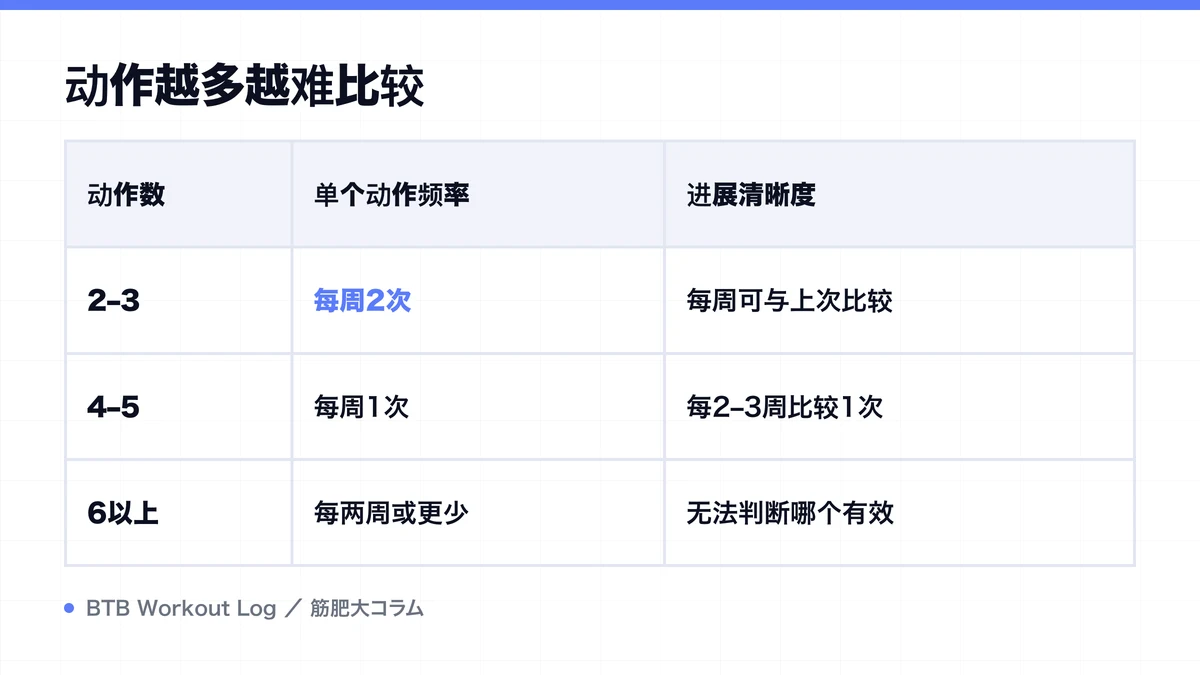
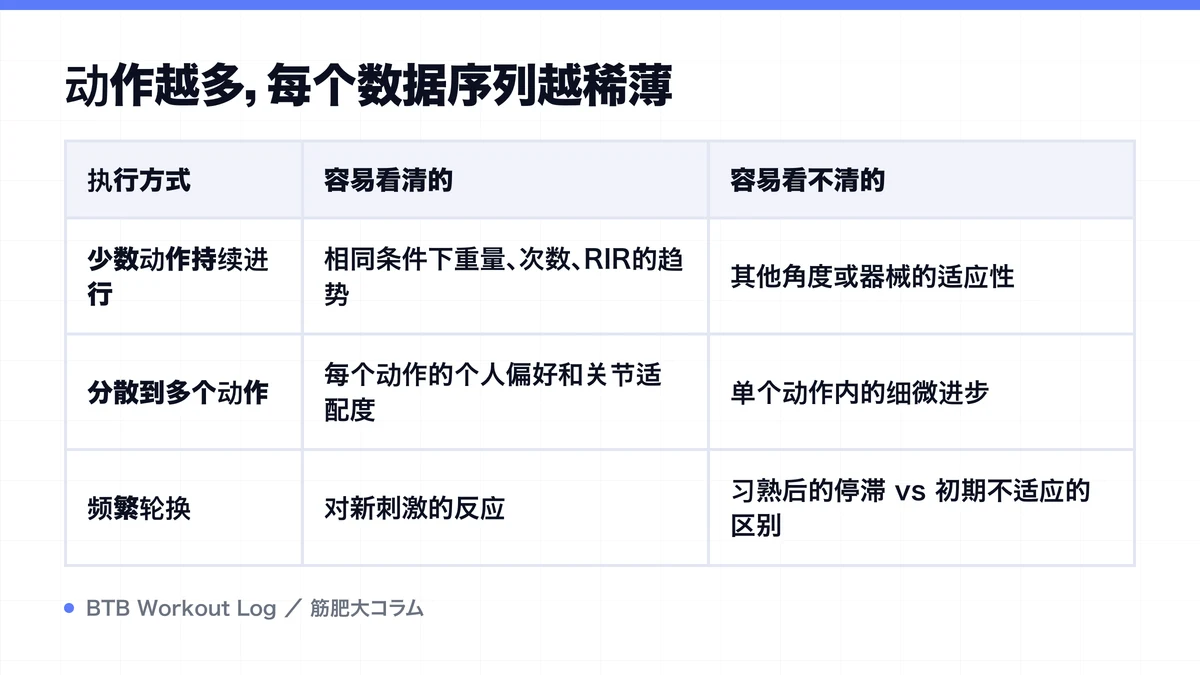
如果把同一肌群的每周训练容量分散到许多动作,每个动作能积累的可比数据就少了。再加上如果每周轮换动作,回到同一个动作的间隔就更长了。上次记录可能已经是几周前的事,这期间睡眠、体重、器械、实施顺序等变量都有机会插入,你就容易把短期波动错当成进步或停滞。
| 执行方式 | 容易看清的 | 容易看不清的 |
|---|---|---|
| 少数动作持续进行 | 相同条件下重量、次数、RIR的趋势 | 其他角度或器械的适应性 |
| 分散到多个动作 | 每个动作的个人偏好和关节适配度 | 单个动作内的细微进步 |
| 频繁轮换 | 对新刺激的反应 | 习熟后的停滞 vs 初期不适应的区别 |
还有个混乱源头是实施顺序。加动作后,原来的第1个动作可能变成了第3个。第3个时的次数下降,不一定是这个推力动作变弱了——很可能是前面动作的局部疲劳在起作用。动作数、顺序、组数一起改,你根本分不出哪个变量在影响数字。
观测的动作越多,越容易"只看上升的数字"。六个动作里一个创了新高,但其他动作在相同条件下都下降了,这还不足以说这个肌群整体在进步。提前选好几个核心动作来评估,能减少只用对自己有利的数据来判断的偏差。
每周的总训练容量本身是肌肥大的重要变量(见训练容量)。但肌群的每周组数相同,不代表单个动作的进度易读程度也相同。把"看总量"的尺度和"追踪单个动作过负荷"的尺度分开操作才实用。
多元性不舍弃,但要消除角色重叠
The goal of narrowing your exercise selection isn't to do full-body training with just a handful of compound lifts. If you have a clear reason—different movement planes, loading a muscle at longer lengths, direct work on a lagging body part, or avoiding movements that don't suit your joints—multiple exercises serve a purpose. The problem is stacking similar exercises "just in case."
When organizing, place an anchor exercise for each muscle group to track progress, then build support around it with accessory exercises that have different roles. For chest, use a horizontal press as your reference point, then add presses at different angles or fly variations as needed. What you keep depends on your overall program design, and there's no fixed exercise count that works for everyone.
Before adding, ask whether a new exercise fills a gap that existing ones don't. If the answer overlaps with something you already do, lower its priority. When swapping accessory lifts, keep your anchor fixed—this gives you a consistent measuring stick even after program changes. Variety and measurability aren't mutually exclusive; separating fixed elements from flexible ones lets you have both.
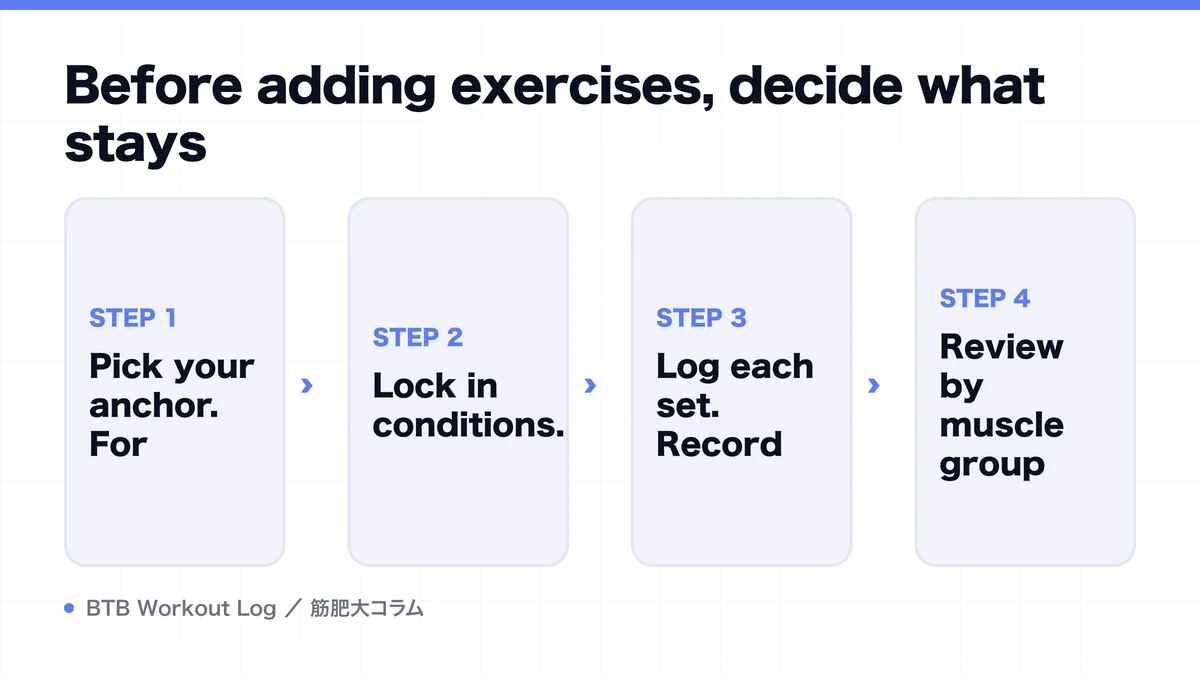
Before adding exercises, decide what stays fixed and what gets recorded
When reviewing your exercise selection, follow this sequence to avoid confusion:
- Pick your anchor. For each muscle group, name the main lift you'll use to track progress.
- Lock in conditions. Keep equipment, form, 动作幅度, exercise order, and 次数区间 as consistent as possible.
- Log each set. Record weight, reps, and set count, plus RIR to account for effort differences.
- Review by muscle group too. Don't just track individual lifts—also monitor weekly 有效组 volume and recovery status for each muscle.
- Change one thing at a time. Pick a reason (discomfort, equipment limits, wrong stimulus, repeated 平台期), then add or swap a single exercise.
One bad session doesn't mean you need more exercises. Daily output fluctuates with sleep and stress, so build a pattern from multiple identical conditions before drawing conclusions. Only when your anchor stalls, accessories plateau, weekly volume and recovery look fine, and you still see no progress—then question exercise selection or imbalanced stimulus. The more data you have, the sharper your judgment: do you need a new lift, or should you push the ones you've got?
A logging app isn't for adding exercises; it connects the data from your fixed conditions to your next decision. Whether to add depends on how many exercises you're doing now and what week-to-week gains you're pulling. BTB Workout Log preserves how often each exercise appears in your rotation.
常见问题
- For muscle growth, how many exercises should I do per body part?
- There's no universal upper limit. Start by keeping a trackable anchor exercise and check whether each accessory has a distinct role. If exercises overlap in purpose and your spacing between sessions is too wide to compare previous lifts, you're adding too much.
- If I stick with the same exercise, won't my muscles adapt and stop growing?
- The same lift isn't stale as long as you're gradually raising weight, reps, or set quality. Switch if you feel joint discomfort, wrong target-muscle connection, or a genuine 平台期 under identical conditions—but there's no need to change every week just for novelty.
- When should I swap out an exercise?
- Not after one bad day. The right time is when you've recorded the same form, order, and RIR multiple times with no progress, and your recovery and weekly volume aren't the culprits. Pain or equipment changes are exceptions to handle early; otherwise, replace one exercise at a time and compare before and after.
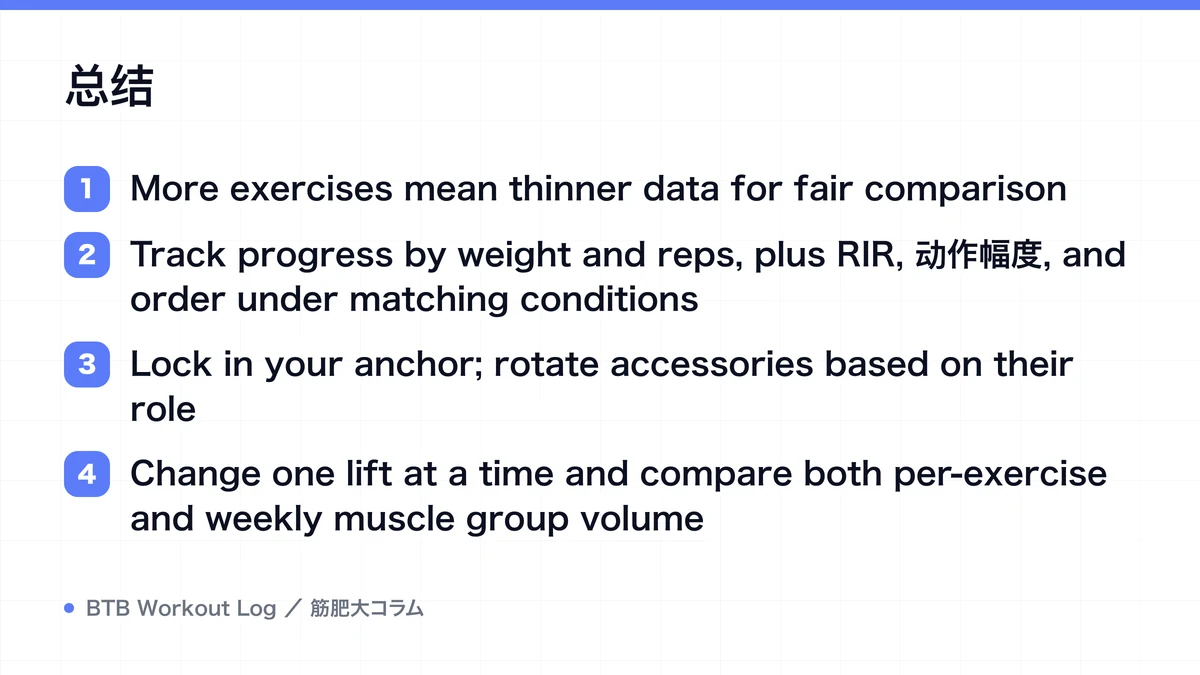
总结
- More exercises mean thinner data for fair comparison
- Track progress by weight and reps, plus RIR, 动作幅度, and order under matching conditions
- Lock in your anchor; rotate accessories based on their role
- Change one lift at a time and compare both per-exercise and weekly muscle group volume