
动作做得越多,肌肉就长得越快?这个想法可能正在拖慢你的进步
只有当新增动作能补足当前训练计划欠缺的动作模式或目标部位刺激时,增加动作才有价值。如果只是加入相似动作,增加的可能不是肌肉肥大效果,而是疲劳和重复训练。
判断标准不在于动作数量,而在于能否高质量地完成足够的、作用各不相同的有效组,并长期在这些动作上持续进步。
Does hitting more exercises actually drive muscle growth?
即便是同一块肌肉,关节角度或动作方向一旦改变,受力较大的部位和动作幅度也会随之变化。比如平板卧推和45°上斜卧推,胸大肌各部分的肌肉激活程度并不均匀。腿部训练也是如此,膝关节大幅度屈伸的动作与以髋关节为中心的动作相比,虽然都是"腿部训练",但其作用是有区别的。
因此,用辅助动作来填补主要动作难以充分刺激的部位和动作,这一想法是合理的。多关节动作提供整体负荷,再用单关节动作补充不足,就是这样的例子。在思考仅做复合动作是否足够时,应该先问的不是"做了多少个动作",而是"还缺什么"。
但是,观察到不同的肌肉激活模式,并不等于增加更多动作变化就能带来更多长期肌肉肥大效果。变化动作可能有其意义,但这并不是无限增加动作的理由。
训练动作数量不是肌肉肥大的"剂量"
误解源于把训练动作数量本身当作刺激量来计算。在肌肉肥大研究中,衡量训练量的核心指标通常是每周每个肌群的组数。5个动作各做1组是5组,2个动作各做3组也是6组。光看动作数量,根本看不出实际的训练强度。
区分是"分散"还是"增加"
把胸部训练从2个动作分散到4个动作,即便每个动作的组数不变,周总组数仍然是12组。刺激的分配改变了,但训练量没有翻倍。反之,如果保持每个动作的组数不变,再添加2个新动作,周总组数就增加了。这时候产生变化的因素,不只是动作数量,还有新增的组数。
周组数与肌肉肥大之间存在剂量反应关系,但增加的总组数并不都有相同的价值。关键在于这些组是否对目标肌群施加了充足的负荷,是否属于能在RIR 1-3次范围内完成的有效组。两者需要区分对待。
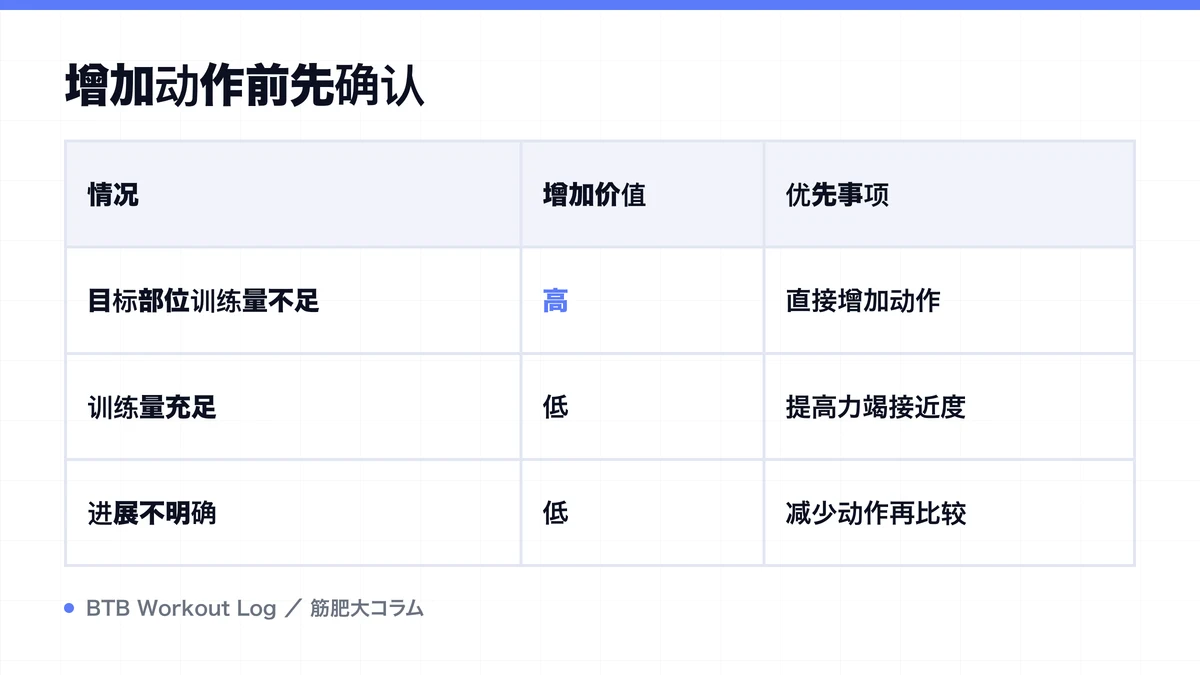
相似的动作越多,后期组数的质量越容易下降
如果在卧推后依次加入胸部推举、哑铃推举,再加上轨迹类似的器械推举,确实会增加训练种目的数量。但这些动作都偏向同一个推的模式,到了后面几组,三头肌或整体疲劳可能比胸肌先到达极限。即使完成了预定的次数,如果有越来越多的组数无法给目标肌肉施加足够的张力,那花费的额外时间就很难说是相应的刺激了。
还有一个成本是,每个种目的练习机会被摊薄了。如果每周轮换8个种目,那么每个种目在相同条件下重复的次数就会减少,动作稳定性和负荷设定都需要花更多时间来调整。肌肉肥大未必不需要新鲜感,但如果在增加重量或次数之前就换到下一个种目,就会很难积累渐进超负荷。
此外,增加的组数不仅影响局部疲劳,还会影响关节压力、训练时间和下次训练前的恢复。即便增加的组数在当时泵感很强,但如果后续主力种目的重量或次数持续下降,从整周来看可能反而是不利的。
Research Shows the Power of "Variable Combinations Done Right"
肌肉肥大不是靠单纯的种目数字来评判的。频率、强度、训练量、训练方式等多个因素同时起作用,即便是同样的3个动作,如果组数、RIR、动作幅度、频率不同,训练计划的内容就完全不一样了。
周训练量增加确实会带来更大幅度的平均肌量增长。但这不等于"种目越多增长越大"这样的规律。无论是把有效组数集中在少数几个动作上,还是把同样的总量分散到多个动作中,真正需要比较的是目标肌群的刺激强度、组的质量、恢复状况和持续进步。
一般来说,动作角度的确会改变肌肉活动的分布,但仅凭这一点判断不了长期的肌肉肥大效果。实际操作中,我们的想法不是"种目越多越好",而是"用必要的辅助动作补足主要动作无法有效刺激的部分"。这也有别于对重复同样训练菜单的误解——认为每周必须制造变化。
为什么会觉得"种目越多效果越好"
新动作因为不习惯,容易产生强烈的泵感和延迟肌肉酸痛,这看起来像是额外的增长。如果在加入新动作的同时还增加了组数,那就无法区分变化到底来自动作的多样性,还是单纯的训练量增加。新鲜感和工作量的叠加,使人容易误认为种目数本身就是原因。
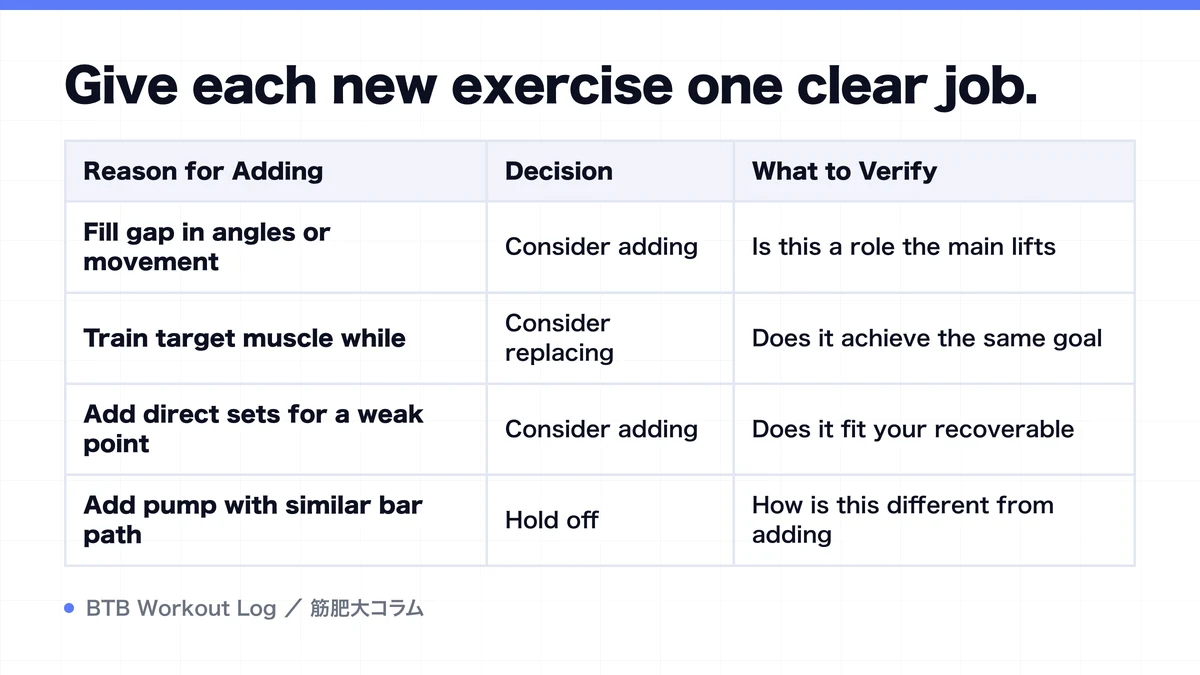
Give each new exercise one clear job.
Before adding an exercise, answer in one sentence: "What does this exercise fill in?" If your answer is only "I want different stimulus" or "I'm bored," that's not a strong enough reason. Comparing roles with existing exercises makes the decision clearer.
| Reason for Adding | Decision | What to Verify |
|---|---|---|
| Fill gap in angles or movement patterns | Consider adding | Is this a role the main lifts miss? |
| Train target muscle while avoiding pain | Consider replacing | Does it achieve the same goal more stably? |
| Add direct sets for a weak point | Consider adding | Does it fit your recoverable weekly volume? |
| Add pump with similar bar path | Hold off | How is this different from adding sets to existing lifts? |
Lock in anchor lifts; change one thing at a time
First, keep the anchor exercise for each muscle group so you can compare weight, reps, and RIR side by side. Then add one supplemental exercise to address the gap, and observe for several weeks without changing other variables significantly. The reason adding too many exercises clouds judgment is explained in detail in the section on comparing progress.
The right exercise count is determined by data after adding
Whether adding an exercise worked is judged not by how you felt that day, but by the trend over 3–6 weeks. If you can load the target muscle consistently with the new lift, maintain or improve weight and reps on your anchor lifts, and recover by the next session, the exercise earns its spot. If late-session reps drop sharply, joint discomfort increases, your main lift plateaus, or only the clock gets longer, it's a candidate for removal.
The order to check: ① Is there a gap in roles? ② Is weekly 有效组 volume insufficient? ③ Can you keep each set high-quality after adding? ④ Is there progress in weight or reps over several weeks? ⑤ Are you recovering? This order shifts your mindset from "just add more exercises" to "add only what's needed."
Using your training log as a reference lets you compare changes before and after the addition by the same standard.
常见问题
- How many exercises should I do per muscle group?
- There's no fixed answer. First, lock in the weekly 有效组 volume on your anchor lifts, then add only if you need to fill gaps in angles, movement patterns, or weak points. Prioritize set quality and progress in weight or reps over several weeks—not the number of exercises.
- Won't my muscles adapt if I keep the same exercise?
- Even with the same exercise, if weight, reps, RIR, and 动作幅度 are improving, the stimulus isn't fixed. Change is worth considering if you have pain, a long 平台期, or a gap in roles—but don't swap exercises just to create novelty.
- What signs mean I should cut exercises?
- Sharp drops in weight or reps on later exercises, a 平台期 in your anchor lift, growing joint discomfort, no 恢复 by the next session, or time just keeps climbing. Remove one overlapping exercise and compare the 3–6 week trend.
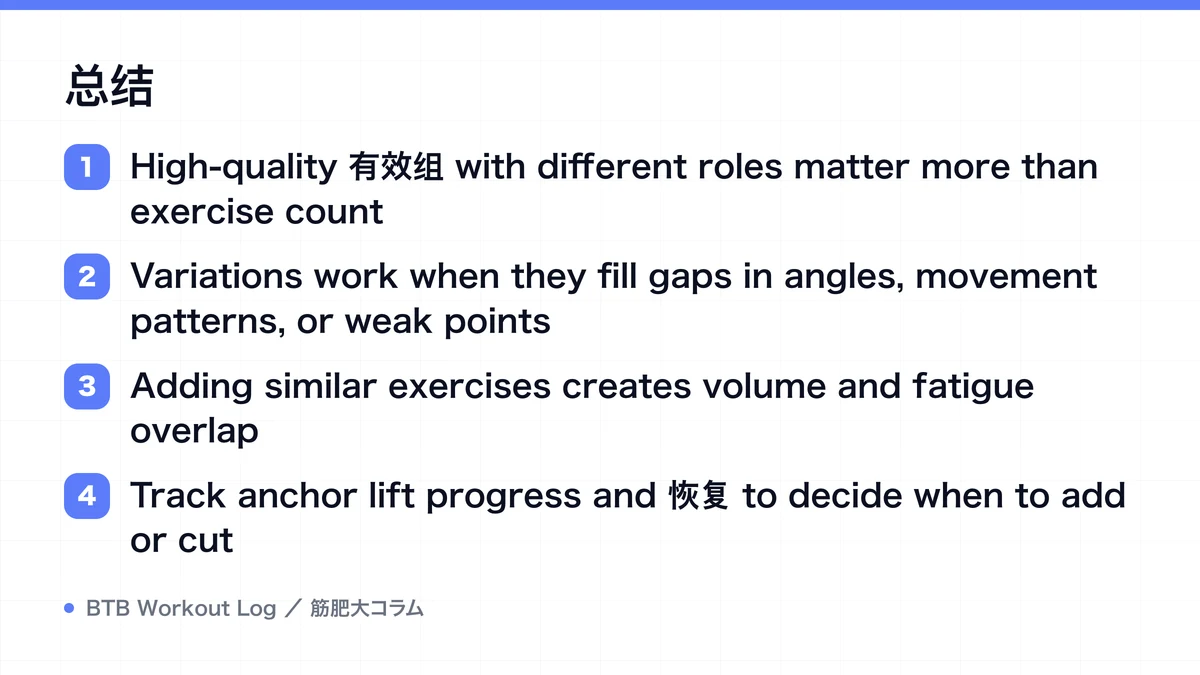
总结
- High-quality 有效组 with different roles matter more than exercise count
- Variations work when they fill gaps in angles, movement patterns, or weak points
- Adding similar exercises creates volume and fatigue overlap
- Track anchor lift progress and 恢复 to decide when to add or cut