Ağırlık Artmasa da Büyüyebilirsin | Tekrar Sayısını Artıran Progresyonun Mekanizması
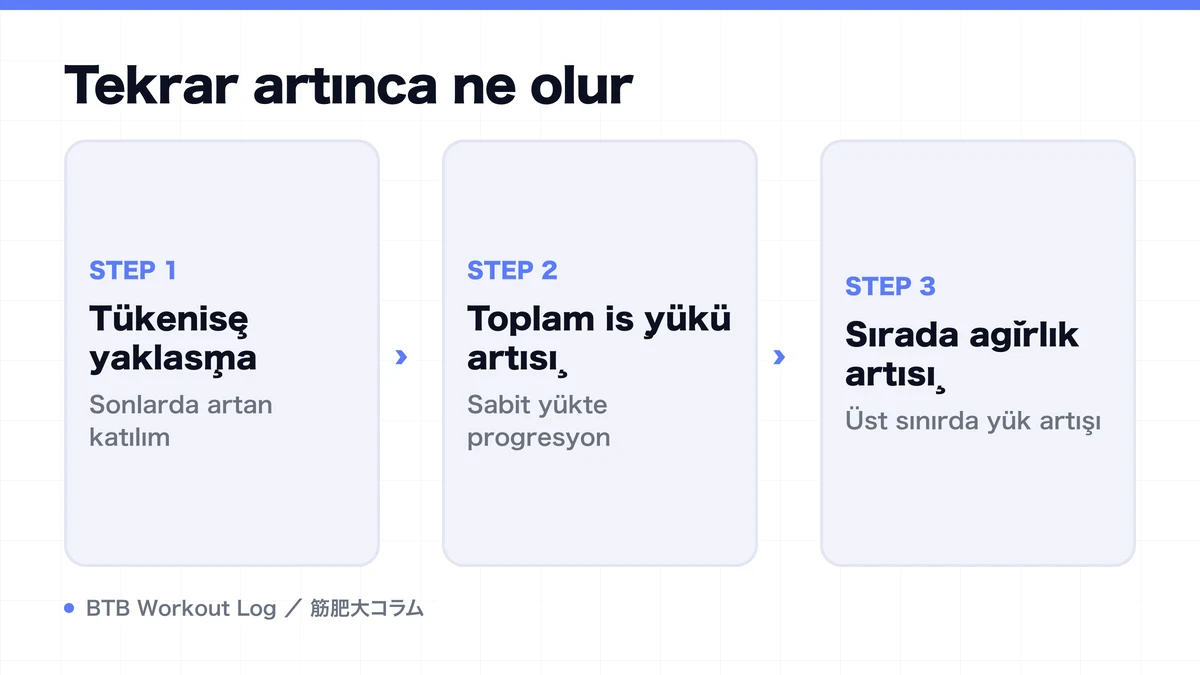
Aynı ağırlıkta da, form, hareket açısı, dinlenme ve RIR eşlenirse tekrar sayısı arttığında, tekrarlama kapasitesi yükselir ve öncekinden biraz daha fazla iş yapabildiğin anlaşılır. Bu küçük ilerlemeyi biriktirir, tekrar aralığının üst sınırında ağırlık artışına geçmek, kas hipertrofisi için progresif yüklenmedir.
Fakat sadece limite yaklaşmış bir tekrar ya da hareketi kısaltarak kazanılan bir tekrar aynı ilerleme değildir. Tekrar sayısı rakamı ne değiştirdiğini sırasıyla çözeceğiz.
Aynı ağırlıkta bir tekrar arttığında, setin neyi değişir
Bir tekrar arttığında, ilk değişen o sette tamamlanan tekrar sayısıdır. Aynı ağırlık, aynı hareket açısı, benzer hareket hızında, hedef kas gerilim altında kuvvet göstermek için bir kez daha fırsat bulur. Ağırlık × tekrar sayısıyla hesaplanan toplam tonaj da artar, ancak toplam tonaj tek başına kas hipertrofisi uyarısının puanı değildir. Sığ hareket açısı ya da momentum ile tekrar sayısı şişirilse bile, hedeflenen kasa gelen uyarı da aynı oranda artmayabilir.
Bir diğer önemli nokta, ek tekrarın kapasite gelişiminin gözlemlenebilir kanıtı olmasıdır. Bir önceki sette 80kg'de 8 tekrar, RIR 2 idiyse, bu sette aynı koşullarda 9 tekrar, RIR 2 ise, limite kadar olan rezervi korurken bir tekrar fazla yapabiliyorsun. RIR, "daha kaç tekrar yapabilirdin" anlamına gelir. Bu karşılaştırmada, sadece dayanmışsın değil, o ağırlığa karşı tekrarlama kabiliyetin gelişmiş olması yüksek ihtimal vardır.
Tekrar sayısı artışı, kasları direkt büyüten sihirli bir işlem değildir. Antrenman ve toparlanmanın ürünü olan uyumlamayı sayı olarak görmek ve sonraki seansta ele alınan işi kademeli olarak arttırmanın yoludur. Ağırlık dışında da kapsayan bütün resim, progresif yüklenme anlayışıyla bağlanır.
Ek tekrarlar büyüme uyarısının güncellenmesine nasıl bağlanır
"Bir tekrar arttığı için kas büyür" diye tek basamaklı düşünmek, nedenselliği yanlış yorumlar. Aslında şu akış mantıklı olur:
- Sabit yük altında hedef kas kuvvet gösterir: Stabil form ve hareket açısıyla tekrar ederken, kas lifi mekanik gerilim alır.
- Uyarı ve toparlanmayı tekrarla: Yeterli beslenme ve toparlanma aralarken aynı hareketi sürdür, vücut o talebe uyum sağla.
- Aynı çabada tekrarlama kapasitesi yükselir: Aynı ağırlığı öncekinden daha çok yapabilecek hale gel, RIR'yi koruyarak.
- Tamamladığın işi biraz arttır: Ek tekrarlar, aynı set sayısında bile hedef kasın gerilim altında çalışma fırsatını arttır.
- Sınırda ağırlığı güncelle: Belirlenen tekrar aralığının üst sınırına ulaşınca, minimum artış yap ve yeni yükle baştan tekrar artışını başlat.
Bu döngüde, tekrar artışı "uyumlamanın sonucu" ve "uyarıyı biraz arttırmak" olmak üzere çift işlev görür. Setiçi her seferinde plaka ekleyemeyecek orta seviye antrenörler için, ağırlıktan daha ince kademelemeler ile talep ilerletilebilir. Ağırlık mı yoksa tekrar sayısı mı önce hareket ettirilecek ağırlık artırma ile tekrar sayısı artırma karşılaştırmasında ayrı bir değerlendirme konusu.
Genel olarak, kas hipertrofisi düşük yükten yüksek yüke kadar geniş bir yelpazeye sahip, tekrar sayısı ilerletme ve yükü ayarlama işleyişi de bu gerçeklikle uyumlu. Yalnız hafif ağırlıklar, etkili tekrarlara ulaşana dek daha fazla tekrar gerektirme eğiliminde, nefes darlığı ya da lokal yanma uyarısı daha önce sınırlama yaratabilir. Tekrar sayısını sınırsız arttırmak değil, hareketin uygunluğu ölçüsünde ilerletmek gerekir.
Tekrar artışını ilerleme saymak için RIR ve hareket koşullarını eşle
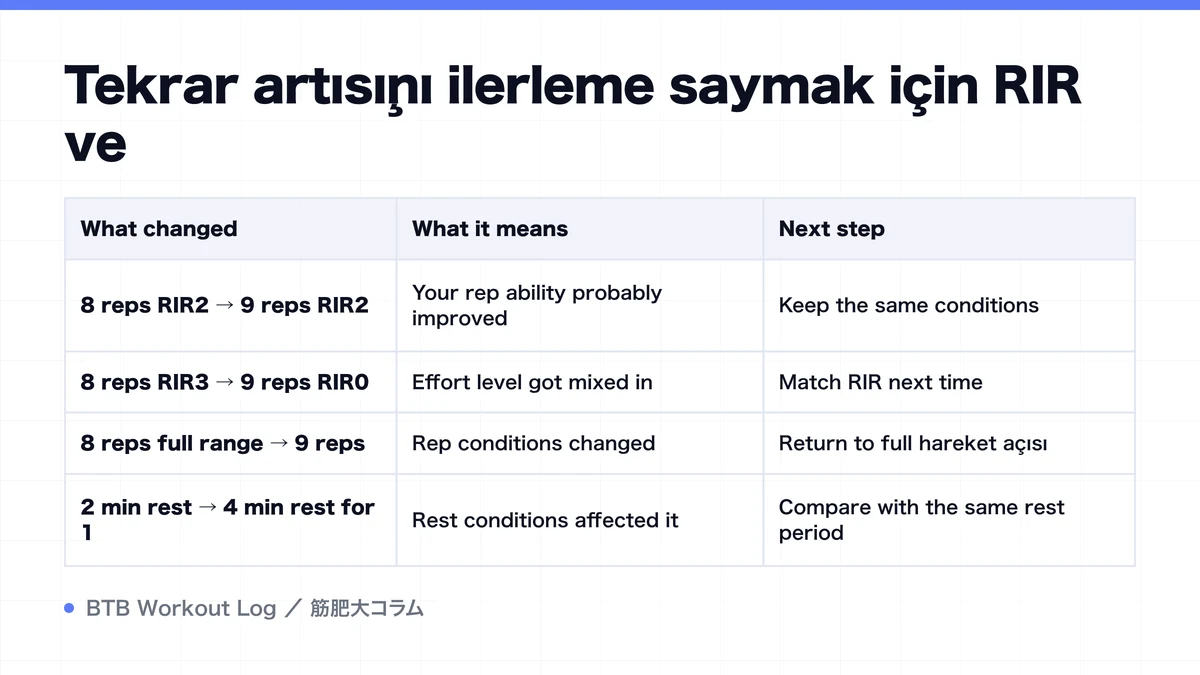
The trickiest part of comparing reps is effort level. If your previous 80kg×8 reps was RIR3 and today's 80kg×9 reps is RIR0, you can't tell whether your ability improved or you just pushed harder. But if both were RIR2, you've genuinely made progress—the same number of reps left in reserve, one more rep completed. Check the RIR guide for how to use it properly.
| What changed | What it means | Next step |
|---|---|---|
| 8 reps RIR2 → 9 reps RIR2 | Your rep ability probably improved | Keep the same conditions |
| 8 reps RIR3 → 9 reps RIR0 | Effort level got mixed in | Match RIR next time |
| 8 reps full range → 9 reps shallow movement | Rep conditions changed | Return to full hareket açısı |
| 2 min rest → 4 min rest for 1 extra rep | Rest conditions affected it | Compare with the same rest period |
Sleep, fatigue, exercise order, and equipment differences can shift reps by 1–2 on any given day. So don't call one personal record proof that kas hipertrofisi happened—look at the trend across several sessions under identical conditions. Repeatable reps you can perform again make better data than a single max rep where form falls apart. That's what you can actually use to track progress next time.
Convert reps to weight with double progression
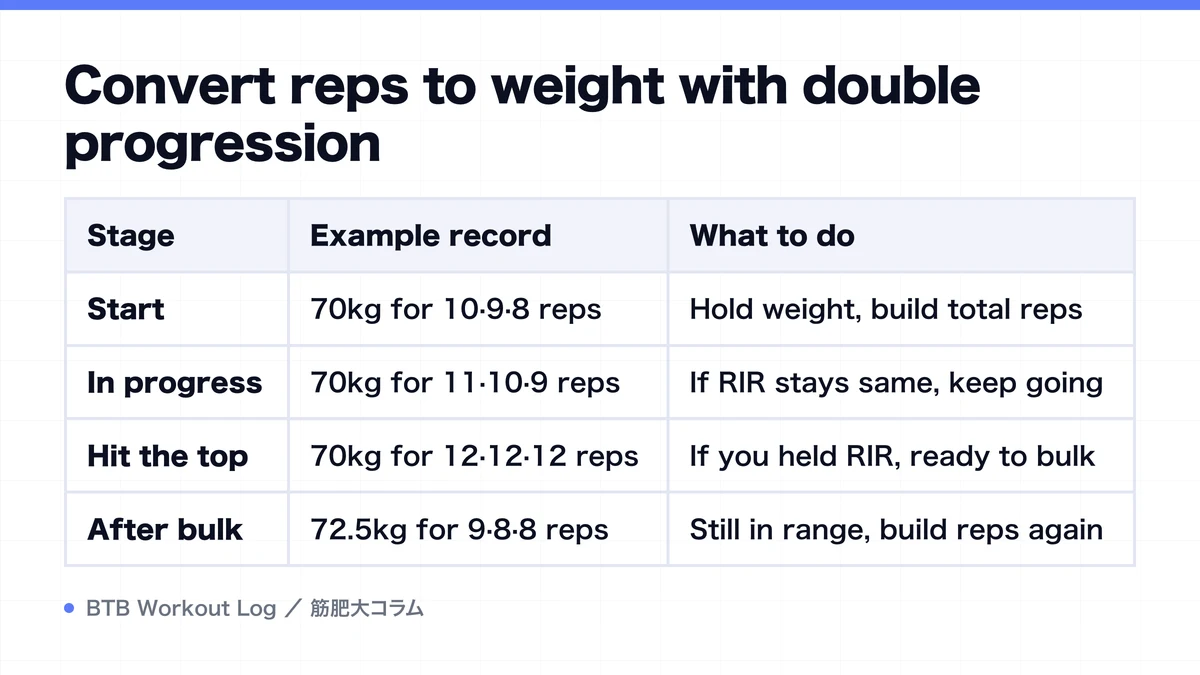
Double progression is the clearest way to turn rep increases into long-term load progression. Set a tekrar aralığı first, then fix the weight and build reps within that range. Once you hit the target, raise the weight. See how to choose load from rep count for more on weight and rep ranges.
Example: 8–12 reps, 3 sets
| Stage | Example record | What to do |
|---|---|---|
| Start | 70kg for 10·9·8 reps | Hold weight, build total reps |
| In progress | 70kg for 11·10·9 reps | If RIR stays same, keep going |
| Hit the top | 70kg for 12·12·12 reps | If you held RIR, ready to bulk |
| After bulk | 72.5kg for 9·8·8 reps | Still in range, build reps again |
Waiting for all sets to hit the upper limit before increasing weight is conservative and works well with dumbbell exercises where weight jumps are large. You can also raise weight once only the first set hits the top, or base it on total reps across three sets. Any method works—as long as you don't change the rule mid-program and you can compare fairly.
If set one gains a rep but sets two and three drop three reps total, the workout didn't get harder overall. Line up each set's reps, total reps, and RIR side by side to see whether you fought hard early or whether your whole rep ability went up. The bigger picture of weight × reps × sets is covered in antrenman hacmi.
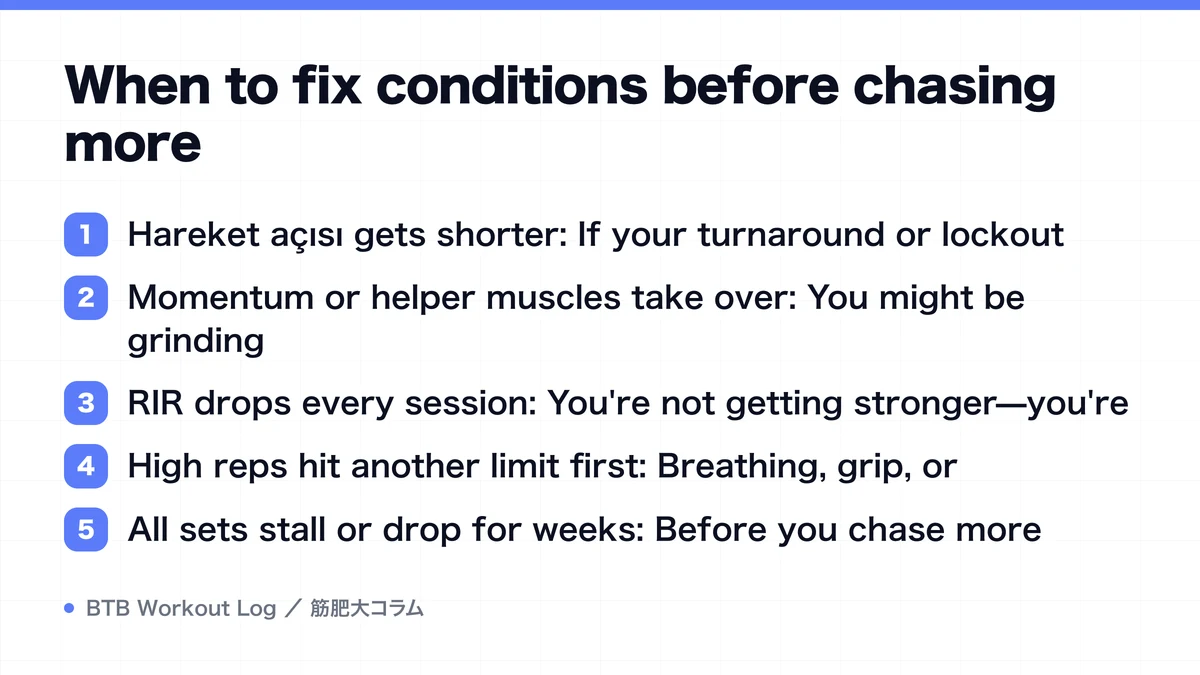
When to fix conditions before chasing more reps
Force "one more rep than last time" every session and soon the comparison breaks down. Fix these issues before you chase rep increases.
- Hareket açısı gets shorter: If your turnaround or lockout shifts, one rep no longer compares fairly to the last one.
- Momentum or helper muscles take over: You might be grinding out reps with technique tricks instead of target muscle strength.
- RIR drops every session: You're not getting stronger—you're just adding fatigue to hit a number.
- High reps hit another limit first: Breathing, grip, or posture gives out before the target muscle does.
- All sets stall or drop for weeks: Before you chase more reps, check sleep, food, weekly set count, and exercise placement.
On the flip side, exercises where the smallest weight jump is huge benefit most from rep progression. If bumping dumbbells means a big two-handed increase, it makes sense to drive current weight to the upper end of your range first. Then when you bulk, you'll still land inside the range and progress smoothly.
The call is simple. As long as reps climb under the same conditions and RIR stays steady, keep the weight. Hit the ceiling, then raise it by the smallest step available. Reps stall and later sets fall apart at the same time? Check toparlanma and current volume before adding more sets.
Log weight, reps, and RIR together to make the right call
To use rep progression effectively, log more than just weight and reps—record RIR, rest intervals, hareket açısı, and form changes in the same entry. Don't focus on "did I add one rep today?" Instead, ask whether total reps have trended up over several weeks under identical conditions, or whether you maintained your rep range even after increasing weight.
Logging isn't the stimulus itself, but it gives you the data to choose your next move: add another rep, increase the load, or adjust volume and toparlanma. Rep progression only works if you know what you did last session. BTB Workout Log is built for that—checking the previous session and chasing one more rep.
Sık Sorulanlar
- Does one extra rep at the same weight prove I've built muscle?
- A single rep gain isn't proof of kas hipertrofisi. Sleep, rest intervals, and RIR fluctuations move the needle too. If reps climb consistently over multiple sessions—same form, hareket açısı, rest, and RIR—that's real progress in your ability to produce reps.
- When should I add weight: after how many reps?
- Set a tekrar aralığı for each lift first. When you hit the top of that range at your target RIR across all sets (or by total rep count, depending on your rule), that's your cue to bulk. Stick to one progression rule and pick weight jumps that keep you inside your range after the increase.
- I added reps on set one, but later sets dropped. Is that progress?
- If only the first set rises while others crash, that's not full-body strength gain. Compare each set and total reps to last time, check your RIR, and make sure you didn't push the first set so hard you killed the rest. When your total climbs steadily, it's clearer you're actually improving.
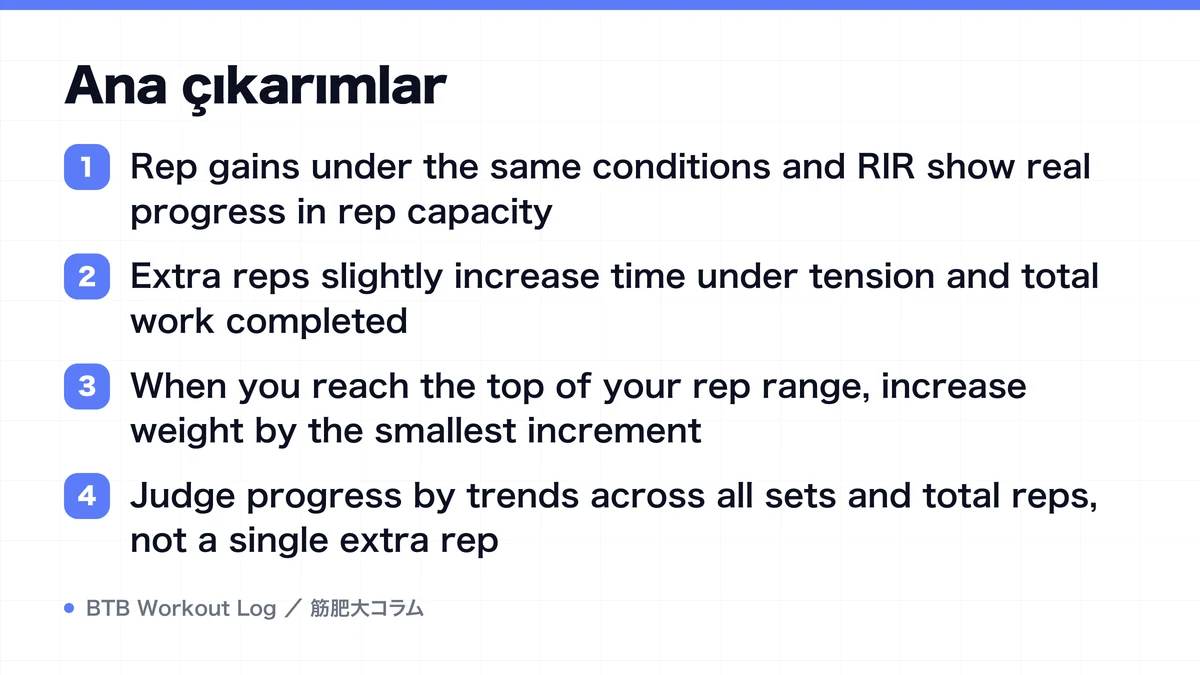
Ana çıkarımlar
- Rep gains under the same conditions and RIR show real progress in rep capacity
- Extra reps slightly increase time under tension and total work completed
- When you reach the top of your rep range, increase weight by the smallest increment
- Judge progress by trends across all sets and total reps, not a single extra rep
Kaynaklar
- ACSM Position Stand: Progression Models in Resistance Training for Healthy Adults
- Low- vs High-load Resistance Training for Strength and Hypertrophy: Meta-analysis
- Proximity-to-Failure and Muscle Hypertrophy: Systematic Review with Meta-analysis
- Mechanisms of Muscle Hypertrophy: Current Understanding and Future Directions