등 운동이 효과가 느껴지지 않는 이유는? 눈에 안 보이는 근육을 키우는 팁
등은 여러 근육을 팔과 전완과 함께 사용해 당기고, 자신의 눈으로 움직임을 확인하기 어려운 부위입니다. 그래서 자극이 분산되어 느껴지고 '어디에 자극이 왔는지' 모호해지기 쉽습니다.
약한 자극감이 자극이 없다는 뜻은 아닙니다. 수축감을 폼 조정의 단서로 삼고, 운동의 효과는 반복 가능한 동작과 수주간의 진전으로 판정합니다.
등 자극을 느끼기 어려운 3가지 이유
'등'이라고 한 마디로 해도 광배근, 승모근, 마름모근, 척추세운근 등은 위치와 기능이 다릅니다. 위에서 당기는 동작에서는 광배근의 관여가 크고, 수평으로 당기는 동작에서는 견갑골을 모아주는 근군이 강하게 작용합니다. 등 운동의 구성이 수직 풀과 수평 풀로 나뉘는 것은 외형뿐 아니라 동작의 역할이 다르기 때문입니다. 등 전체에 하나의 강한 수축감을 기대하면, 실제로는 작용하는데도 '아무것도 느껴지지 않는다'고 판단하기 쉬워집니다.
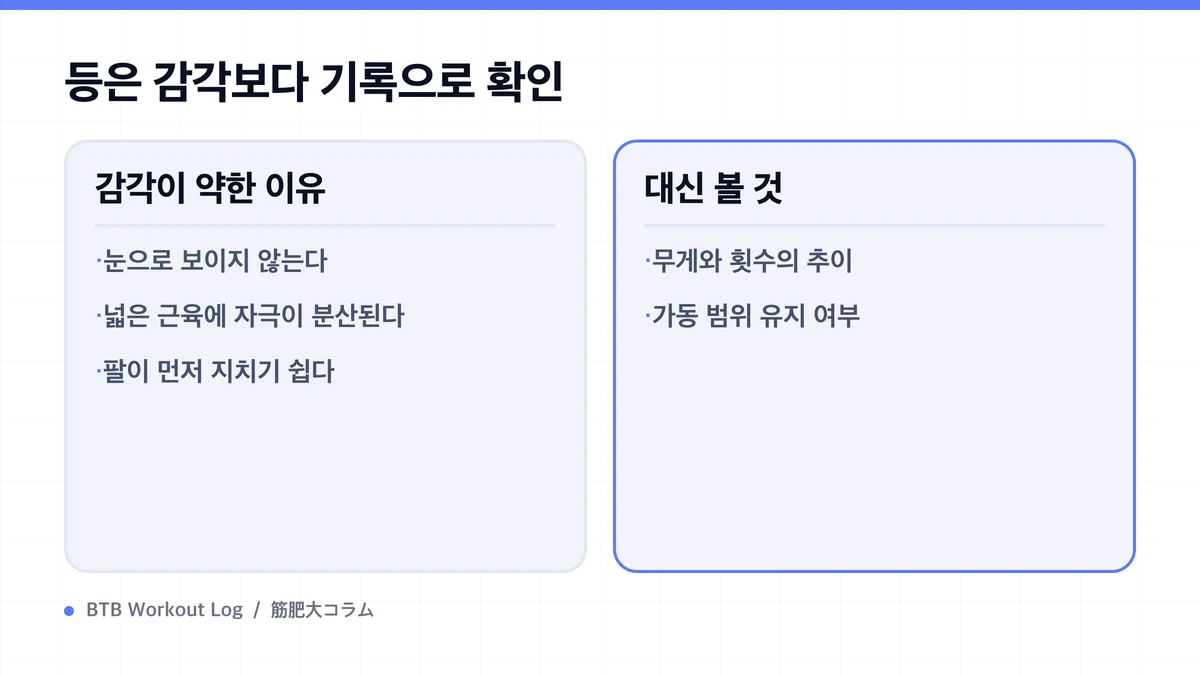
다음으로, 풀 동작은 어깨 관절이나 견갑골만으로 끝나지 않습니다. 팔꿈치를 굽히는 이두근, 바를 잡는 전완, 자세를 유지하는 체간도 동시에 참여합니다. 전완의 팽팽함이나 이두근의 피로는 감지하기 쉬워서, 그 감각이 등 쪽의 긴장을 덮을 수 있습니다. 이것은 팔이 작용하는 것 자체가 잘못된 것이 아니라 복합 운동으로서 자연스러운 현상입니다. 문제가 되는 것은 목표하는 등 근군보다 먼저 악력이나 팔꿈치 굽힘근이 한계에 도달해 세트를 끝내는 경우입니다.
더욱이 등은 거울에 직접 보기 어렵고, 가슴이나 상완처럼 근육의 단축을 눈으로 확인하면서 수정하기 힘든 부위입니다. 신체의 뒤에서 일어나는 상완과 견갑골의 움직임을 손의 궤적만으로 추측해야 합니다. 복수 근군, 복수 관절, 시각 정보 부족이 겹치면서 등의 자극감은 원래 노이즈를 많이 포함한다고 생각하는 것이 실전에 더 맞습니다.
'자극감'이 약하면 실패한 것은 아닙니다
펌프감이나 화끈거림은 장기적 결과 자체가 아닙니다
고반복으로 동작할 때의 펌프감이나 화끈거림은 명확하고, 세트를 끝낸 실감을 줍니다. 하지만 그 순간의 감각은 반복 횟수, 휴식, 익숙하지 않은 동작에 따라서도 달라집니다. 강한 펌프가 있었던 운동을 자동으로 좋게 평가하고, 자극감이 조용한 운동을 버리면 다룰 수 있는 무게나 가동 범위, 지속적인 진전을 놓칩니다. 수축감과 근비대 효과의 관계는 자극감이 강한 운동일수록 우수한가라는 별개의 질문으로 분리해야 합니다.
'견갑골을 모은다'는 모든 등 운동의 정답이 아닙니다
광배근의 주요 역할은 상완을 체측으로 당기는 것입니다. 한편 승모근 중부나 마름모근을 노리는 로우에서는 견갑골의 후퇴가 중요해집니다. 랫 풀다운이든 로우든 견갑골을 최대한 모으면 된다고 하나의 신호로 통일하면, 목표와 동작이 어긋날 수 있습니다. 수직 풀이면 팔꿈치를 골반 방향으로 운반하고, 수평 풀이면 노리는 부위에 맞춰 팔꿈치의 궤적과 견갑골의 움직임을 맞추는 식으로 목적에 따라 생각합니다.
자극감을 찾아 계속 무게를 내리는 것도 틀렸습니다
폼을 배우는 동안 부하를 줄이는 것은 효과적이지만, 가벼울수록 좋은 것은 아닙니다. 노린 가동 범위를 유지하면서 세트 후반에 충분한 노력이 필요한 부하까지 돌아가는 것이 중요합니다. 자극감은 '올바르게 동작하고 있는가'를 탐색하는 정보이지, 무게를 늘리지 않을 이유가 아닙니다.
자극감은 활용하되, 판정을 하나에만 맡기지 않기
Even in traditional pulling exercises that target the lats, the pattern of muscle activation can shift when the lift or conditions change. But a single snapshot of muscle activity in a study doesn't determine long-term 근비대. You need a sustained perspective on load, volume, frequency, and 가동 범위. Rather than relying on one signal like "my lats felt contracted today," check whether multiple markers point in the same direction.
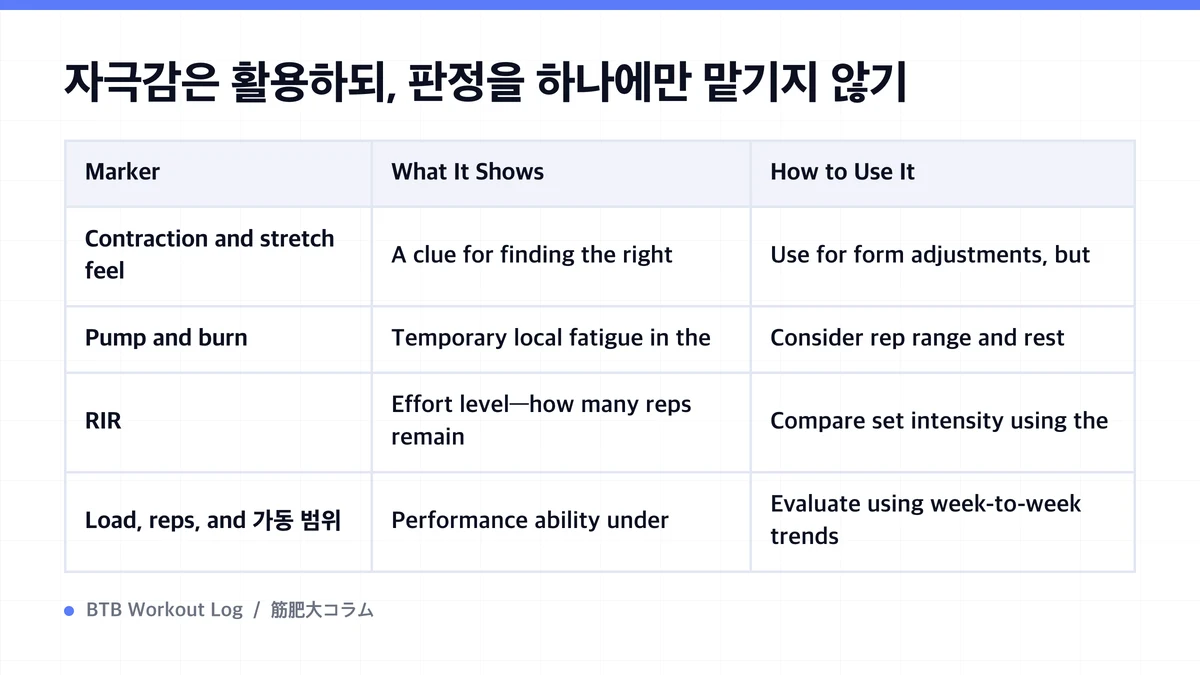
| Marker | What It Shows | How to Use It |
|---|---|---|
| Contraction and stretch feel | A clue for finding the right movement path | Use for form adjustments, but don't judge success on this alone |
| Pump and burn | Temporary local fatigue in the moment | Consider rep range and rest periods as factors too |
| RIR | Effort level—how many reps remain | Compare set intensity using the same standard |
| Load, reps, and 가동 범위 | Performance ability under matching conditions | Evaluate using week-to-week trends |
| Pain or numbness | A warning to pause or modify | Don't chase this as a sign of good stimulus |
RIR shows how many reps you had left. If your back feel is weak but you maintain form and reach your target RIR, you can still compare effort levels. Conversely, even if a set feels strong, changing form or 가동 범위 every rep makes the comparison to last week unclear. The answer isn't to ignore feel—it's to combine defined feel with numbers.
Steps to align back feel with your form
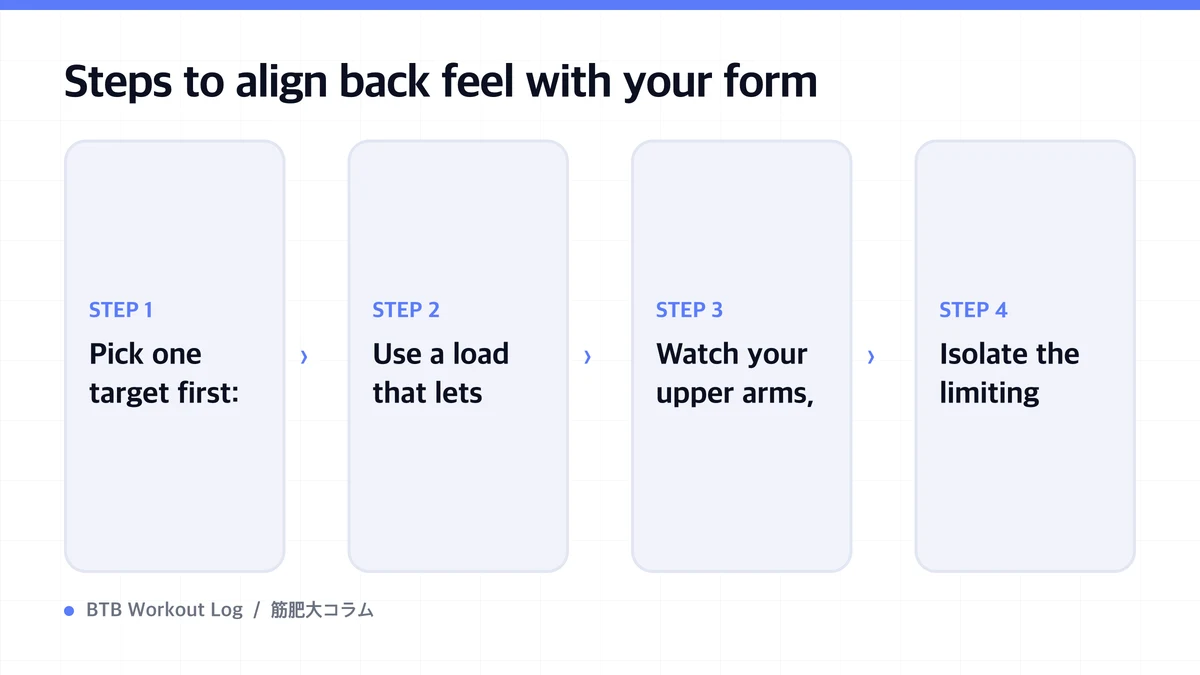
- Pick one target first: Decide whether you're targeting the lats with a vertical pull or upper-back thickness with a horizontal pull. Choices like pull-ups versus lat pulldowns are covered in lat pulldown versus pull-up comparison, and row variations in barbell row versus seated row comparison—separate purpose from stability.
- Use a load that lets you repeat the path: If you're grinding out reps with momentum or changing torso angle, drop the weight. Your baseline is a load where you can match starting position, end point, and tempo.
- Watch your upper arms, not your hands: In vertical pulls, drive elbows toward the hips; in horizontal pulls, toward your target. Think of your hands as a bridge between you and the bar—don't fixate on gripping hard.
- Isolate the limiting factor: If your forearms fail first each rep, try straps; if your lower back breaks down, try a chest-supported row. Test one change at a time and compare what shifted.
- Repeat the same lift several times: Switching grip or exercise every session resets both motor learning and comparison. Stay with the same conditions in a pain-free range and watch how feel and numbers stabilize.
Film yourself from the side or rear. Check whether you're over-arching your chest, cutting 가동 범위 short at the end, or showing big left-right differences. Video won't measure muscle stimulus directly, but it's valuable for spotting form breakdowns on a muscle you can't see.
Keep or swap the lift based on progress over weeks
When evaluating a back exercise, first check whether you can repeat your target 가동 범위 pain-free, then whether you're hitting the limit of the intended movement (not grip or biceps). Once those are locked in, look for load or reps climbing at the same RIR. If the numbers rise and form stays solid, weak sensation alone isn't a reason to ditch the lift.
On the flip side, strong pump doesn't excuse weeks of dropping load and reps and shrinking 가동 범위. You'd need to rethink it. Check your weekly back volume, 회복 since the last session, and your RIR estimates. Before adding sets just to feel more, confirm your current sets are hitting 점진적 과부하 repeatedly.
Because vertical and horizontal pulls serve different roles, track them separately—it makes the call easier. Use feel to tweak form on the day; use the record to decide whether to keep or change the lift.
자주 묻는 질문
- If my back doesn't feel engaged but load and reps are climbing, should I keep the lift?
- If you're pain-free, holding your target 가동 범위 and form, and seeing load or reps rise at the same RIR, weak feel alone isn't a reason to switch. Check video and left-right symmetry too, and judge by multiple markers.
- My biceps burn out first on lat pulldown. How do I fix it?
- Drop the load and drill the path of driving your elbows toward your hips rather than pulling with your hands. If grip gives out first, straps are an option. If your arms still hit the wall every session, try changing grip or 가동 범위 one variable at a time and compare.
- Should I use straps every session to make sure my back engages?
- 스트랩은 필수가 아닙니다. 악력이 목표 근육보다 먼저 한계에 도달하는 세트에서는 유용하지만, 스트랩 없이도 동작을 완료할 수 있다면 굳이 써야 할 필요는 없습니다. 워밍업은 맨손으로, 하드 세트만 사용하는 식으로 목적에 맞춰 나누면 됩니다.
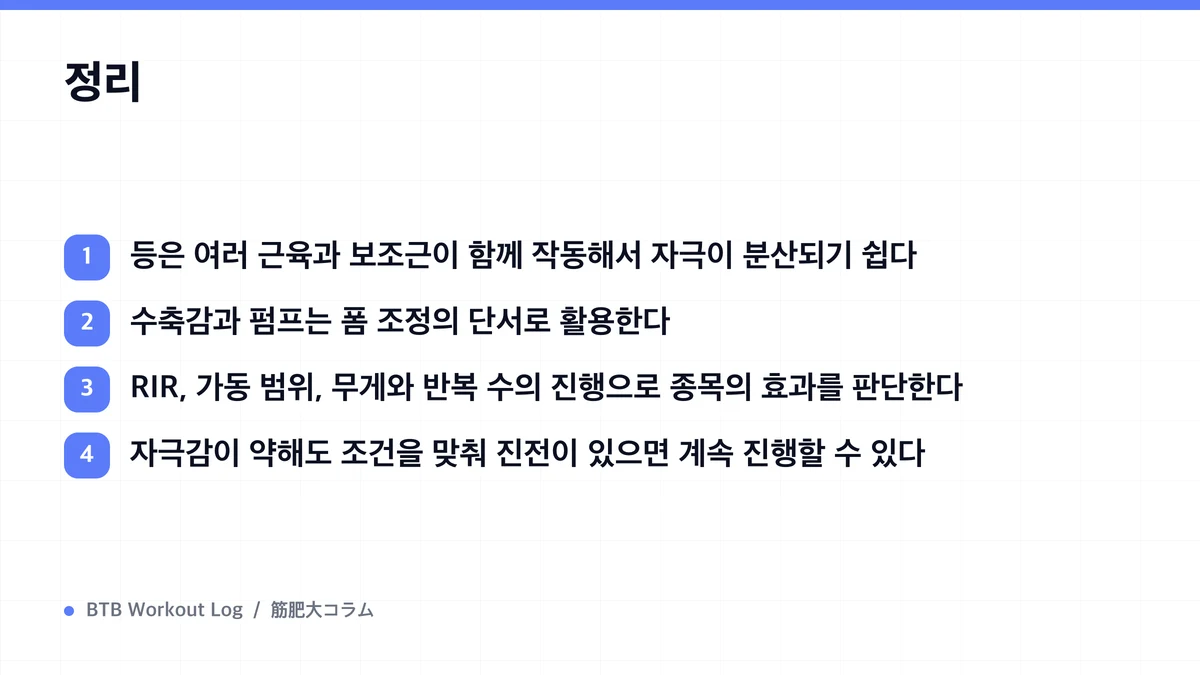
정리
- 등은 여러 근육과 보조근이 함께 작동해서 자극이 분산되기 쉽다
- 수축감과 펌프는 폼 조정의 단서로 활용한다
- RIR, 가동 범위, 무게와 반복 수의 진행으로 종목의 효과를 판단한다
- 자극감이 약해도 조건을 맞춰 진전이 있으면 계속 진행할 수 있다
참고문헌
- Variations in Muscle Activation During Traditional Latissimus Dorsi Exercises
- The Mechanisms of Muscle Hypertrophy and Their Application to Resistance Training
- The Influence of Frequency, Intensity, Volume and Mode of Strength Training on Whole Muscle Cross-sectional Area in Humans
- Repetitions in Reserve Is a Reliable Tool for Prescribing Resistance Training Load