한 종목만으로 가슴이 커질까? 시간이 없는 사람을 위한 대흉근 운동 검증
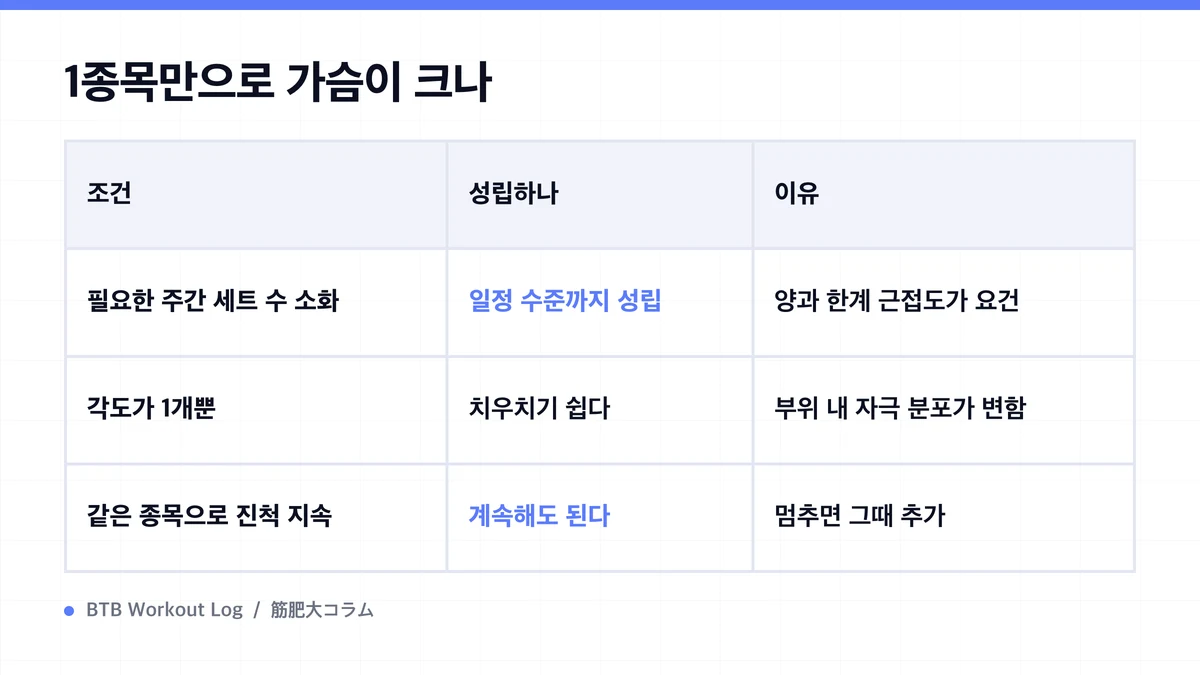
1종목만으로도 가슴을 크게 할 수 있습니다. 단, 그 1종목에서 대흉근이 충분히 작용하고 질 높은 주간 세트 수와 점진적 과부하를 지속할 수 있어야 합니다.
검증해야 할 두 가지는 '성장하는가'와 '가슴 전체를 최대한 발달시킬 수 있는가'입니다. 전자는 성립 가능하지만 후자는 각도별 자극 편차와 어깨·팔뚝 삼두근이 먼저 한계에 도달하는지에 따라 달라집니다.
'1종목이면 충분'을 어떻게 판단할까
여기서 1종목이란 기구, 벤치 각도, 그립, 가동 범위를 거의 고정한 하나의 동작을 의미합니다. 플랫 프레스와 인클라인 프레스를 날마다 바꿔 사용한다면 기구가 같아도 자극 조건이 다르므로 '1종목'으로 취급하지 않습니다.
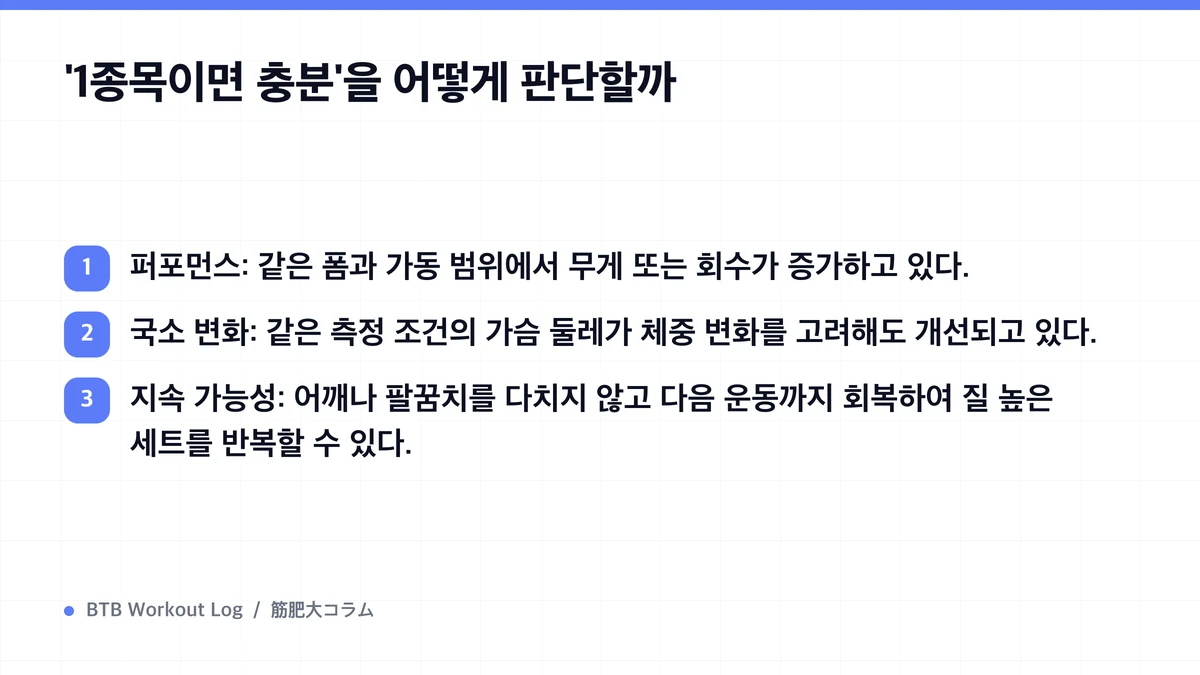
또한 펌프나 근육통이 강하다고 해서 '가슴이 커졌다'고 판단할 수 없습니다. 최소 8~12주간 같은 조건으로 다음 세 가지를 추적합니다.
- 퍼포먼스: 같은 폼과 가동 범위에서 무게 또는 회수가 증가하고 있다.
- 국소 변화: 같은 측정 조건의 가슴 둘레가 체중 변화를 고려해도 개선되고 있다.
- 지속 가능성: 어깨나 팔꿈치를 다치지 않고 다음 운동까지 회복하여 질 높은 세트를 반복할 수 있다.
하나만 움직여서는 단정 짓지 않습니다. 예를 들어 체중 증가 중 가슴 둘레는 지방이나 등의 변화도 포함합니다. 여러 지표가 같은 방향으로 진행하는지 확인함으로써 '1종목으로도 성장 중'이라는 판단의 신뢰도가 높아집니다.
근비대는 종목 개수보다 세트의 질로 결정된다
근비대 자극은 몇 종목을 소화했는지가 아니라 목표 근육에 충분한 장력이 작용하는 세트를 누적하고 이를 회복하며 반복한 결과로 생깁니다. 주간 저항 운동량과 근비대 사이에는 평균적인 용량-반응 관계가 있지만, 이는 종목을 늘릴수록 유리하다는 뜻이 아닙니다. 같은 주간 가슴 세트 수를 1종목으로 확보할 수 있다면 '하나뿐'이라는 이유만으로 실패라고 봐야 할 근거는 없습니다. 주간 세트 수 개념은 주간 하드 세트 수도 참고할 만합니다.
한편 이번 질문을 총 세트 수와 노력도까지 맞춰 '가슴 1종목'과 '가슴 복수 종목'을 장기간 직접 비교한 연구는 여기서 참고하는 논문에 없습니다. 주간 세트 수, 한계까지의 거리, 각도별 근활동에 관한 주변 연구를 조합하고 실제 진행으로 성립 조건을 확인하는 것이 타당합니다.
다만 워밍업이나 여력을 많이 남긴 세트까지 수를 세어 맞추는 것은 부적절합니다. RIR은 '앞으로 몇 회 더 할 수 있었나'의 추정이며 실전상 많은 세트를 RIR 1~3 정도에 유지하면 가슴에 충분한 노력을 들이면서도 반복하기 쉬워집니다. 매 세트를 완전 실패까지 할 필요는 없으며 실패까지 가는 방식이 실패 전까지만 가는 방식보다 근비대에 우월하다는 명확한 근거도 없습니다. 몰아붙임 정도를 맞추는 방법은 RIR 사용법에서 확인할 수 있습니다.
또 하나의 조건이 진전입니다. 같은 무게, 같은 회수, 같은 가동 범위를 오래 반복하면 자극이 바뀌지 않아 1종목이든 5종목이든 정체합니다. 설정한 렙 범위 내에서 회수를 늘리고 상한에 도달하면 작은 폭으로 무게를 올리는 등 비교 가능한 형태로 점진적 과부하를 만들어야 합니다.
가슴에서는 '자극 편차'와 '먼저 피로해지는 근육'을 확인해야 한다
대흉근은 한 덩이의 근육처럼 보여도 쇄골 쪽과 흉골 쪽에서 근섬유 주행 방향이 다릅니다. 플랫 벤치와 45도 인클라인 벤치프레스를 비교한 연구에서는 대흉근 내 강하게 활성화되는 영역이 각도에 따라 달라졌습니다. 다만 이는 단일 세션의 근활동을 측정한 연구로, 각도를 늘리면 장기 근비대가 더 커진다고 직접 보여주는 것은 아닙니다. 그래도 하나의 각도가 가슴 전체를 정확히 같은 방식으로 자극한다고 가정할 이유는 없습니다.
1종목으로 성립하기 쉬운 것은 통증 없이 큰 가동 범위를 쓸 수 있고, 가슴이 강하게 늘어난 위치에서 밀어낼 수 있으며, 세트 후반을 대흉근의 출력 저하로 맞을 수 있는 종목입니다. 반대로 상완삼두근, 전삼각근, 자세 유지, 악력 등이 매번 먼저 한계에 도달한다면 그 세트 전부를 가슴의 유효 세트로 봐야 하기 어렵습니다. 종목 이름보다 자신의 몸에서 무엇이 제한 요인인지가 중요합니다.
종목을 하나로 제한하는 장점도 있습니다. 기술이 안정화되고 전회 대비를 측정하기 쉬우며 워밍업과 기구 이동 시간도 줄어듭니다. 반면 같은 관절 각도에 부하가 집중되고 후반 세트 품질이 떨어져도 다른 동작으로 회피할 수 없습니다. '종목 개수를 늘리지 않는 것'을 목표로 하지 말고 종목 개수와 성장의 관계처럼 각 세트의 역할로 생각합니다.
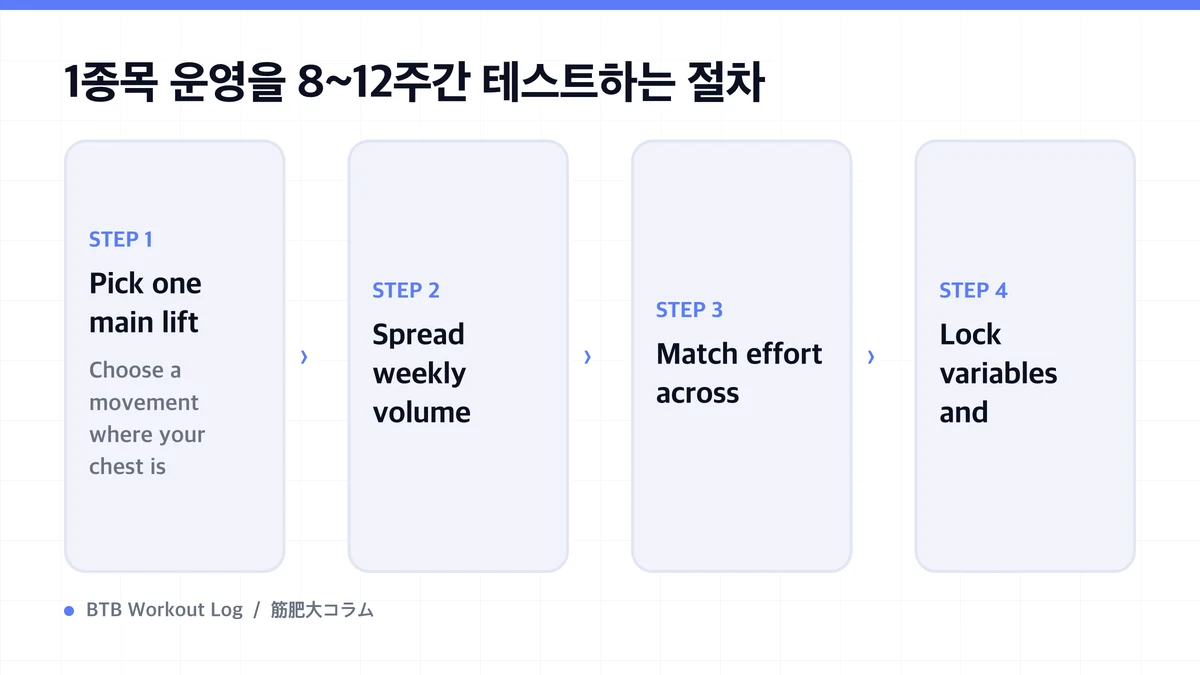
1종목 운영을 8~12주간 테스트하는 절차
- Pick one main lift: Choose a movement where your chest is the limiting factor, you can reproduce a full pain-free 가동 범위 each session, and load adjustments are straightforward. Free weights aren't mandatory.
- Spread weekly volume across sessions: Use your current recoverable 주간 세트 수 for chest as the baseline, dividing roughly 2 sessions per week instead of packing one day. If reps or 가동 범위 drop noticeably in later sets, reduce the per-session count first.
- Match effort across sets: Log RIR for each work set, avoiding both excessively light loads and total failure every session. Manage fatigue by taking your final set close to failure while keeping earlier ones controlled.
- Lock variables and drive progress: Don't frequently change bench angle, grip, tempo, or 가동 범위. Build load or reps under identical conditions. Shortening your range to add reps doesn't count as progress.
- Assess at 8–12 weeks: Review performance, chest development, and joint health together. If pain emerges or your chest stops being the limiting factor, adjust before the full period ends.
For example, 2 sessions per week with 3–5 work sets each is a solid starting point, but your actual needs shift with training age, effort level, and recovery capacity. Don't treat numbers as prescription; begin with a volume you can sustain without quality decay in later sets.
Single-exercise work pairs well with detailed logging since you have fewer variables to track.
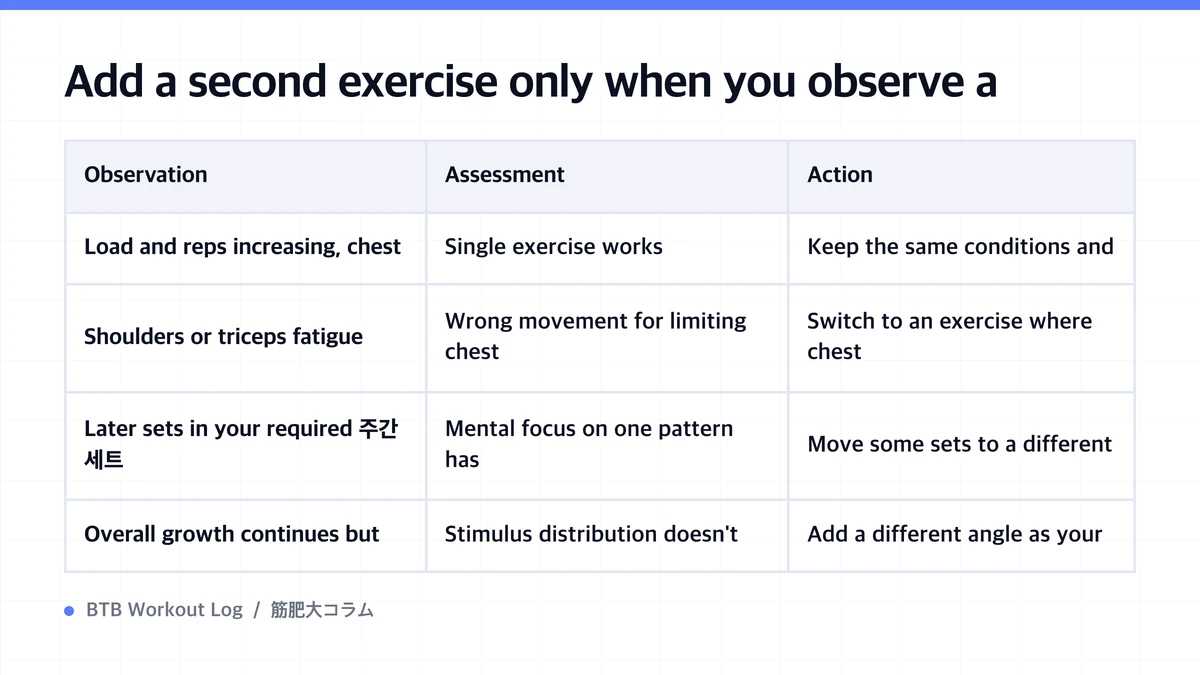
Add a second exercise only when you observe a specific weakness
| Observation | Assessment | Action |
|---|---|---|
| Load and reps increasing, chest visibly growing, no pain | Single exercise works | Keep the same conditions and continue |
| Shoulders or triceps fatigue before chest | Wrong movement for limiting chest | Switch to an exercise where chest is the bottleneck |
| Later sets in your required 주간 세트 수 lose quality | Mental focus on one pattern has limits | Move some sets to a different exercise |
| Overall growth continues but upper chest (or target area) plateaus | Stimulus distribution doesn't match goals | Add a different angle as your second movement |
| Shoulder or elbow discomfort recurs | Long-term sustainability is compromised | Replace with an exercise using different equipment or path |
When adding a second exercise, don't simply stack extra sets. Instead, shift some volume from your main lift. This keeps total work roughly the same while letting you see how angle and stability changes affect results. Keep your main lift as your comparison baseline and add a second movement purely to address observed gaps—this makes progress easier to interpret.
For broader chest programming, see 근비대 chest training; for whether to stick with bench alone, see bench press only for chest. If you're still growing with one exercise, there's no reason to add more. But once you identify a specific weak point, a second movement has clear value.
자주 묻는 질문
- If I'm training chest with one exercise, what should I choose?
- Pick a movement where your chest is the main limiting factor, you can repeat a large pain-free 가동 범위 consistently, and fine-tune the load easily. Don't limit yourself to barbells—dumbbells and 머신 work too. Choose whatever lets you track progress in the same form for 8–12 weeks.
- Can upper chest grow if I only do flat-bench movements?
- The upper chest does get stimulated, but research shows that bench angle changes how activation distributes across the pectorals. If your whole chest grows but upper chest stalls as a priority area, either move your main lift to incline or shift some sets to a different angle.
- How many weeks without progress before I should add a second movement?
- Start with 8–12 weeks as your benchmark, tracking load, reps, and chest development with the same form, 가동 범위, and RIR. Consider adding a second lift if multiple metrics stall even after fixing recovery and load assignment. Change sooner if you notice pain or other muscles tiring before your chest.
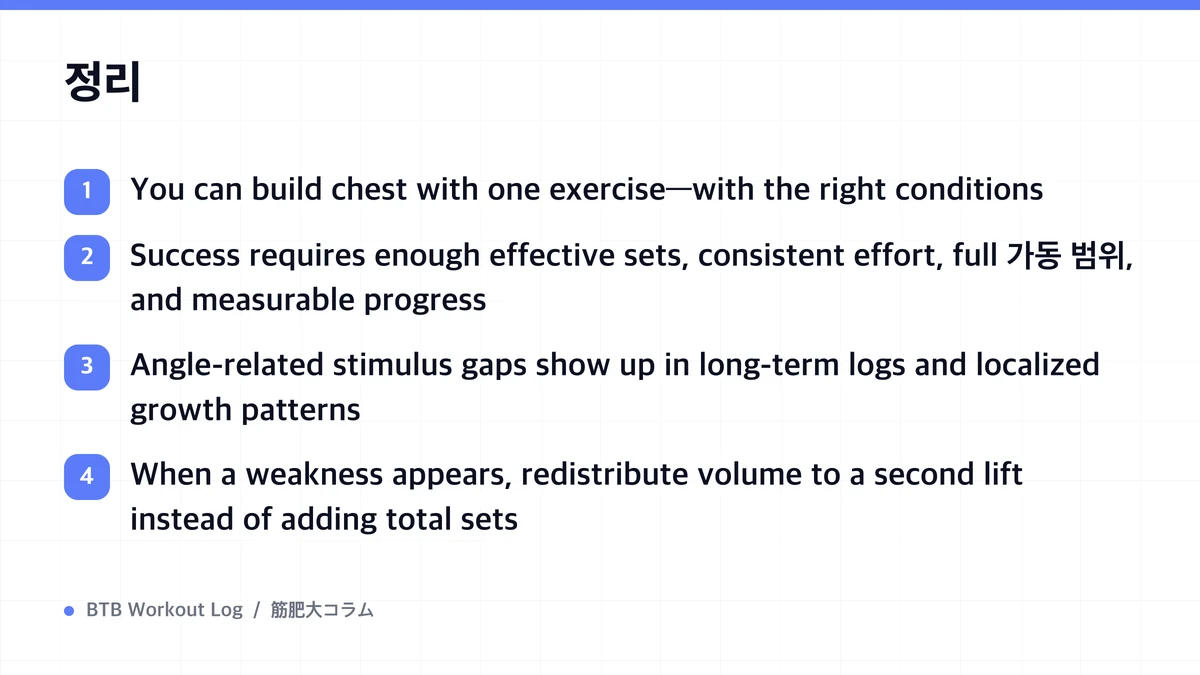
정리
- You can build chest with one exercise—with the right conditions
- Success requires enough effective sets, consistent effort, full 가동 범위, and measurable progress
- Angle-related stimulus gaps show up in long-term logs and localized growth patterns
- When a weakness appears, redistribute volume to a second lift instead of adding total sets