바벨 벤치프레스 vs 덤벨 벤치프레스, 가슴을 더 키우려면 어느 쪽?
가슴을 키우는 데만 관심 있다면, 바벨과 덤벨 중 하나가 항상 우월하다고 할 수 없습니다. 높은 출력과 부하 증진성을 우선한다면 바벨, 독립적인 팔 궤적과 넓은 가동 범위를 살릴 수 있다면 덤벨이 선택하기 쉬워집니다.
비교해야 할 것은 기구의 평판이나 들어올린 무게가 아니라, 대흉근이 충분한 노력도에 도달하는지, 같은 조건에서 계속 진행할 수 있는지, 그 자극을 주 중에 회복할 수 있는지입니다.
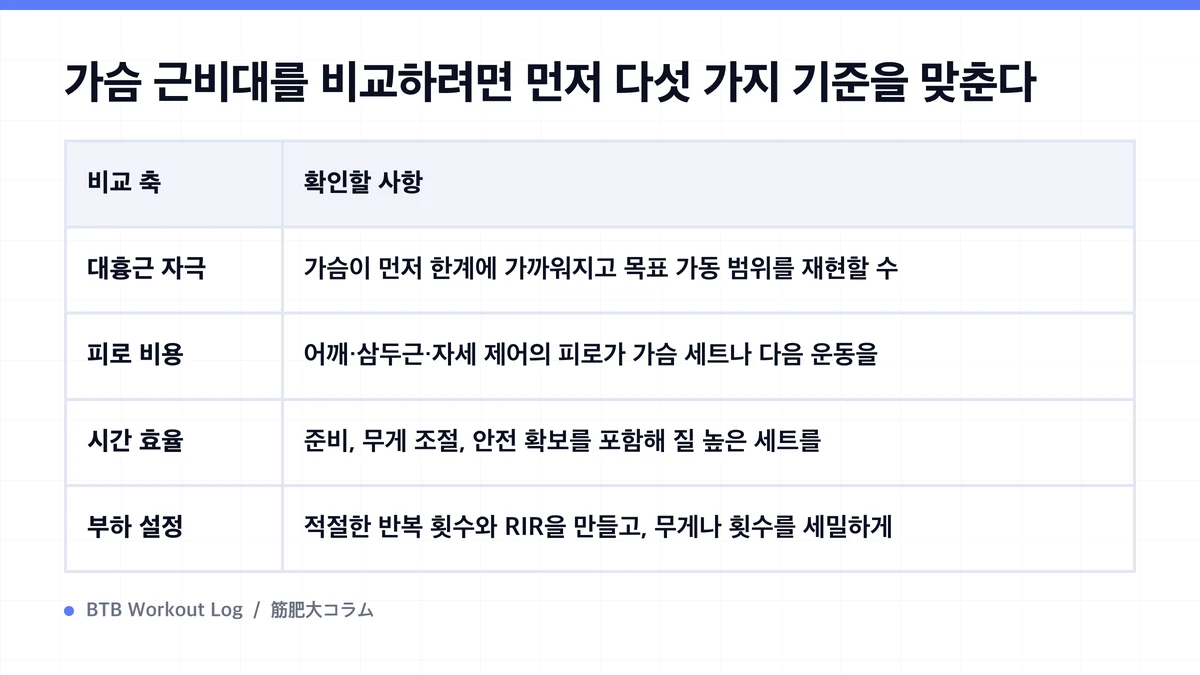
가슴 근비대를 비교하려면 먼저 다섯 가지 기준을 맞춘다
바벨로 100kg, 덤벨로 한 손 36kg을 들 수 있어도, 숫자의 크기로 근비대 효과는 비교할 수 없습니다. 양손이 하나의 바에 연결된 동작과 좌우를 독립적으로 제어하는 동작은 무게의 의미와 안정성 요구도 다릅니다. 근비대 목표의 비교에서는 다음 다섯 가지를 봅니다.
| 비교 축 | 확인할 사항 |
|---|---|
| 대흉근 자극 | 가슴이 먼저 한계에 가까워지고 목표 가동 범위를 재현할 수 있는가 |
| 피로 비용 | 어깨·삼두근·자세 제어의 피로가 가슴 세트나 다음 운동을 방해하지 않는가 |
| 시간 효율 | 준비, 무게 조절, 안전 확보를 포함해 질 높은 세트를 소화할 수 있는가 |
| 부하 설정 | 적절한 반복 횟수와 RIR을 만들고, 무게나 횟수를 세밀하게 늘릴 수 있는가 |
| 개인 차이와 목표 | 어깨 가동성, 좌우 불균형, 장비, 벤치 근력 목표에 맞는가 |
RIR은 세트 종료 시 몇 번 더 할 수 있었을지 추정하는 여력입니다. 같은 횟수라도 RIR 5인 세트와 RIR 1인 세트는 노력도가 다릅니다. 기구만 바꿔서 승패를 정하지 말고, 가동 범위, RIR, 주간 세트 수를 맞춘 후 자신이 어느 쪽에서 질 높은 반복을 더 많이 쌓을 수 있는지 비교합니다.
근비대 효과는 동등할 수 있지만, 자극을 만드는 방식은 같지 않다
둘 다 어깨 관절의 수평 내전과 팔꿈치 신전을 사용하는 프레스로, 대흉근 외에도 앞어깨와 이두근이 작용합니다. 충분한 노력도와 주간 볼륨을 확보하고 같은 종목 내에서 부하를 늘릴 수 있다면, 바벨이든 덤벨이든 가슴을 발달시킬 수 있습니다. 장기적 대흉근 근비대를 직접 비교한 문헌이 없어서 '평균 얼마나 우월한가'라는 결론을 내릴 수 없습니다.
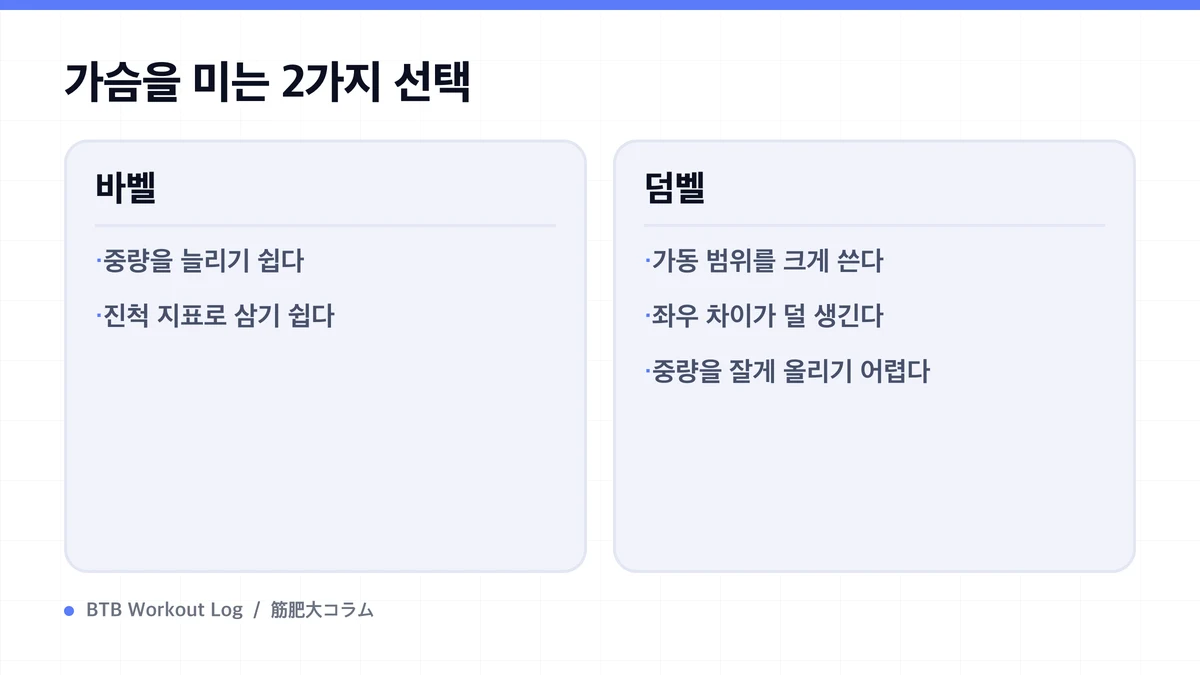
바벨은 양손이 하나의 바에 연결돼 무거운 부하에도 궤적을 유지하기 쉬운 것이 강점입니다. 가슴에 바가 닿는 위치가 최저점이 되므로 덤벨만큼 팔꿈치를 몸통 아래로 내릴 수 없지만, 그렇다고 자극이 부족한 것은 아닙니다. 가슴을 팽팽하게 유지하고 매번 비슷한 위치까지 내릴 수 있다면 재현성 높은 가동 범위로 쓸 수 있습니다.
덤벨은 바가 가슴에 닿지 않으므로 어깨 가동성이 허용하는 범위 내에서 깊이 내리기 쉽고, 좌우 팔을 별도 궤적으로 움직일 수 있습니다. 손 방향도 조정하기 쉬워 중립에 가까운 그립이 맞는 사람도 있습니다. 다만 깊이를 늘릴수록 좋은 것은 아닙니다. 어깨가 앞으로 밀려나고, 가슴 팽팽함이 빠지고, 최저점에서 반동으로 올린다면 추가된 가동 범위는 질을 높이지 않습니다. 가슴 종목 구성과 마찬가지로 가동 범위는 대흉근에 부하를 유지할 수 있는 범위 내에서 결정합니다.
경기 벤치프레스 선수 12명을 대상으로 바벨의 그립 폭과 벤치 각도를 바꾼 연구에서 일부 근육군의 활동과 6RM 중량에 차이가 나타났습니다. 하지만 그 결과는 바벨 vs 덤벨 장기 근비대의 우승자를 보여주는 것이 아닙니다. 가슴보다 삼두근이 먼저 지칠 때는 기구를 바꾸기 전에 삼두근이 먼저 피로해지는 원인도 분석합니다.
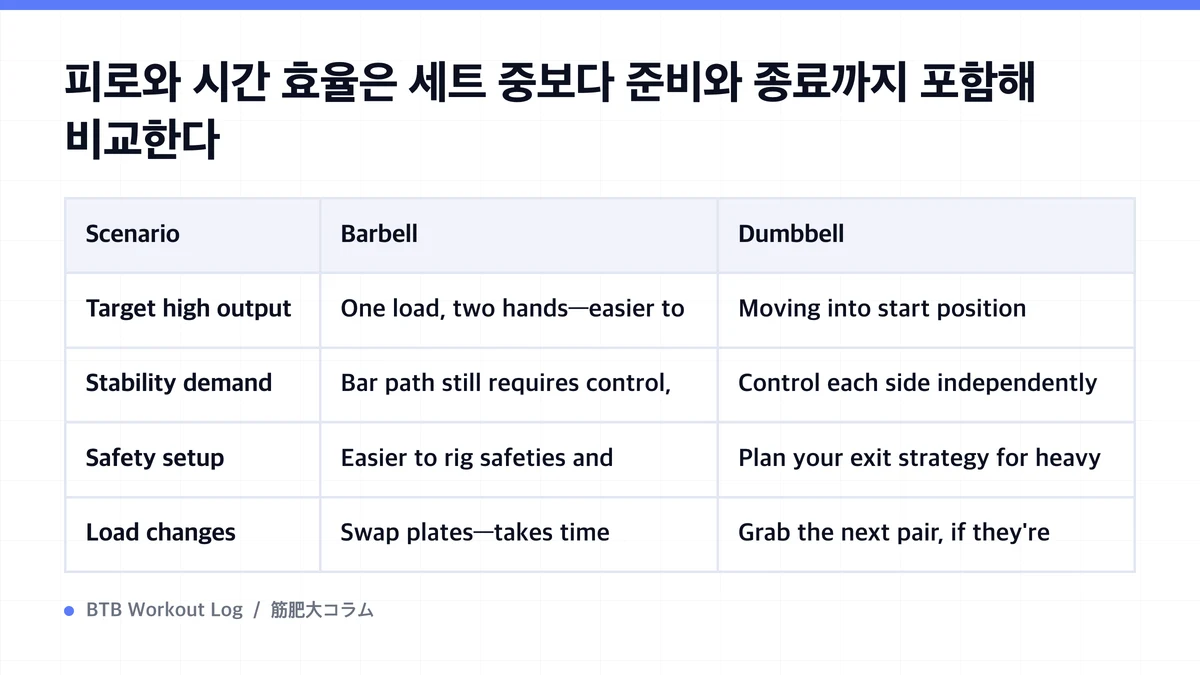
피로와 시간 효율은 세트 중보다 준비와 종료까지 포함해 비교한다
Barbell pressing means loading one bar with both hands—easy to add small plates for fine progression and straightforward to plan high-output sets. Solo lifters need to dial in rack height and safety pins beforehand. The rule: manage your 여력, use a spotter or proper safety bars, and don't chase limit reps carelessly.
Dumbbells demand independent stabilization of each side. Some lifters hit a wall with forearm and shoulder control before chest fatigue. As weight climbs, so do the logistics: moving dumbbells into position and clearing them safely afterward. That said, dumbbells don't monopolize a rack—if your gym stocks the weights you need within arm's reach, you'll keep momentum and minimize downtime.
| Scenario | Barbell | Dumbbell |
|---|---|---|
| Target high output | One load, two hands—easier to manage | Moving into start position becomes the limiter |
| Stability demand | Bar path still requires control, but hands are linked | Control each side independently |
| Safety setup | Easier to rig safeties and spotters | Plan your exit strategy for heavy singles |
| Load changes | Swap plates—takes time | Grab the next pair, if they're nearby |
Fatigue isn't just the burn—judge it by rep count in subsequent chest work and recovery heading into next session. If barbell lets you load heavy but demolishes every set after, that weight costs too much for your weekly volume. If dumbbells give you an intense stretch but stabilization exhausts you before your chest hits limit, you've lost the plot.
Barbell edges ahead on load incrementing, but dumbbell progress is absolutely achievable
For fine-grain progression, barbell wins in most setups. Fractional plates let you creep the total weight up in smaller steps, and you can lock in grip width and chest contact point the same way every time. If bench strength itself matters—not just 근비대—barbell specificity is a real win. That's why lifters chasing both size and lift numbers lean on barbell as their main lift.
Dumbbell steps are usually bigger. A 2 kg jump per hand means 4 kg total, and at certain loads that's a huge jump; you'll miss your target rep range the moment you go up. Double progression handles this neatly: stay in an 8–12 rep window across all sets, push reps to the top, then jump load. Reps dropping to the floor after a weight increase isn't 정체—it's part of the plan.
Meta-analyses comparing heavy and light loads—both driven to near-failure—show similar 근비대 returns below and above 60% 1RM, while strength gains favor heavy. This isn't a direct barbell-vs-dumbbell shootout, but it kills the myth that "heavy barbell = bigger chest" and "light dumbbells = inferior." Use the same RIR on either tool and push 점진적 과부하 within it.
Don't cross-compare bar weight to dumbbell weight. Barbell 80 kg versus 30 kg dumbbells per hand—that's meaningless. Look at the same 가동 범위 and similar RIR: did you add a rep or move up in load? If grip, bench angle, or depth changed, don't count the weight swing as progress alone.
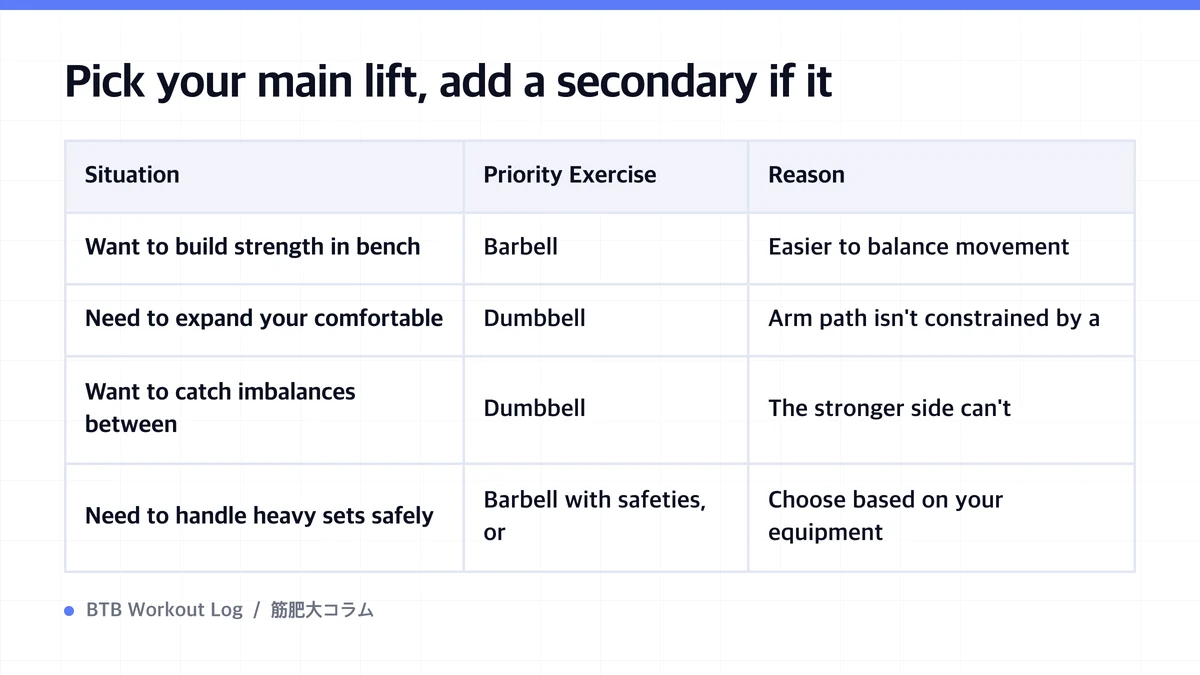
Pick your main lift, add a secondary if it fits—how to split them by context
| Situation | Priority Exercise | Reason |
|---|---|---|
| Want to build strength in bench press too | Barbell | Easier to balance movement practice with gradual load increases |
| Need to expand your comfortable stretch range | Dumbbell | Arm path isn't constrained by a bar, so you can adjust depth freely |
| Want to catch imbalances between sides | Dumbbell | The stronger side can't compensate for the weaker one |
| Need to handle heavy sets safely alone | Barbell with safeties, or dumbbells you can start and stop without help | Choose based on your equipment and what weight you can control safely |
| Limited time; want to stack chest volume | Whichever your gym has available | Less wait time and setup keeps your consistency up |
If you use both on the same day, split their roles. A common pairing is barbell for low-to-mid rep ranges where you chase output, then dumbbells for mid rep ranges to dial in arm path and 가동 범위. That said, if your chest feels more stable with dumbbells, lead with those instead. Just having both available shouldn't be the goal—if they're triggering similar stimulus and only your weekly set count grows, one lift is enough.
Pick your main lift by holding conditions steady for four to eight weeks. Track weight, reps, RIR, which body part fatigued first, shoulder response, and whether output stays up. Check your reps next session and whether chest sets are climbing. When progress stalls, look at the root causes of bench press 정체 before deciding which tool wins.
Choose barbell if raw output and fine-tuned progression matter most. Choose dumbbell if an independent path and personalized depth work for your body. If both build enough chest stimulus, pick your main lift based on your goal, what equipment you have, shoulder comfort, and what lets you keep progressing—only add the second one if it fills a real gap.
자주 묻는 질문
- Should beginners start with barbell or dumbbell bench press?
- Pick whichever lets you practice your starting position and exit safely with light weight. If your gym has safeties you can set properly, barbell teaches bar path well. If you can handle light dumbbells steadily, you'll also catch side-to-side differences. No need to chase heavy weight from day one.
- Can I do both barbell and dumbbell on the same chest day?
- Yes, but don't duplicate their roles. One should chase output and progress; the other adjusts 가동 범위 or arm path. If your reps drop hard in the second lift or you're not 회복 by next session, keep both but don't add sets—adjust what you have.
- Is dumbbell safer if my shoulder feels off?
- Some people find it easier because hand angle and path are adjustable, but dumbbells aren't automatically safer. Review your weight, lowering depth, and elbow angle instead, and stay in the pain-free range. If you feel sharp or ongoing discomfort, stop and consult a professional.
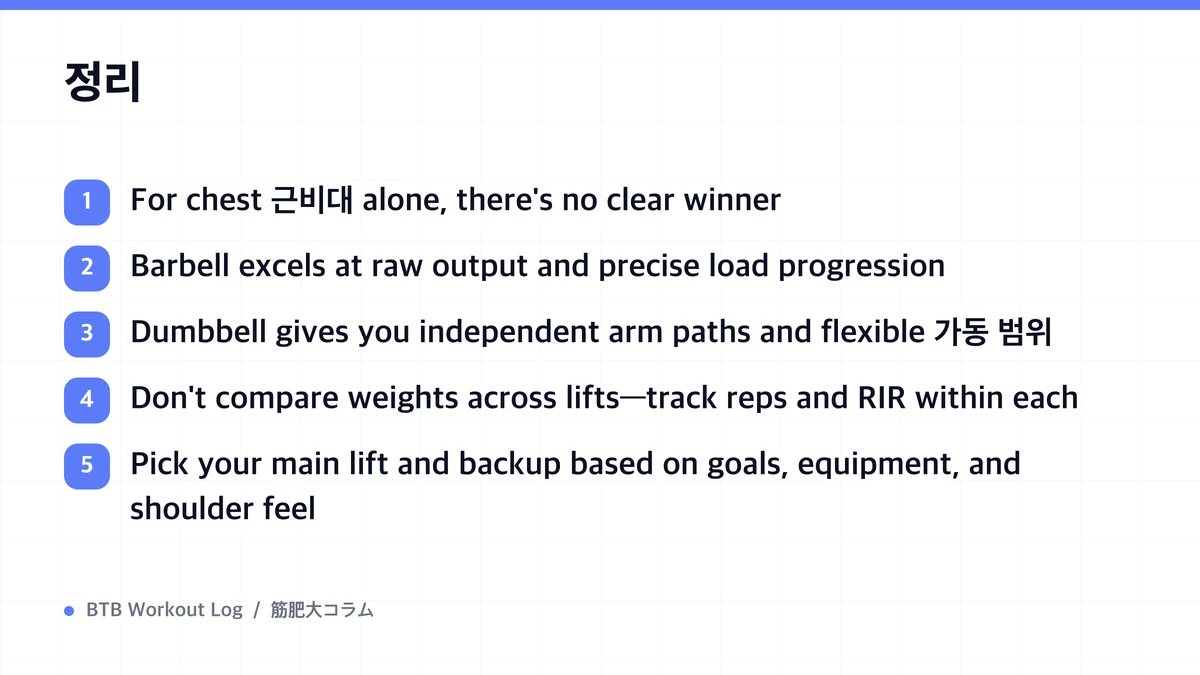
정리
- For chest 근비대 alone, there's no clear winner
- Barbell excels at raw output and precise load progression
- Dumbbell gives you independent arm paths and flexible 가동 범위
- Don't compare weights across lifts—track reps and RIR within each
- Pick your main lift and backup based on goals, equipment, and shoulder feel