'올바른 자세는 하나뿐이다'를 믿으면 손해 | 근비대를 위해 알아야 할 진짜 이유
위험한 것은 폼을 소중히 여기는 것이 아니라, 모든 사람·모든 목표에 적용되는 하나의 형태를 정답으로 삼고 골격, 통증, 목표 근육, 기구의 차이를 무시하고 강요하는 것입니다.
좋은 폼에는 지켜야 할 조건이 있습니다. 하지만 그 조건을 만족하는 동작은 한 가지만 있는 게 아니며, 재현성을 유지하면서 개인에 맞게 조정할 여지가 있습니다.
"교과서 같은 형태가 유일하게 올바르다"는 게 어떻게 위험한가
폼 지도에서는 발 너비, 그립 너비, 관절 각도, 바의 궤적까지 하나의 형태로 제시되기도 합니다. 기준이 있으면 동작을 배우기 쉽고 명백한 붕괴도 알아채기 쉬워서, 초기의 참고로서는 유용합니다. 문제는 그 참고를 누구나 같은 형태로 재현해야 하는 완성 형태로 격상시킬 때 발생합니다.
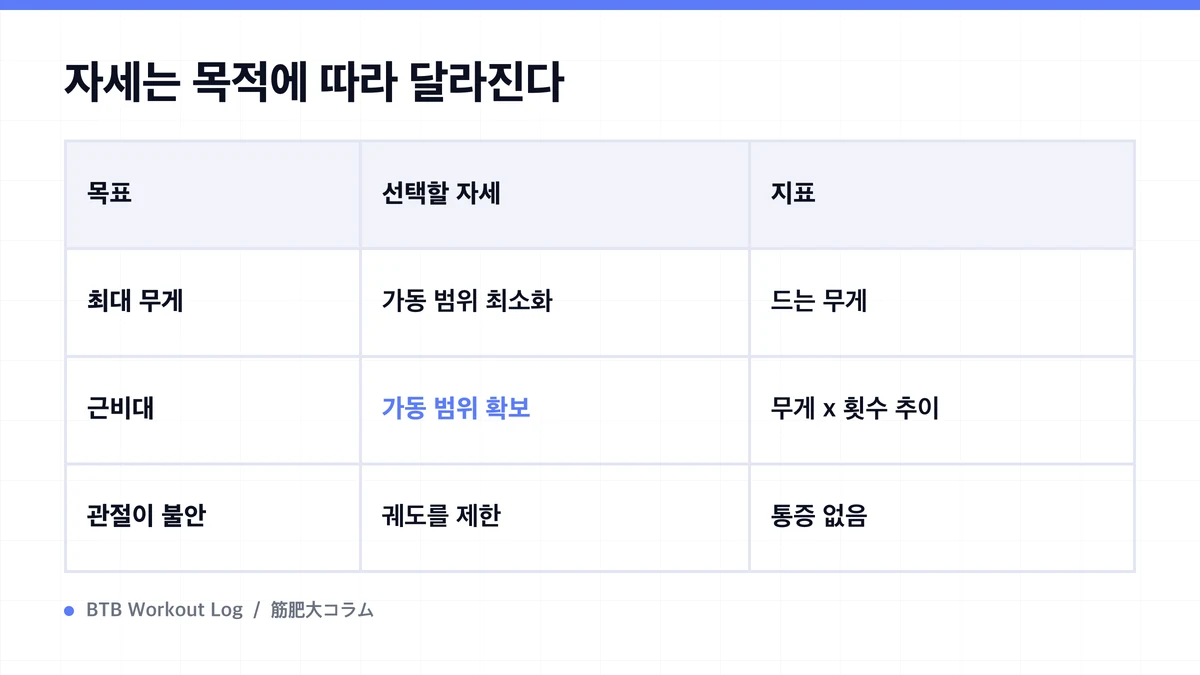
팔다리의 길이, 관절이 움직이기 쉬운 방향, 현재의 가동 범위, 기구의 구조는 사람마다 다릅니다. 게다가 같은 벤치프레스라도 경기로서 무거운 무게를 들어올리는 것과 근비대 목표로 대흉근에 안정적으로 부하를 주는 것은 우선하는 조건이 같지 않습니다. 하나의 외형에 맞추려고 하면 그 사람에게 다루기 어려운 자세를 강요하거나, 목표에 맞는 조정까지 "틀린 것"으로 버릴 수 있습니다.
반대로 "개인차가 있으니 자유로워도 된다"고 생각하는 것도 극단적입니다. 제어할 수 없는 반동, 무게에 눌려서 바뀌는 궤적, 회수를 늘리기만 하려고 좁아지는 가동 범위는 의도된 조정과 구분이 필요합니다. 풀레인지를 기본으로 하는 이유도 모든 사람의 관절을 같은 최대 각도까지 움직이기 위함이 아니라 대상 근육을 넓은 범위에서 작동시키고 동작 조건을 맞추기 위한 것입니다.
폼을 안정화하는 생각은 맞습니다
"폼을 고정한다"는 조언에는 중요한 의미가 있습니다. 무게나 회수의 증가를 평가하려면 이전과 이번의 조건이 비슷해야 합니다. 그립 너비, 발 너비, 시트 위치, 가동 범위, 반동 사용 방법이 매번 바뀌면 숫자가 증가해도 근력이 올랐는지, 동작을 유리하게 바꿨을 뿐인지 판별하기 어려워집니다.
여기서 고정하고 싶은 것은 사진 같은 하나의 자세가 아니라 그 사람이 선택한 실행 조건입니다. 목표 근육과 운동의 역할을 정하고, 통증 없이 제어할 수 있는 범위에서 시작 위치와 종료 위치, 주요 궤적, 템포 방침을 맞춥니다. 이 재현성이 있어야 처음으로 점진적 과부하를 무게나 회수의 추이로 확인할 수 있습니다.
| 구분 | 확인할 내용 | 생각하기 |
|---|---|---|
| 지켜야 할 조건 | 동작을 제어할 수 있음, 예리한 통증 없음, 목표한 가동 범위 유지 | 세트 중에도 크게 무너뜨리지 않기 |
| 맞춰야 할 조건 | 그립, 발 너비, 시트, 가동 범위, 반동 정도 | 이전과의 비교에 사용 |
| 조정할 수 있는 조건 | 관절 각도, 궤적, 스탠스, 기구, 운동 변형 | 목표와 개인차에 맞추기 |
어디까지가 개인차이고 어디부터가 붕괴인가
개인차로 허용할 수 있는 변화와 부하를 견디지 못해 생긴 붕괴는 외형만으로는 구별할 수 없습니다. 판단의 기준은 그 변화가 의도되었는지, 재현할 수 있는지, 목표에 맞는지입니다. 예를 들어 스쿼트의 발 너비를 넓힌 결과 목표한 깊이까지 안정적으로 앉을 수 있다면 조정입니다. 같은 세트의 후반부에만 갑자기 발 너비나 무게중심이 바뀐다면 피로로 인한 붕괴를 의심해야 합니다.
가동 범위도 마찬가지입니다. 풀레인지는 좋은 초기 설정이지만 "관절의 끝까지 가는 것"과 동의어는 아닙니다. 대상 근육에 부하를 유지하면서 자세를 제어할 수 있는 범위를 기준으로 합니다. 통증이나 기구의 제약이 있을 때는 가동 범위를 조정하는 선택지가 있지만, 단지 무거운 무게를 다루려고 줄인 경우와는 구분해서 기록할 필요가 있습니다. 풀레인지와 부분 가동 범위의 사용 구분은 풀레인지와 파셜의 비교에서도 같은 전제가 중요합니다.
또한 폼의 일부를 바꾸면 같은 운동 이름이어도 부하 분포나 어려운 구간이 달라집니다. 그립을 바꾼 세트를 이전과 같은 조건의 개인 최고 기록으로 취급하는 것은 적절하지 않습니다. "이전보다 들었다"는 것과 "이전과 같은 동작으로 능력이 올랐다"는 것을 구분하는 것만으로도 폼 조정과 진전 평가를 동시에 할 수 있습니다.
연구가 보여주는 것은 "바뀌면 결과도 바뀐다"는 것
Bench press research shows that variations in bench angle and execution method produce uneven activation and performance across different pec regions. The same principle applies to back and shoulder work—exercise selection and execution conditions shift the distribution of muscle activity. This demonstrates why pinning a single aesthetic form as the universal solution is impractical.
However, a form that shows high muscle activity in a brief measurement window cannot be automatically declared superior for long-term 근비대. Muscle activation data, lifting performance, and 근비대 measured months later are separate evaluations. Different subject experience, exercise choice, load, and measurement sites will produce different outcomes.
Resistance training reviews treat 근비대 stimulus as multiple variables—not just load, but frequency, intensity, volume, and movement pattern. Form relates to movement pattern and load distribution. Rather than extracting a universal trajectory from research, it's more practical to fix your goal, keep conditions consistent, and monitor your response.
Why one form looks like the right answer
In coaching, simpler cues travel better—"don't let your knees cave," "keep your elbows at this angle." These rules help when learning complex movement, but they're originally fixes for specific people with specific problems. Once the original context disappears, they persist as universal law and turn adjustable variables into forbidden territory.
Advanced lifters' videos are easy to imitate as "the answer." But form optimized for that athlete's skeleton, sport rules, years of training, and loaded weights may not transfer directly to your 근비대 work. Videos also show one rep from one angle—they don't capture pain, stability, local muscle fatigue on the target, or rep-to-rep consistency across a set.
Avoid choosing form based only on feel. Sensation can guide adjustments, but a strong pump or burn alone doesn't determine long-term superiority. Separate the pump sensation from objective metrics: weight and reps at the same conditions, RIR, and 회복. Distinguish between feel and actual performance.
In practice: decide by goal, constraint, then record
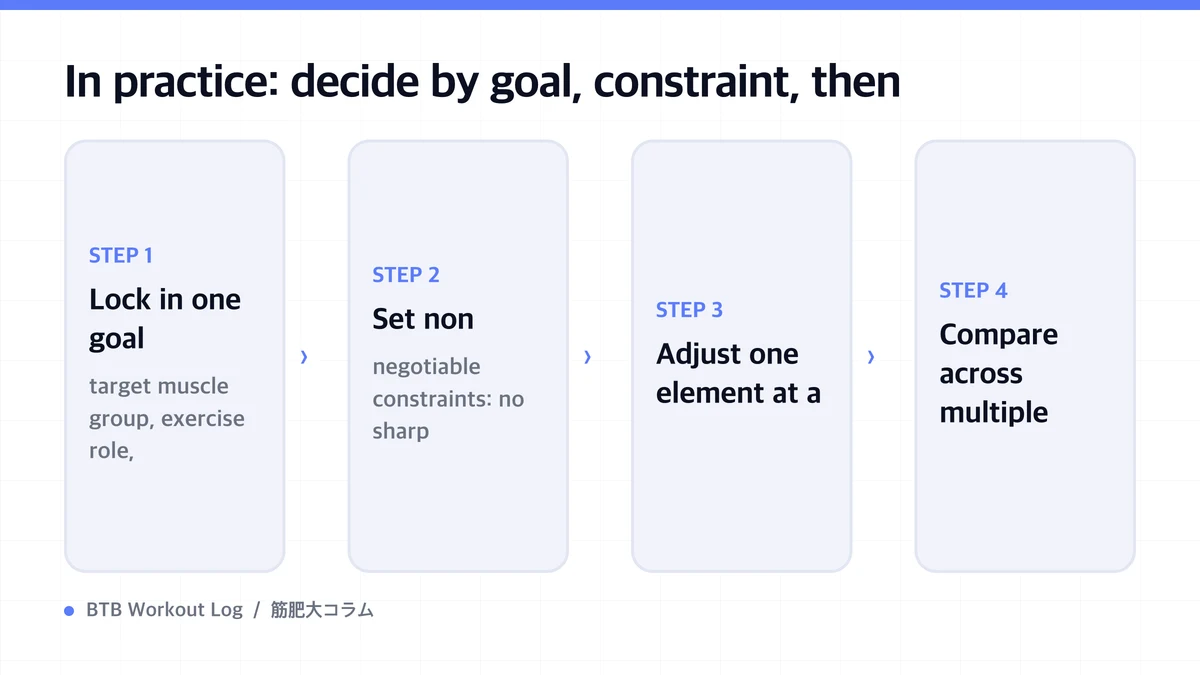
Instead of hunting for the correct form video, narrow conditions in this order:
- Lock in one goal: target muscle group, exercise role, and 렙 범위.
- Set non-negotiable constraints: no sharp pain, load stays controlled, target 가동 범위 is repeatable.
- Adjust one element at a time: don't change grip, stance width, seat position, and bar path all at once.
- Compare across multiple sessions: at similar RIR, check reps, stability, unwanted muscle fatigue, and 회복 by next session.
- Lock in your conditions: once improvement shows, keep those variables constant for a training block, then progress weight or reps.
If sharp pain appears, worsens over reps, or persists even at lower loads, skip form tweaks and consult a professional. Conversely, if your form looks slightly different from the textbook but you move smoothly, target the right muscle, and progress matches your goal, question whether change is needed at all.
Just as progress isn't only weight gain each session, don't directly compare numbers before and after a form change—treat them as separate conditions.
자주 묻는 질문
- Should I copy the same form as someone else doing the same exercise?
- Limb length, comfortable joint angles, equipment, and goals all shift what stance width or bar path suits you. Use a reference form as a starting point, then prioritize staying pain-free and in control while reproducing your target 가동 범위 and movement conditions.
- Does my record become invalid if I change form?
- Not invalid, but track it separately as your previous-condition personal best. Log the date you changed grip or 가동 범위, establish a baseline over a few reps in the new condition, then compare weight and rep progress from there.
- Is any form fine as long as it doesn't hurt?
- No pain is important, but not enough. Check whether you control the load, hold your target muscle group and 가동 범위, and stay stable even late in the set. If sharp pain or worsening discomfort appears, stop and consult a professional if needed.
정리
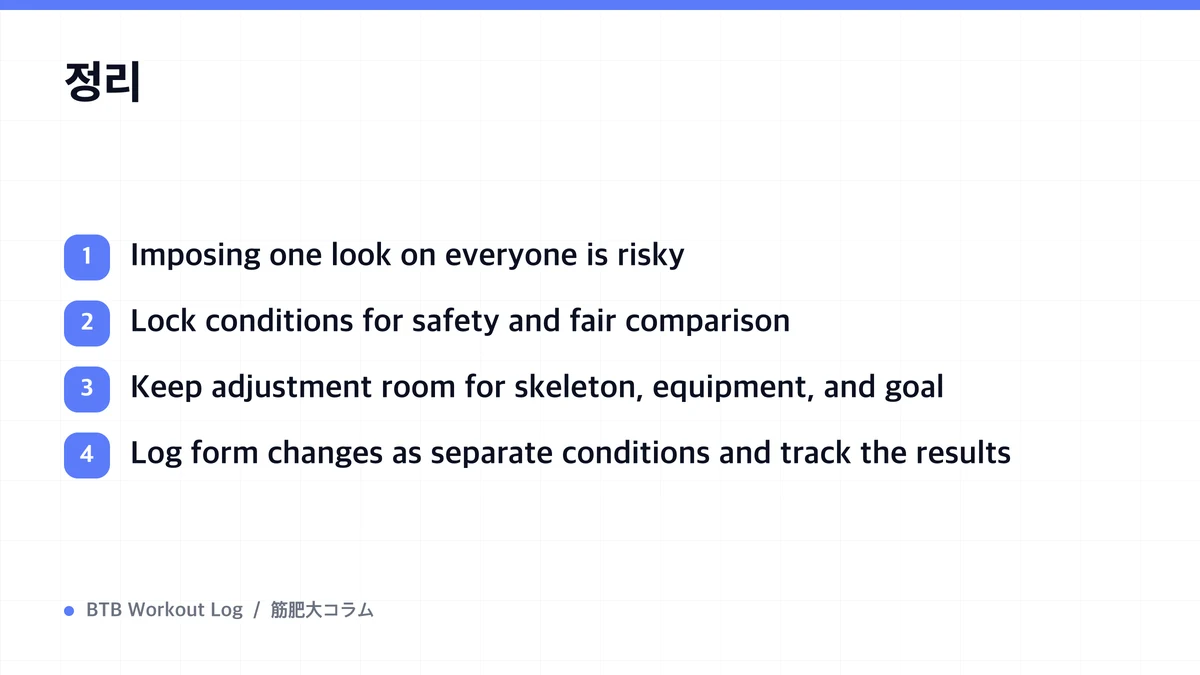
- Imposing one look on everyone is risky
- Lock conditions for safety and fair comparison
- Keep adjustment room for skeleton, equipment, and goal
- Log form changes as separate conditions and track the results
참고문헌
- Non-uniform Excitation of the Pectoralis Major During Flat and Inclined Bench Press
- The Effects of Bench Press Variations in Competitive Athletes on Muscle Activity and Performance
- Variations in Muscle Activation During Traditional Latissimus Dorsi Exercises
- Different Shoulder Exercises Affect the Activation of Deltoid Portions
- The Influence of Frequency, Intensity, Volume and Mode of Strength Training on Whole Muscle Cross-sectional Area in Humans