'BIG3만으로 충분하다'는 어디까지 맞을까? 복합 운동만으로는 자라기 힘든 부위가 있다
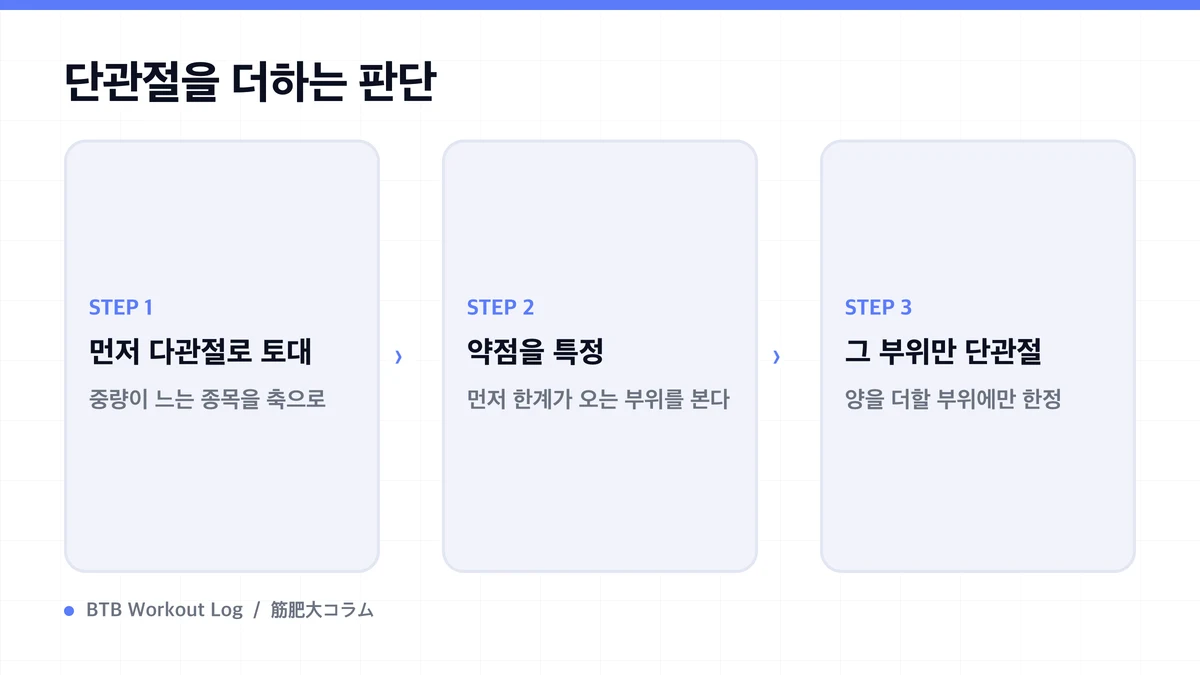
전신을 효율적으로 단련하는 기초로는 충분하지만, 목표하는 모든 근육을 완벽히 발달시키는 처방으로는 미완성입니다. 다관절 운동을 중심에 두되, 약점이나 자극 부족이 확인된 부위에만 단관절 운동으로 보완하는 것이 현실적입니다.
다관절이냐 단관절이냐의 이분법이 아니라, 각 운동이 어느 근육을 늘리는 역할을 할지로 생각하면 필요한 운동과 생략할 수 있는 운동을 구분할 수 있습니다.
"BIG3만 하면 전신에 효과가 있다"는 생각
스쿼트, 벤치프레스, 데드리프트, 로우, 풀업처럼 여러 관절이 움직이는 운동을 다관절 운동이라 부릅니다. 한 동작으로 여러 근육군에 부하를 줄 수 있고, 무게나 반복 횟수를 단계적으로 늘리기 쉬워 근비대 프로그램의 중심에 두는 것이 합리적입니다.
여기서 "주요 다관절 운동 몇 가지만 하면 단관절 아이솔레이션 운동은 불필요하다"는 주장이 나옵니다. 시간이 제한적이고 전신을 대략적으로 발달시키는 것이 목표라면 이 단순화는 작동합니다. 프레스에서는 가슴뿐 아니라 삼두근과 전면 삼각근이, 풀에서는 등뿐 아니라 팔꿈치 굽힘근들이 작동하므로 한 세트를 여러 부위의 자극으로 활용할 수 있기 때문입니다.
하지만 여러 근육이 참여한다는 것과 참여한 모든 근육이 동등한 자극을 받는다는 것은 별개입니다. 근육 그룹당 주간 세트 수를 계산할 때 벤치프레스 1세트를 가슴·삼두·어깨 각 1세트씩으로 기계적으로 삼중 계산하면 실제 자극을 과대평가할 수 있습니다.
다관절 운동만으로도 충분한 조건
다관절 운동만으로 성공하기 쉬운 경우는 목표와 제약이 명확할 때입니다. 먼저 운동 시간을 단축하면서 전신 근량과 기초 근력을 늘리려는 사람에게는 동작별 다관절 운동에 집중할 가치가 있습니다. 운동을 줄이면 연습 기회가 늘어나 이전과 같은 조건에서 무게, 반복 횟수, RIR를 비교하기 쉬워집니다.
다음으로, 각 운동에서 목표하는 주동근이 실제로 세트 성공을 결정하고, 그 근육의 퍼포먼스가 계속 향상하고 있을 때입니다. 예를 들어 가슴을 목표로 한 프레스에서 가슴의 국소 피로가 충분히 생기고, 같은 가동 범위와 RIR에서 반복 횟수나 무게가 올라가고 있다면, 플라이를 추가할 긴급성은 낮습니다. 더하기 전에 현재 운동에서 점진적 과부하를 계속할 수 있는지 먼저 확인하는 것이 우선입니다.
또한 약점 부위를 세세하게 조각내기보다는 적은 운동을 오래 반복하는 시기에도 맞습니다. 초보자 초기, 중단 후 재개 시기, 바쁜 주의 유지 운동 등입니다. 이 경우의 "충분"은 전신을 균등하게 최대화한다는 뜻이 아니라 제한된 시간 내에 목표를 충족한다는 뜻입니다.
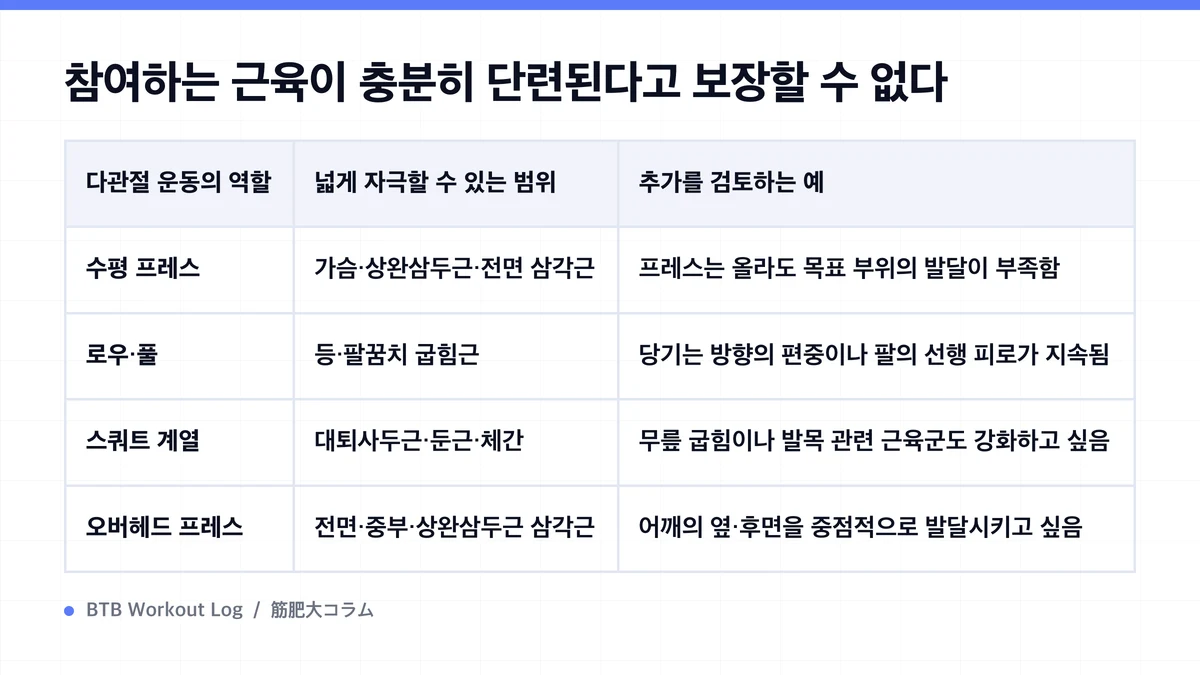
참여하는 근육이 충분히 단련된다고 보장할 수 없다
다관절 운동에서는 여러 근육과 관절이 한 번의 반복을 함께 완성합니다. 세트를 멈추는 것이 단련하고 싶은 주동근이 아닐 수 있습니다. 가슴에 여력이 남아도 삼두가 먼저 지치면 프레스가 끝나고, 등에 여력이 남아도 악력이나 팔꿈치 굽힘근이 먼저 한계에 가까워지면 풀이 멈춥니다. 공동 동작에서 약한 부분이 다른 근육의 자극량까지 제한할 수 있다는 뜻입니다.
반대로 보조적으로 작동하는 근육이 항상 부족한 것도 아닙니다. 많은 프레스를 하는 사람의 전면 삼각근에 직접 세트를 더 추가하면 발달 이전에 회복이나 관절 부담이 문제가 될 수 있습니다. 간접 자극은 0이 아니지만 직접 세트와 같지도 않으며, 운동 종류, 폼, 가동 범위, 개인의 동작 전략에 따라 기여도가 달라집니다. 가슴 운동 날 삼두가 먼저 지치는 이유처럼 어느 근육이 세트를 제한했는지까지 봐야 합니다.
| 다관절 운동의 역할 | 넓게 자극할 수 있는 범위 | 추가를 검토하는 예 |
|---|---|---|
| 수평 프레스 | 가슴·상완삼두근·전면 삼각근 | 프레스는 올라도 목표 부위의 발달이 부족함 |
| 로우·풀 | 등·팔꿈치 굽힘근 | 당기는 방향의 편중이나 팔의 선행 피로가 지속됨 |
| 스쿼트 계열 | 대퇴사두근·둔근·체간 | 무릎 굽힘이나 발목 관련 근육군도 강화하고 싶음 |
| 오버헤드 프레스 | 전면·중부·상완삼두근 삼각근 | 어깨의 옆·후면을 중점적으로 발달시키고 싶음 |
연구는 "다관절만으로 충분하다"고 보여주지 않는다
The ACSM's position stand on resistance training calls for exercise selection that includes both single-joint and multi-joint movements. While multi-joint work takes priority in many contexts, the prescription isn't to eliminate single-joint moves for hypertrophy—it's a matter of varying the approach based on goals, ability level, and training experience.
Muscle activity research provides insight into how different exercises produce different stimuli. Bench press, shoulder press, and lateral raise show that the anterior, medial, and posterior deltoids don't activate uniformly. The evidence makes it hard to claim that "any multi-joint shoulder movement hits all three heads equally." Structuring shoulder work around these activation differences ties directly into developing balanced shoulder size.
At the same time, high muscle activity during a lift doesn't automatically predict long-term hypertrophy gains—the measurements differ. Electromyography is a snapshot; muscle thickness and cross-sectional area months later are separate outcomes. With the quadriceps and elbow flexors, when frequency, intensity, and volume are adequate, hypertrophy occurs across multiple movement patterns. In practice, exercise selection avoids treating any one category as sacred. The real question is how to distribute the right stimulus to target muscles based on your goal.
Why compound-only training seems to work
First, multi-joint lifts show measurable progress. When your squat or bench press goes up, you feel the whole program working. But loaded weight depends not just on the muscles involved, but also on technique, coordination, and how comfortable you are in a 가동 범위. A new PR matters, but it doesn't prove each targeted area developed as planned.
Second, early training responds broadly to minimal exercise selection, so differences don't show up yet. As experience builds and you pursue specific weak points or aesthetic balance, you run into gaps that full-body compound movements alone can't address. What you need then isn't unlimited exercise variety—it's pinpointing what's missing.
Third, simple rules are easier to teach. "Build your program around basics" is solid advice, but it warps into "anything else is waste." The opposite—"more exercises always mean more angles and more growth"—carries the same flaw. As with the misconception that exercise count drives growth, what matters isn't labels or totals, but the role each lift plays and your response after adding it.
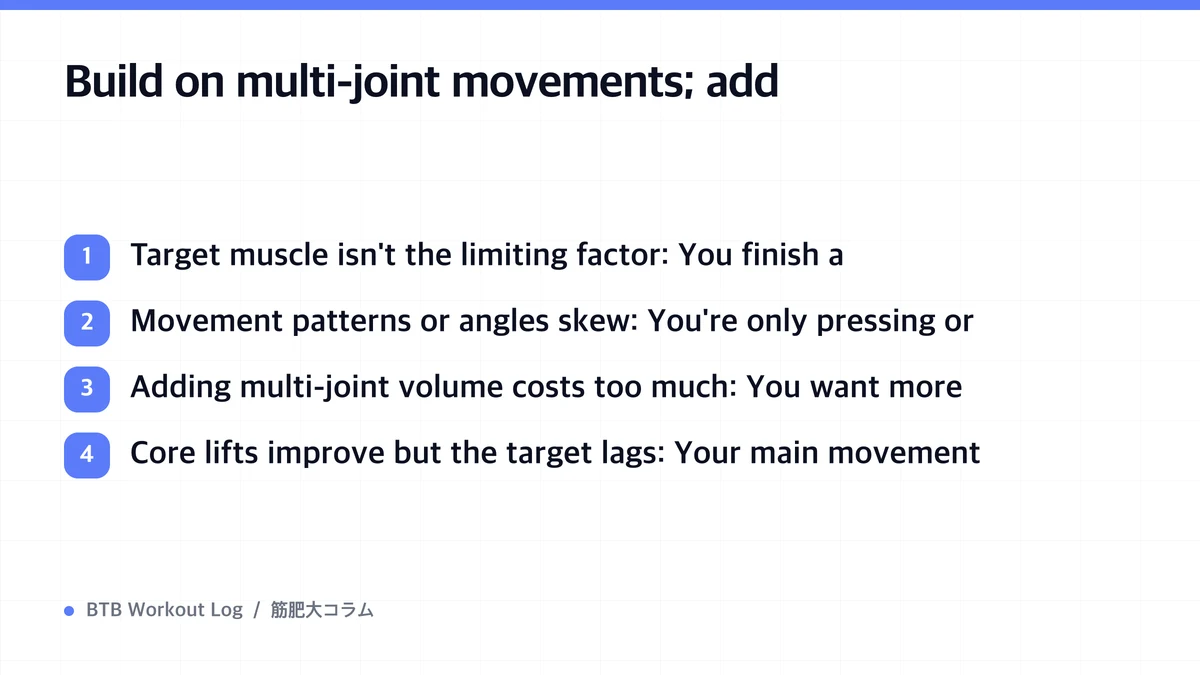
Build on multi-joint movements; add single-joint work where gaps appear
Start by filling main movement slots—horizontal press, vertical press, horizontal pull, vertical pull, squat, hinge—with multi-joint exercises. Then pick one lift as your progress metric per muscle group. For chest, that might be bench; for back, rows or pull-ups; for side delts, lateral raises. Even if a lift recruits multiple areas, don't leave the primary intent fuzzy.
Add isolation work when you see these markers:
- Target muscle isn't the limiting factor: You finish a multi-joint lift when another muscle or whole-body fatigue hits; the target still has 여력.
- Movement patterns or angles skew: You're only pressing or pulling one direction, with no dedicated work for the area you want to grow.
- Adding multi-joint volume costs too much: You want more sets on the target muscle, but lower back, grip, breath, or joint stress climbs first.
- Core lifts improve but the target lags: Your main movement numbers climb, yet size or strength indicators for the muscle haven't budged over weeks.
When any apply, introduce a small amount of single-joint work without overhauling everything else, then watch for several weeks. If the added lift's weight or reps climb and your core lifts stay solid with good 회복, keep it. If core lifts drop or you just get local burn with no real progress, cut the volume or drop the addition. Muscle soreness and the pump are secondary data; don't anchor a decision to them.
Stop choosing based on ideology. Choose based on which split lets you drive target-muscle progress while staying within 회복. That builds the tightest effective menu.
자주 묻는 질문
- Can beginners start with only compound exercises?
- Starting compound-only works well for building full-body strength and learning basic movement patterns. However, if you notice a particular muscle tiring first or can't evaluate stimulus to small areas like the side delts or calves, add small amounts of single-joint work.
- If arm size is your goal, is pressing and pulling alone enough?
- The triceps and elbow flexors get indirect stimulus, but that often isn't enough if arms are primary. Watch whether arms become the limiting factor before chest and back, or whether they still have 여력 left. Use that to decide whether to add direct elbow extension and flexion work.
- Do I count one set of a compound exercise as one set for secondary muscles too?
- Avoid mechanically counting the secondary muscle's set the same as the primary. Secondary contribution varies by lift and form. Start by logging direct sets and indirect stimulus separately, then adjust your direct set count based on target-muscle progress and 회복.
정리
- Multi-joint lifts alone train a broad range efficiently
- Not every muscle gets adequate stimulus from compound work alone
- Use single-joint moves to fill gaps without heavy systemic fatigue
- Decide whether to keep additions based on muscle-group volume and per-lift progress