스트레칭 포지션에서 부하를 걸면 근비대가 잘될까? 요즘 주목받는 '늘린 상태로 자극하기'의 원리
근육이 신장된 위치에서 충분한 긴장을 받으면, 짧은 위치만으로는 얻기 어려운 역학적 조건을 만들 수 있어 근비대에 유리해질 수 있습니다. 효과를 내는 것은 신장감 자체가 아니라 긴 근길이에서 목표 근육이 실제로 력을 발휘하고 있다는 점입니다.
관절을 깊게 구부리는 것, 근육이 늘어나는 것, 그 위치에서 부하가 크다는 것은 각각 별개의 조건입니다. 이 셋을 구분하면 어떤 종목을 선택하고, 얼마나 움직이며, 무엇을 기록해야 하는지 보입니다.
'신장된 상태'와 '부하가 걸린 상태'는 다르다
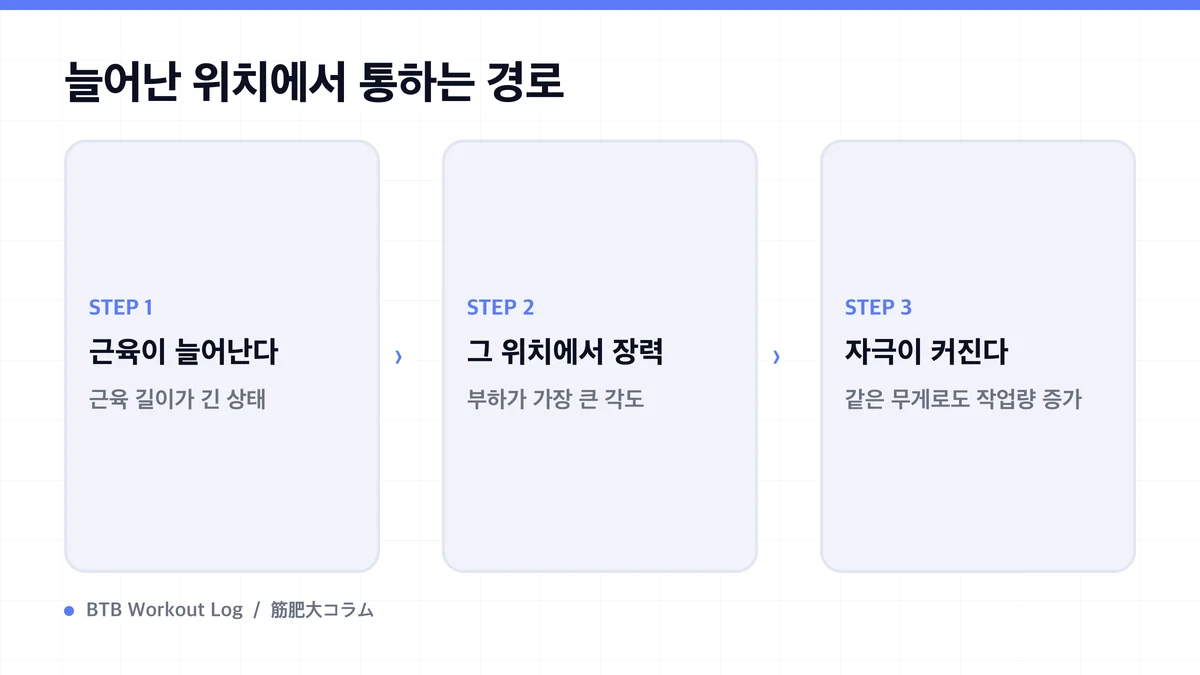
여기서 근길이란 목표 근육이 관절 위치에 따라 얼마나 길어지는지를 말합니다. 예를 들어 발목을 배굴한 종아리 레이즈 최하단에서 종아리가 길어지고, 오버헤드 트라이셉스 익스텐션 최하단에서 삼두근 장두가 길어집니다. 하지만 근육이 길기만 해서는 근비대 자극을 설명할 수 없습니다.
근육이 발휘해야 할 힘은 외부 무게뿐 아니라 그 무게의 작용선과 관절 사이의 거리, 즉 외적 모멘트 암으로 결정됩니다. 근육이 가장 신장된 끝점에서도 중력이나 케이블 방향으로 관절을 회전시키려는 힘이 거의 없다면, 목표 근육이 발휘하는 힘도 작아집니다. 반대로 겉으로 보기에 무게가 가벼워도 긴 위치에서 큰 관절 토크에 저항하고 있다면, 목표 근육에는 무시할 수 없는 긴장이 걸립니다.
따라서 확인해야 할 순서는 ①관절 위치에 따라 목표 근육이 길어진다, ②그 구간에 외부 저항이 남아있다, ③자세를 유지하면서 목표 근육으로 저항에 저항한다, 입니다. 단순히 동작 거리를 늘리는 것과의 차이는 가동 범위에서 자극이 변하는 메커니즘에서 정리할 수 있습니다.
관절 각도가 변하면 목표 근육에 필요한 긴장이 변한다
외부 저항이 관절을 구부리거나 펼치려 하는 힘에 대해, 목표 근육은 반대 방향의 관절 토크를 만듭니다. 이 필요 토크는 동작 중 항상 같지 않습니다. 관절 각도, 도구의 궤적, 케이블 방향, 신체 기울임이 바뀌면 같은 10kg이라도 힘든 구간이 이동합니다. 이것이 종목마다의 저항 곡선입니다.
긴 근길이 쪽에 부하를 거는 종목이란 최하단을 깊게 하는 종목이 아니라, 목표 근육이 긴 구간에서도 필요 토크가 충분히 남아있는 종목입니다. 예를 들어 루마니안 데드리프트는 고관절을 구부릴수록 바벨과 고관절 사이 수평 거리가 생기고, 햄스트링 같은 고관절 신전근이 긴 상태에서 저항합니다. 반면 프리웨이트 종목은 끝점에서 외적 모멘트가 작아질 수 있어서 '가장 신장된 자리가 가장 힘들다'고만 할 수 없습니다.
여기서 중요한 것은 무게 표기에서 근육 긴장을 직접 읽을 수 없다는 점입니다. 머신의 캠, 케이블 위치, 팔다리 길이, 폼에 따라 필요 토크는 달라집니다. 종목명만으로 판단하지 말고, 어느 관절 각도에서 감속하는지, 반동 없이 전환할 수 있는지, 목표 근육 이외가 먼저 제한하지 않는지까지 관찰하면 긴 위치의 부하를 실용적으로 구분할 수 있습니다.
긴 근길이에서는 능동 긴장과 수동 긴장의 조합이 바뀐다
근육이 힘을 낼 때는 근섬유가 수축하면서 만드는 능동 긴장뿐 아니라 길어질수록 티틴이나 결합조직 같은 탄성 요소가 만드는 수동 긴장도 관여합니다. 둘의 비율은 근육, 관절 각도, 동작, 개인에 따라 다르고, 긴 위치면 총 긴장이 항상 최대가 되는 것은 아닙니다. 그래도 짧은 위치에만 편중된 동작과는 다른 긴장 환경을 만들 수 있다는 점이 중요합니다.
긴 근길이에서 외부 저항에 저항하면, 신장된 근섬유와 주변 구조가 힘을 받으며 수축합니다. 이때 생기는 기계적 변형은 근섬유 내 감지 기구를 통해 단백질 합성과 구조 재편에 관련된 신호로 변환됩니다. 자극 후 회복과 재료 공급을 거쳐 이 과정을 반복하면서 근섬유 단면적이 장기적으로 증가하는 것이 근비대까지의 기본 인과 사슬입니다.
긴 근길이 쪽이 유리해질 수 있는 것은 이 성장 경로에 별개의 스위치가 있어서가 아니라, 긴장을 받는 위치와 조직 내 분포가 바뀌기 때문이라고 보는 것이 합리적입니다. 수동 긴장이 근비대에 얼마나 직접 기여하는지, 근육마다의 차이를 뭐가 결정하는지 등은 아직 미해결 부분도 있습니다. 따라서 '늘릴수록 성장한다'는 직선적 설명은 할 수 없습니다.
근비대에 유리한 것은 긴 위치에서 고품질 반복을 쌓을 수 있을 때
Loading at the stretched position only works if you reach long muscle length and repeat sets through that range with sufficient effort. If you lighten the weight to the point where you finish with significant 여력 remaining, you'll get minimal tension stimulus even though you're using the longer position. Conversely, if you stick with the weight and use momentum through the endpoint, or if joints and secondary muscles—not the target—limit your range, you've missed the point entirely.
Adding stretched-position work also increases your 주간 세트 수, which muddies whether improvements come from muscle length or just more volume. To test fairly, replace part of your current work first and keep total 주간 세트 수 roughly constant—this makes cause-and-effect clearer. Whether to use full 가동 범위 or partial reps in the longer range isn't settled ideology; you choose based on the target muscle, resistance curve, and joint tolerances. For comparison guidelines, see how to apply full-range versus partial reps.
With unfamiliar stretched-position movements, dial back load and reps for the first few sessions. Watch not just next-day soreness but also joint pain, your output on follow-up workouts, and whether you can reproduce the same 가동 범위 each time. Sudden heavy loads at a new muscle length spike recovery cost, so start by finding the control threshold within current volume rather than stacking sets—it's safer and makes comparisons cleaner.
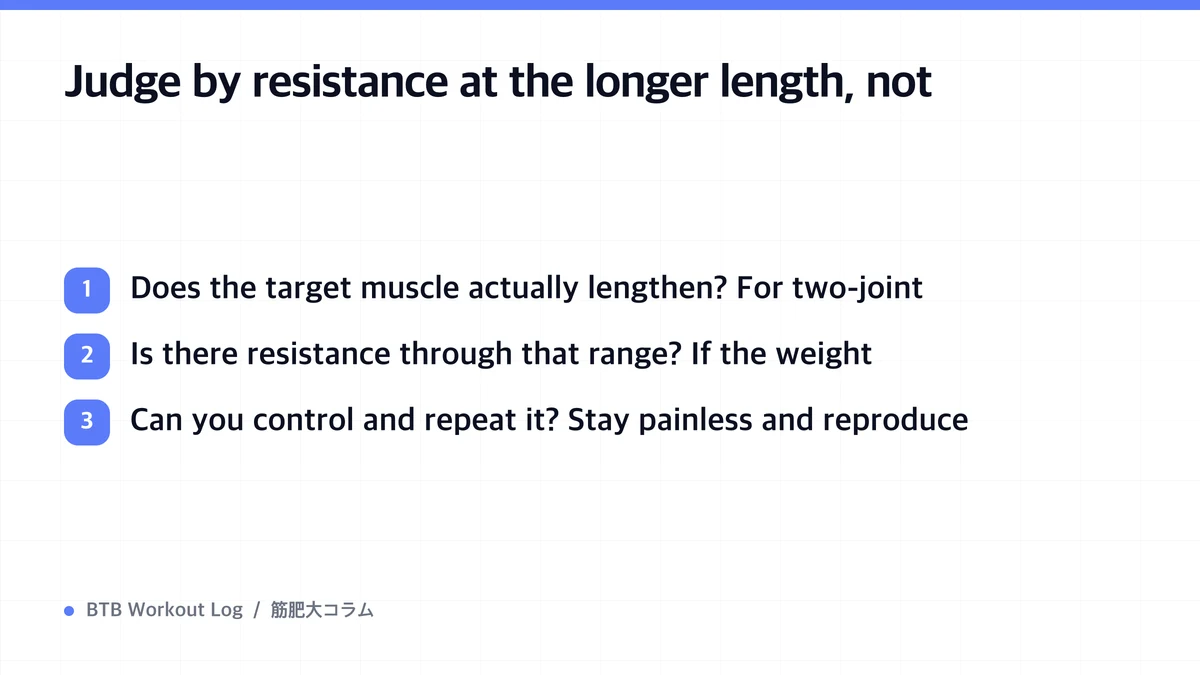
Judge by resistance at the longer length, not exercise name
Loading the longer muscle length isn't just about moving into deeper 가동 범위. You can shift resistance by changing joint angle, body orientation, cable height, or 머신 resistance curve. When choosing, check these three things together:
- Does the target muscle actually lengthen? For two-joint muscles, confirm both end positions, not just one joint.
- Is there resistance through that range? If the weight stacks touch, the cable goes slack, or gravity's moment disappears, reconsider.
- Can you control and repeat it? Stay painless and reproduce the same endpoint and posture every set within a manageable 가동 범위.
Real-world examples include the dorsiflexion end of calf raises, the long head of the triceps in overhead presses, and hamstrings in hinged hip patterns. That said, lengthening anatomically and loading hard through that range on a given tool are separate checks. You don't need to chase extreme joint angles—use the deepest 가동 범위 you can control without discomfort. Why reproducible full-range is the default foundation appears in why full range is the standard.
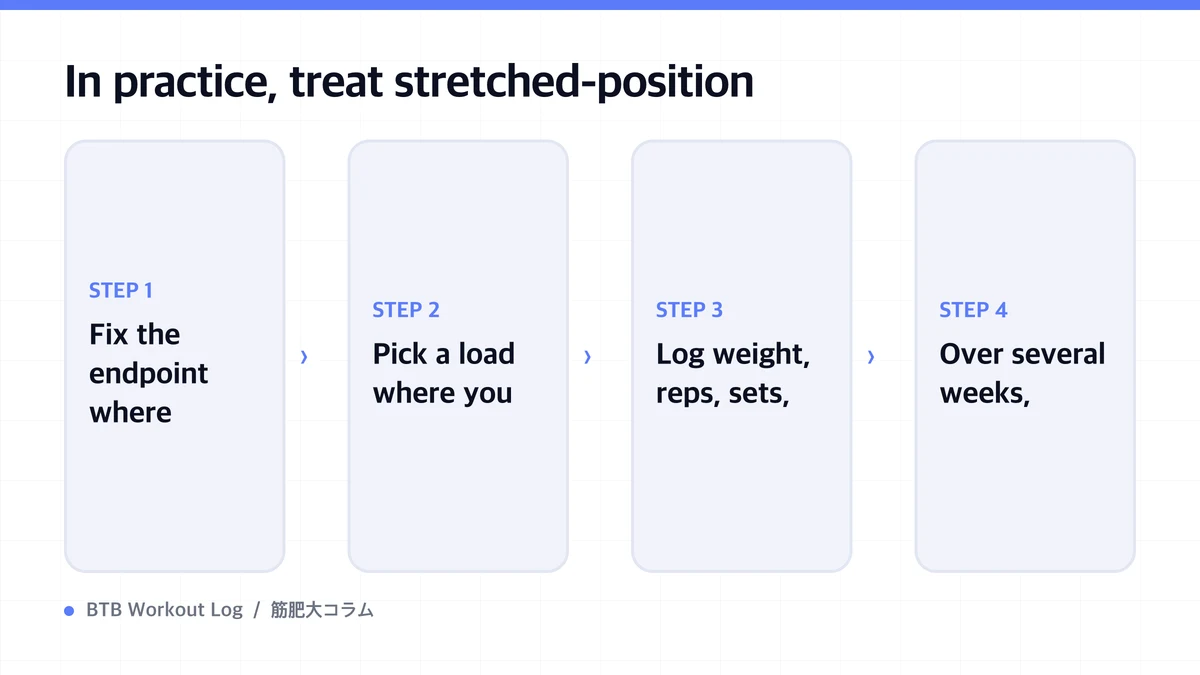
In practice, treat stretched-position variations as separate conditions
When you shift 가동 범위 or body position, the weight and reps mean different things even under the same exercise name. A drop in load right after going deeper doesn't signal weakness—it's just a different travel distance, resistance curve, and turnaround condition. Don't force old records; establish baseline load under the new setup.
- Fix the endpoint where the target muscle lengthens, at a position you can nail pain-free every rep.
- Pick a load where you hit your target rep range without momentum and hold steady RIR. RIR is reps in reserve—roughly 1–3 RIR works well for initial calibration.
- Log weight, reps, sets, RIR, plus endpoint and form cues.
- Over several weeks, watch whether reps or load climbs, and whether joint symptoms or next-session output worsen.
If progress holds and 회복 stays solid, that exercise is delivering sustained tension at the longer length. Stalled? Before deepening the endpoint to "get more stretch," recheck whether resistance is actually there, your RIR, 주간 세트 수, and exercise order. 점진적 과부하 only counts when you're comparing identical conditions.
자주 묻는 질문
- Does stronger stretch feel mean easier 근비대?
- Stretch sensation helps you recognize the longer muscle position, but it's not the stimulus itself. What matters is whether external resistance exists at that point and whether the target muscle generates force without rebound. Pain or sharp discomfort isn't proof of effective stimulus.
- Should longer-length partials take priority over full 가동 범위?
- No blanket rule. Use reproducible full-range as your baseline, then consider longer partials when resistance peaks at that end or when your program skews short. Once you change 가동 범위, treat weight, reps, and RIR as separate records.
- Can I add sets when I introduce stretched-position work?
- Starting with substitution rather than addition keeps cause and effect clear. If you raise 주간 세트 수 at the same time, you can't separate muscle-length gains from volume gains. Log output and 회복 for a few weeks first, then fine-tune volume gradually if needed.
정리
- Tension at longer length matters more than how much stretch you feel
- Joint leverage and resistance curve set how much force the target muscle must produce
- Blending active and passive tension reshapes your stimulus pattern across ranges
- After changing exercises, log weight, reps, and RIR as separate baselines
참고문헌
- The Mechanisms of Muscle Hypertrophy and Their Application to Resistance Training
- Mechanisms of Muscle Hypertrophy: Current Understanding and Future Directions
- The Influence of Frequency, Intensity, Volume and Mode of Strength Training on Whole Muscle Cross-sectional Area in Humans
- Low- vs High-load Resistance Training for Strength and Hypertrophy: Meta-analysis
- Muscle Hypertrophy Is Independent of Load Across Upper and Lower Limbs When Effort Is Matched