
减载周会发生什么?休息了却变强,疲劳消退的原理
减载周能恢复力量,并不是因为短期内新增了肌力,而是因为积累的适应能力原本被疲劳掩盖,如今疲劳先行消退了。
降低负荷会减少新的疲劳产生,睡眠和营养带来的恢复就能占上风。结果是,同样的肌量和技能能更容易以重量和次数的形式表现出来。
看得见的力量是「适应-疲劳」的结果
训练后留下的不止一种东西。长期积累的肌量、肌力、动作技能这样的适应,和最近几组训练产生的短期疲劳同时存在。实际的举重表现,就是这两者叠加在一起时观察到的结果。
比如在某个阶段肌力确实有所提升,但如果有效组数不断增加、疲劳累积的幅度超过了力量增长,那么用同样的重量次数反而会下降。此时若判断为「力量丧失了」,很容易陷入继续加大刺激、加重疲劳的怪圈。反过来,降低负荷几天后次数恢复了,也不代表几天内肌肉突然增长。更合理的理解是,隐藏的能力逐渐能够完整表达了。
这不是说适应和疲劳能分别量化测量,而是一个用来解读训练记录变化的模型。尤其是在做到力竭的有效组或高周训练量时期,需要把「能力本身」和「当天是否能发挥出能力」分开看。
新的负荷赶上恢复完成之前,疲劳就开始显现
一次训练会产生多个时间轴不同的变化:肌肉内能量耗尽、代谢产物堆积、肌纤维和结缔组织承受负担、神经肌肉输出下降。有些在组间就能恢复,有些要到第二天才消散。接着新的训练课来临,产生的疲劳超过了恢复的速度,这种状态持续下去,就不再是单次训练的表现不佳,而是连续几次都能看出衰退。
典型现象是:用同一重量、相同动作幅度、固定休息时间,次数却更快下降;达不到预定的RIR就感觉速度变慢;后面的几组越来越难保持姿态。因为RIR反映的是余力,如果同一重量和次数下RIR从3掉到1,表面数据没变,但身体承受的负担确实增加了。
不过单次训练不佳可能由睡眠、饮食、时间、热身等多种因素引起。成为减载周理由的,是控制好条件后仍然持续出现的输出下滑,或多个动作都恢复不足。如果只是组间的问题,考虑休息时间对疲劳的影响;如果跨越多天,那就看周期安排或总训练量。按时间轴分层能更清楚地定位问题。

减载周是把「疲劳输入」暂时压低到恢复量以下
只要继续做通常周一样的有效组,身体会一边恢复一边承受新的疲劳。减载周通过降低有效组数、使用重量或接近力竭的程度,有意识地减少产生的新疲劳。如果睡眠和营养条件没有大幅变差,差额就会向疲劳减少的方向倾斜。
关键点是不必清零,而是要把原本超过恢复的输入压低。保留轻负荷动作练习的话,能在维持动作感觉的同时减少有效组带来的负担。不过如果有关节疼痛、身体不适或严重睡眠不足,可能需要完全休息或其他处理方式。减载周不是伤病治疗。
具体的有效组数和重量调整在减载周的做法里讲。从机制角度,关键不在选哪种方式,而在于比通常周明显降低了负担,为恢复留出了空间。短期降负荷和长期停训是两码事,如果中断时间很长带来的变化要用运动能力衰退的进程单独分析。
疲劳衰退快于适应,能力就以重量和次数的形式显现
Fatigue doesn't vanish uniformly once load drops. Local muscle tightness, whole-body lethargy, joint discomfort, and focus loss during lifts each clear at different rates. Still, introducing a light training window typically shrinks the acute fatigue effect—showing first in warm-up speed and rep capacity on main sets.
Adaptations don't disappear after a few light days. Muscle mass shifts through repeated stimulus and recovery cycles; technical skill doesn't regress in a week of reduced load. So when fatigue clears faster than adaptation erodes, net performance rises: the same weight moves at lower RPE (higher RIR), the same RIR yields more reps, form consistency returns.
Long-term studies isolating deload effects are limited, so not everyone hits a PR immediately after. Periodized studies matching total volume show load variation offers no clear hypertrophy advantage, but does outperform non-periodized training for 1RM gains. This supports planned load cycling, yet doesn't directly prove how many percentage points a week of deload restores output through this mechanism. What recovers is mainly force production; that doesn't automatically mean new muscle was built. The boundary matters.
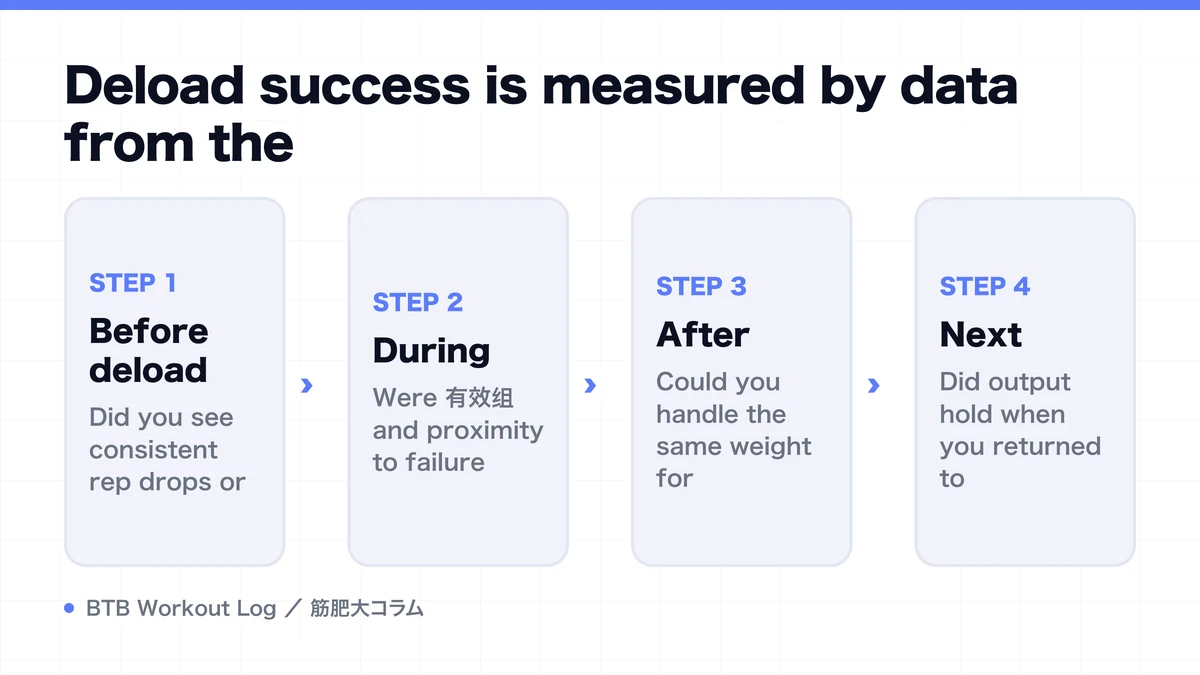
Deload success is measured by data from the same conditions after it ends
"Feeling fresh" alone or "hitting a PR on day one" won't give reliable feedback. Compare load, reps, RIR, range of motion, and rest across the deload week before, during, and one or two sessions after—all matched conditions on the same lifts. For compound movements, prioritize main-set reps and RIR; for isolation work, track rep decline across all sets. Check them in this order:
- Before deload: Did you see consistent rep drops or RIR deterioration across multiple sessions?
- During: Were 有效组 and proximity to failure clearly lighter than normal weeks?
- After: Could you handle the same weight for more reps, or the same reps at higher RIR?
- Next: Did output hold when you returned to normal training, not just on day one?
If performance improved, fatigue likely contributed to the earlier 平台期. If unchanged, check sleep, calorie intake, pain, technique, or insufficient stimulus. Extending deload repeatedly matters less than breaking down how plateaus form. Adding RIR and rest notes to your weight and rep log turns "felt light" into actionable data for the next cycle. You can judge deload success by whether numbers return within a few sessions post-break. BTB Workout Log lets you compare pre- and post-deload on the same scale.
常见问题
- Will I lose strength or muscle during a deload?
- A few days to a week of reduced load shouldn't erase prior adaptation. Extended complete rest is different. Whether you keep light drill work or rest fully depends on fatigue level, pain, and how you feel.
- Is deload a failure if my weight doesn't come back?
- One weak session isn't a failure verdict. Match sleep, food, time of day, and rest, then check one or two sessions after. If recovery still hasn't arrived, separate fatigue from other causes or whether the load cut was deep enough.
- Should I schedule regular deloads before performance drops?
- You can block off the end of a heavy block in advance, or insert a deload when logs show recovery stalling. Fixed intervals don't suit everyone, so pick timing based on past weakness patterns and current recovery state.
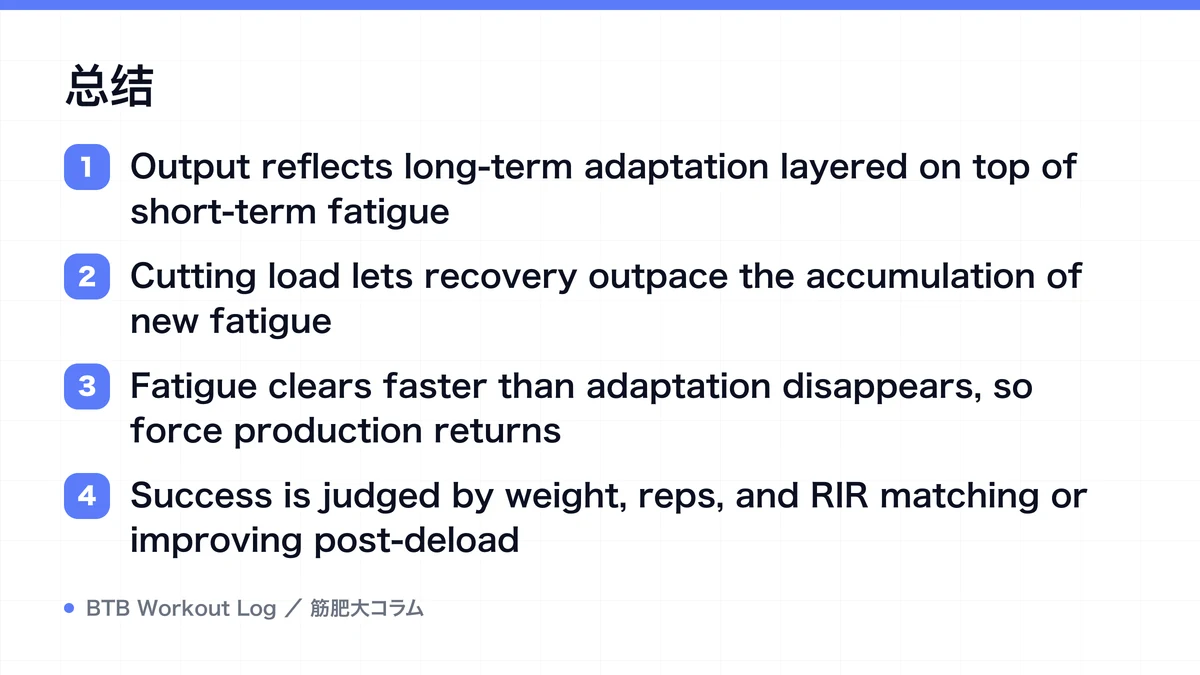
总结
- Output reflects long-term adaptation layered on top of short-term fatigue
- Cutting load lets recovery outpace the accumulation of new fatigue
- Fatigue clears faster than adaptation disappears, so force production returns
- Success is judged by weight, reps, and RIR matching or improving post-deload