
Czy więcej ćwiczeń oznacza większe mięśnie? | To przekonanie może spowalniać twój wzrost
Warto dodać kolejne ćwiczenie tylko wtedy, gdy obecny plan treningowy nie zapewnia dostatecznej pracy w określonym wzorcu ruchowym lub nie stymuluje konkretnej partii mięśniowej. Dodawanie podobnych ćwiczeń może przynieść więcej zmęczenia i dublowania bodźców niż dodatkowej hipertrofii.
Nie liczy się liczba ćwiczeń, lecz to, czy wykonujesz odpowiednio dużo wysokiej jakości ciężkich serii o różnych funkcjach i jesteś w stanie konsekwentnie robić postępy w wybranych ćwiczeniach.
How True Is 'Stimulus Through Variety'?
One muscle changes how it fires depending on joint angle and movement direction—the load distribution and range shift. Flat bench and 45° incline bench don't activate your chest uniformly. Your legs work the same way: knee-dominant squats and hip-dominant movements serve different roles, even though both count as "leg day."
That's why it makes sense to use assistance exercises to fill what your main movements miss—it's logically sound. Compound lifts handle the load base, and single-joint or angled variations patch the gaps. The same thinking applies when you ask whether compounds alone are enough—the key question isn't how many exercises, but what's still missing.
However, observing different activation patterns is not the same as long-term hypertrophy increasing as you add more exercises. Variation can matter, but different muscle activity isn't a license to add without limit.
Exercise Count Isn't the Dose
The mistake starts when you count exercise names as if they were the stimulus itself. In hypertrophy research, the measure that matters is usually weekly sets per muscle group. Five exercises at one set each equals five sets; two exercises at three sets each equals six. The number of exercises alone tells you nothing about how much real work was done.
Distinguish "splitting" from "adding"
If your chest routine is 12 sets and you split it from two exercises to four, you still have 12 sets. The distribution changes, but the volume doesn't double. If you add two more exercises while keeping the original volume, then volume does increase—and the change could come from the added sets, not the variety itself.
Research shows a dose-response between weekly sets and hypertrophy, but not all added sets carry equal weight. The critical distinction is whether each set drives hard tension in the target muscle—RIR around 1–3 reps—or if it's filler. That matters far more than the exercise name.
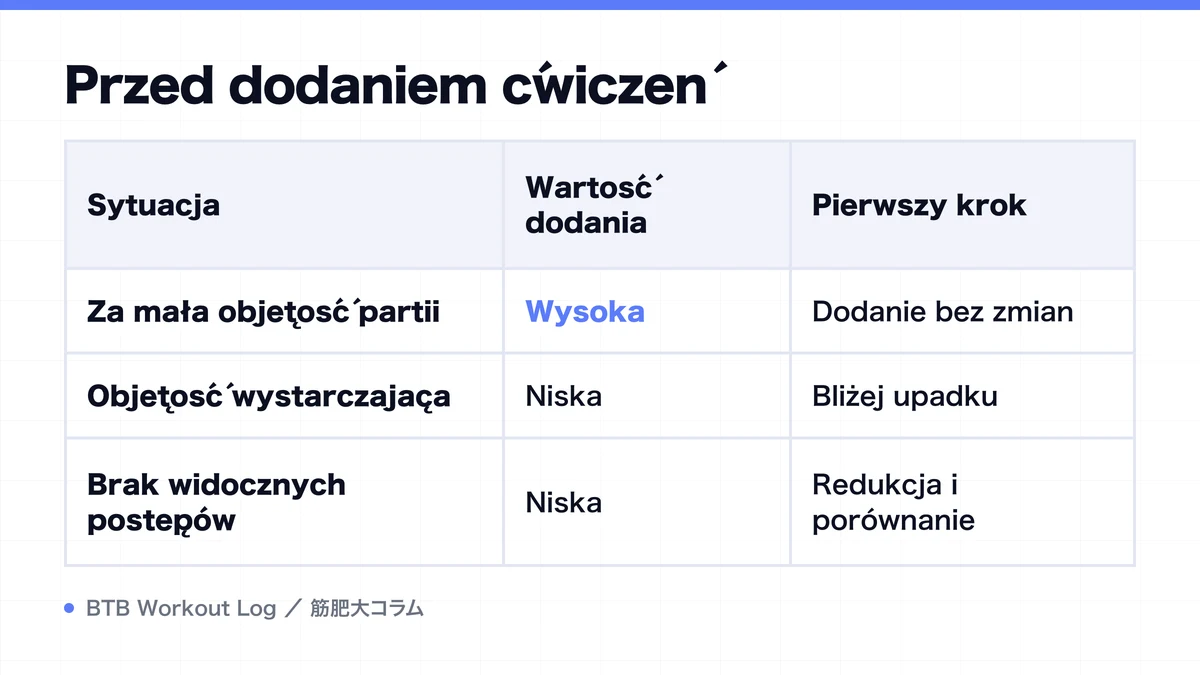
Similar Exercises Drop Later-Set Quality Quickly
Stack bench press, chest press, dumbbell press, and a similar-path machine press, and you've added exercise names. But they all drive the same push pattern—by the last exercises your triceps or general fatigue might limit you before your chest is truly worked. Even if you hit the target reps, sets where the target muscle doesn't take real tension aren't worth the extra session time.
Another cost: each exercise gets fewer reps across the week. Rotating eight exercises every session means each one is done less often, so form stability and load progression slow down. Hypertrophy doesn't need endless novelty, but if you move to the next exercise before you've made weight or rep progress, you kill progressive overload across the board.
The added sets also pile up local fatigue, joint wear, session time, and recovery demand. A strong pump right after doesn't matter if your main lift numbers drop session after session—that means the extra work actually hurt your week as a whole.
Research Shows 'the Right Combination of Variables'
Hypertrophy can't be reduced to a single number—exercise count. Frequency, intensity, volume, and training style all interact, so three exercises differ completely if the sets, RIR, range, or frequency change. The recipe is complex.
There is a trend: more weekly volume generally produces more average muscle gain. But that's not the rule "more exercise names mean more growth." Whether you concentrate your total sets into a few exercises or spread them across many, what you compare is the stimulus to the target muscle, set quality, recovery room, and actual weekly progress.
Joint angle does shift muscle activation patterns, but that fact alone doesn't predict long-term hypertrophy. In practice, you don't "add as many as possible"—you "fill the gaps the main lift leaves." This is different from the myth that always changing your routine is needed.
Why Does "More Exercises" Feel Like It Works?
New exercises prompt strong pump and soreness because your body hasn't adapted. That feels like extra growth. Also, if you add exercises and volume at the same time, you can't tell which caused the change. You get a rush of novelty plus an honest increase in work—so it's easy to credit the exercise variety when it was really just doing more.
Give Each New Exercise One Clear Job
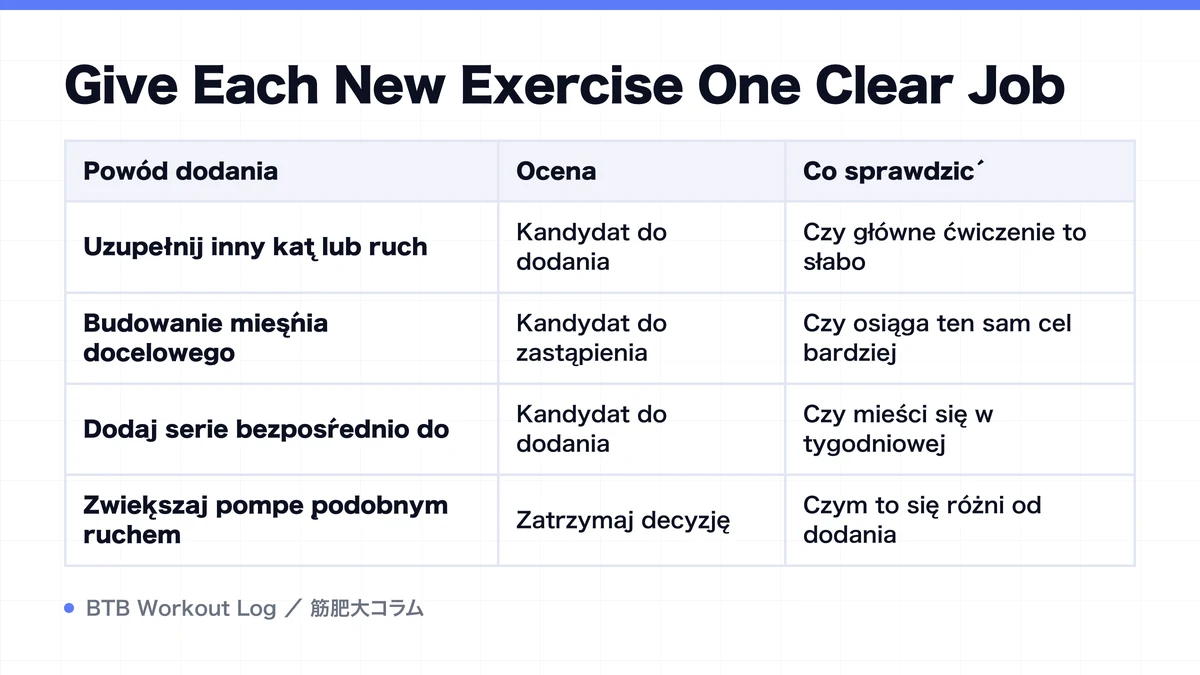
Zanim dodasz ćwiczenie, odpowiedz w jednym zdaniu na pytanie: "co chcę tym ćwiczeniem uzupełnić?". Jeśli odpowiedź brzmi tylko "chcę inną stymulację" lub "nudzę się", ten powód jest zbyt słaby. Porównanie roli z istniejącymi ćwiczeniami ułatwia podjęcie decyzji:
| Powód dodania | Ocena | Co sprawdzić |
|---|---|---|
| Uzupełnij inny kąt lub ruch | Kandydat do dodania | Czy główne ćwiczenie to słabo obejmuje |
| Budowanie mięśnia docelowego unikając bólu | Kandydat do zastąpienia | Czy osiąga ten sam cel bardziej stabilnie |
| Dodaj serie bezpośrednio do słabego miejsca | Kandydat do dodania | Czy mieści się w tygodniowej objętości, którą możesz regenerować |
| Zwiększaj pompę podobnym ruchem | Zatrzymaj decyzję | Czym to się różni od dodania serii do istniejącego ćwiczenia |
Zachowaj główne ćwiczenia na stałe, zmieniaj jedno na raz
Najpierw określ główne ćwiczenie dla każdej partii mięśniowej i stwórz warunki do porównywania ciężaru, powtórzeń i RIR. Następnie dodaj jedno ćwiczenie uzupełniające i przez kilka tygodni obserwuj inne parametry bez drastycznych zmian. Powód, dla którego dodanie zbyt wielu ćwiczeń utrudnia ocenę, wyjaśniam szczegółowo w sekcji porównywania postępu.
Prawidłowa liczba ćwiczeń określa się danymi po dodaniu
Czy dodanie było skuteczne, oceniaj nie po uczuciu w dniu treningu, ale po zmianach w ciągu 3–6 tygodni. Jeśli nowe ćwiczenie pozwala konsekwentnie obciążać mięsień docelowy, ciężar i powtórzenia w głównym ćwiczeniu utrzymują się lub rosną, a regeneracja przed następnym treningiem jest pełna – ćwiczenie ma powód, żeby je zatrzymać. Jeśli natomiast powtórzenia w końcu treningu opadają znacznie, pojawiają się dolegliwości w stawach, postęp głównego ćwiczenia stoi, a czas treningu ciągle rośnie – to kandydat do usunięcia.
Porządek obserwacji: ①czy jest luka w roli poszczególnych ćwiczeń, ②czy tygodniowa objętość hard setów jest wystarczająca, ③czy po dodaniu możesz utrzymać jakość każdego serii, ④czy przez kilka tygodni obserwujesz postęp w ciężarze lub powtórzeniach, ⑤czy regenerujesz się. Ten porządek zmienia myślenie z "po prostu dodam więcej ćwiczeń" na "dodam tylko to, czego naprawdę potrzebuję".
Używając zapisu treningów jako materiału do oceny, porównywać zmiany przed i po dodaniu możesz według tych samych kryteriów.

Często zadawane pytania
- Ile ćwiczeń na partię mięśniową to optymalnie?
- Nie ma uniwersalnej odpowiedzi. Zacznij od zapewnienia wystarczającej tygodniowej objętości hard setów głównym ćwiczeniem, a dopiero wtedy dodawaj, gdy potrzebujesz uzupełnić inny kąt, ruch, lub pracować na słabe miejsce. Priorytetem powinny być jakość każdego serii i postęp w ciężarze lub powtórzeniach przez kilka tygodni – nie liczba ćwiczeń.
- Czy mięsnie nie przyzwyczajają się do tego samego ćwiczenia?
- To samo ćwiczenie nie powoduje przyzwyczajenia, jeśli postępuje się w ciężarze, powtórzeniach, RIR lub zakresu ruchu. Zmiana ćwiczenia to opcja, gdy pojawia się ból, długa stagnacja, lub luka w roli – ale nie trzeba je częściej wymieniać tylko dla samej odmiany.
- Jakie są znaki, że powinienem zmniejszyć liczbę ćwiczeń?
- Znaczący spadek ciężaru lub powtórzeń w ćwiczeniach pod koniec treningu, wznowienie się stagnacji głównego ćwiczenia, wzrost dolegliwości w stawach, brak regeneracji przed następnym treningiem, albo wydłużanie się samego czasu treningu. Usuń jedno ćwiczenie o zbliżonej roli i obserwuj zmiany przez kilka tygodni.
Kluczowe wnioski
- Liczba ćwiczeń liczy się mniej niż jakość hard setów o różnych rolach
- Warianty są skuteczne, gdy wypełniają luki w kącie, ruchu lub pracy nad słabością
- Dodawanie zbliżonych ćwiczeń prowadzi do powielania objętości i zmęczenia
- Decyzje o dodaniu lub usunięciu opieraj na postępie głównego ćwiczenia i regeneracji