근력이 늘면 근비대도 쉬워질까? 무게·반복수·근육량의 예상 밖 관계
근력이 올라가면 근비대를 진행하기 위한 무게와 반복을 업데이트하기 쉬워집니다. 하지만 강해진 것만으로 근육이 늘어나는 것은 아니며, 그 능력을 같은 폼·가동 범위·RIR에서의 점진적 과부하로 전환해야만 다음 성장 자극을 만들 수 있습니다.
근량 증가가 근력을 밀어올리고, 늘어난 근력이 더 높은 부하의 훈련을 가능하게 하므로, 둘은 일방향이 아닌 순환합니다. 이 순환에는 신경 적응과 기술 향상도 포함됩니다.
근력은 근육량만으로 결정되지 않는다
훈련에서 말하는 근력은 단순한 '근육의 크기'가 아닙니다. 같은 근량이어도 운동 단위를 동원하는 능력, 여러 근을 조화시키는 기술, 자세에 대한 숙련도, 관절 각도나 체형에 따라 들 수 있는 무게가 달라집니다. 피로, 수면, 측정 방식에 따라서도 그날 나오는 수치는 변합니다.
최대 근력과 반복 능력은 별개의 지표
1RM은 한 번만 들 수 있는 최대 무게로, 무거운 부하에 대한 기술적 숙련이 강하게 반영됩니다. 반면 같은 무게를 몇 회 할 수 있는지는 최대 근력 외에도 국소 피로 내성과 페이싱에 좌우됩니다. 고부하와 저부하를 비교한 메타 분석에서는 한계까지 진행하는 조건 아래 근비대는 비슷했던 반면, 1RM 증가는 고부하가 유리했습니다. 즉, 근력은 근량과 관련되지만 둘이 같은 것은 아닙니다. 강해졌는데 외형이 변하지 않은 경우의 구분은 근력과 근량이 엇갈리는 이유에서도 정리했습니다.
반대로 근섬유의 단면적이 늘어나면 힘을 발휘하는 토대는 커집니다. 하지만 그 토대를 특정 종목의 기록으로 표현하려면 기술이 필요합니다. '근육이 늘었으니 즉시 1RM이 오른다' '1RM이 올랐으니 같은 비율로 근육이 늘었다' 같은 일대일 해석은 불가능합니다.
근력 향상이 다음 근비대를 뒷받침하는 인과관계
근력이 근비대를 뒷받침하는 경로는 "강해졌으니 자동으로 커진다"는 일직선 논리가 아닙니다. 그 사이의 부하 설정과 노력 정도가 중요합니다.
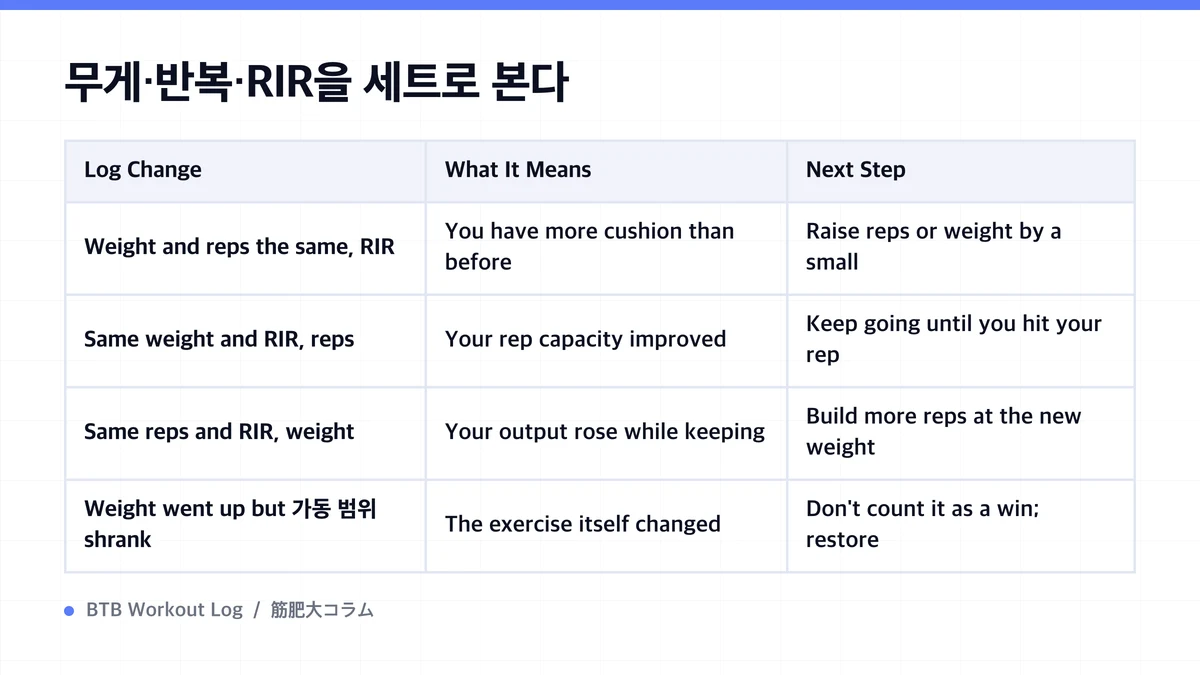
- 훈련에 적응한다: 신경, 기술, 근량 중 하나 또는 여러 개가 개선되어 같은 동작에서 발휘할 수 있는 힘이 늘어난다.
- 이전 부하에 여력이 생긴다: 예를 들어 같은 무게·같은 횟수를 할 때 한계까지의 남은 반복 횟수인 RIR이 3에서 5로 늘어난다. 이 시점에서 능력은 늘었지만 세트의 상대적 난도는 내려간다.
- 무게나 반복을 업데이트한다: 폼, 가동 범위, 휴식을 유지하면서 무게를 더하거나 같은 무게에서 반복을 늘려 목표 RIR로 돌아온다. 이것이 점진적 과부하의 실행 단계다.
- 활성화된 근섬유에 다시 충분한 장력을 준다: 업데이트된 과제를 한계 근처까지 수행하여 성장 후 능력에 맞는 자극을 만든다. 회복 가능한 범위 내에서 이 자극을 반복한다.
- 근량이 다음 근력의 기초가 된다: 장기적 적응으로 근량이 늘어나면 더 높은 힘을 낼 수 있는 여지가 넓어지고, 다음 점진적 과부하로 순환한다.
이 흐름에서 근력 향상은 근비대의 "원인"인 동시에 그때까지의 적응의 "결과"입니다. 중요한 것은 늘어난 능력을 무게 증가나 반복 증가로 변환하는 단계입니다. 예전 무게가 쉬워졌는데 처방을 그대로 두면, 강해진 것이 다음 자극에 반영되지 않습니다.
무게·반복·RIR을 세트로 본다
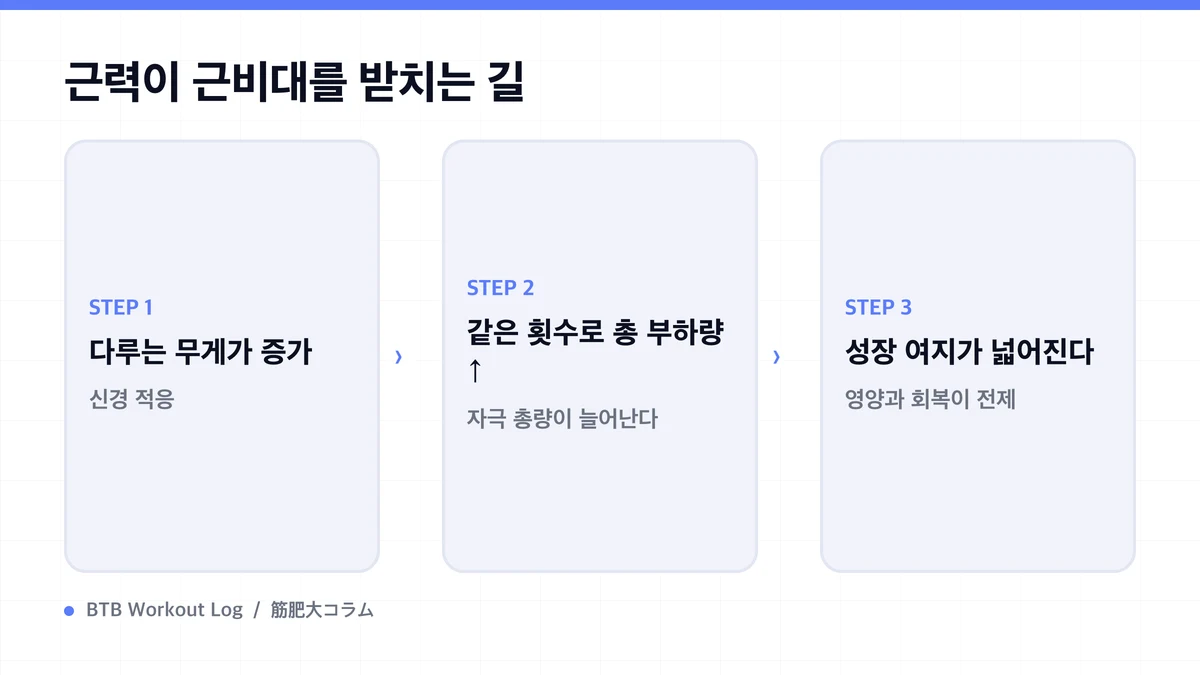
Weight alone doesn't tell you whether you've turned strength gains into a growth stimulus. Track at least weight, reps, RIR, form, and 가동 범위 in the same units. RIR involves some subjectivity, but keeping the same standard each time sharpens your comparison accuracy.
| Log Change | What It Means | Next Step |
|---|---|---|
| Weight and reps the same, RIR increased | You have more cushion than before | Raise reps or weight by a small amount |
| Same weight and RIR, reps increased | Your rep capacity improved | Keep going until you hit your rep ceiling |
| Same reps and RIR, weight increased | Your output rose while keeping tension steady | Build more reps at the new weight |
| Weight went up but 가동 범위 shrank | The exercise itself changed | Don't count it as a win; restore your form |
| 1RM only moved but regular sets stalled | You likely got better at the max lift technique | Grade your 근비대 sets separately |
Say you did 80 kg for 8 reps at RIR 2, then later hit 80 kg for 10 reps at the same RIR 2—that's progress even though the weight didn't budge. Conversely, if you jump to 85 kg but chop your 가동 범위, lean on helper muscles, and grind to RIR 0, that's murky for 근비대 standards. Total 부하량 from weight × reps is just one side of work; it doesn't capture stimulus quality to your target muscle.
So 점진적 과부하 isn't about chasing bigger numbers—it's adjusting your task to match your ability while keeping conditions locked down.
Do you need a heavy phase to build 최대 근력 for 근비대?
Heavy lifting excels at building 최대 근력, so it does underpin long-term 근비대. Low-rep work teaches you compound technique and builds the raw power capacity that later raises your ceiling in moderate rep ranges. But sandwiching in a heavy phase doesn't automatically turbocharge your 근비대 afterward.
In general practice, when sets go to failure, a wide range of loads can trigger similar 근비대, while heavy loads favor 1RM strength. This doesn't mean "higher strength = more muscle"—it shows that 최대 근력 and 근비대 have different load signatures. For how to read load studies, see heavy vs. high-rep comparison.
If 근비대 is your main goal, don't cram all your work into 1–5 reps. One method: pack your main compounds with low-to-moderate rep 하드 세트s, then fill the rest with stable, controlled ranges where you can train the target muscle harder for more reps. Heavy loads jack up joint stress and systemic fatigue; if your weekly 하드 세트 count or later exercises suffer, you're not converting that 최대 근력 into muscle. Distribute rep ranges by your goal, exercise, and 회복 cost.
Converting strength gains into 근비대 progress
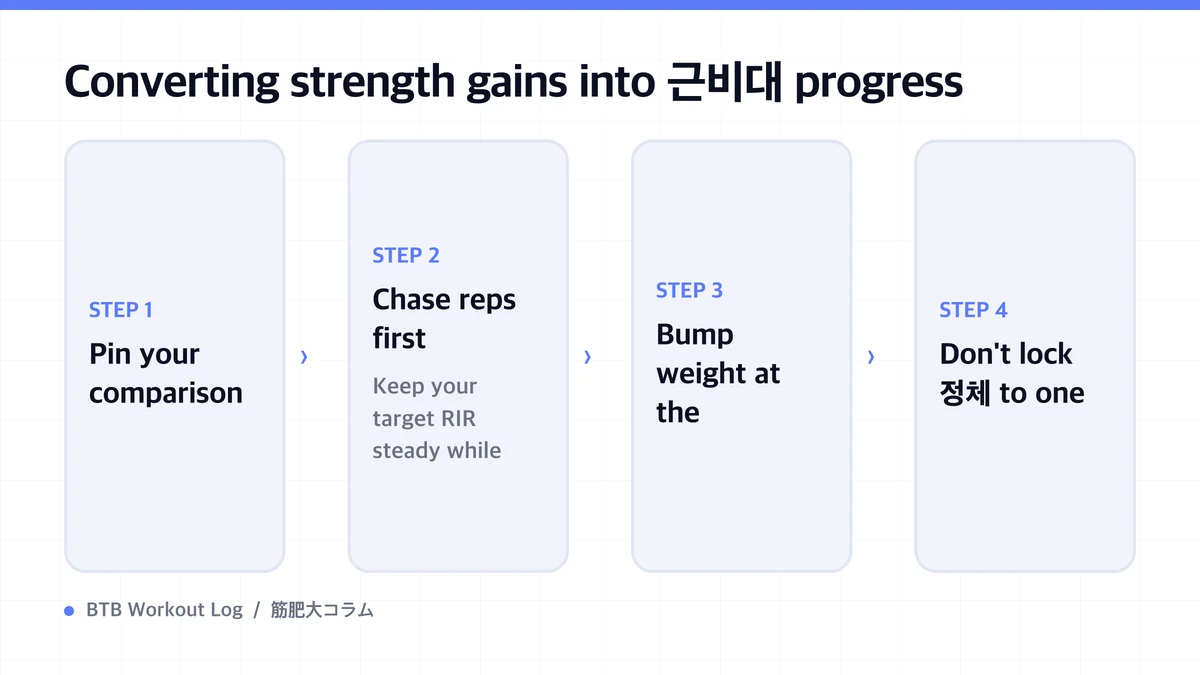
In practice, lock down your 렙 범위 and target RIR per main lift first, then track trends over several weeks under the same conditions. This sequence lets you convert strength gains into the next challenge without friction.
- Pin your comparison rules: Match exercise, form, 가동 범위, rest, and 렙 범위, then log weight, reps, and RIR.
- Chase reps first: Keep your target RIR steady while aiming for your rep ceiling. Look for repeatability across multiple sessions, not just one-off PRs.
- Bump weight at the ceiling: Accept that reps drop back to your range floor when you increase weight, then rebuild reps again.
- Don't lock 정체 to one metric: If weight stalls but reps or RIR move forward, keep going. Only when multiple weeks flat-line across all three—cut through fatigue, weekly 하드 세트 load, nutrition, and exercise fit.
When you assess 근비대, look beyond the log: track circumference and photos under the same conditions, plus bodyweight trends over weeks. Don't judge muscle gain from a 1RM PR right after practicing max lifts. For a deeper breakdown of why lifts stall, see why your lifts plateau.
Watch whether strength gains translate into higher loads in your next tier by scanning weight, reps, and set count over time from the same exercise. Whether a strength boost lifts your 총 부하량 only shows up when you track volume, not just the bar. BTB Workout Log keeps both in one view.
자주 묻는 질문
- Should I add heavy 1–5 rep work for 근비대?
- Not required. Heavy work builds 최대 근력 and compound technique, but 근비대 happens across a broader load spectrum. Monitor joint wear and fatigue spillover; if needed, reserve heavy 하드 세트s for one or two main lifts. You'll be fine.
- If weight is going up, can I assume my muscles are too?
- Muscle growth is possible, but you can't assume it from weight alone. Neural adaptation, form groove, and 가동 범위 shifts all drive weight up. Layer in steady-state reps, RIR, weekly 하드 세트 count, plus circumference and bodyweight trends over weeks.
- Can muscle grow while weight stays stuck?
- There are exceptions. High-rep endurance capacity sometimes improves first, or a specific movement's technique, fatigue, or weight increment constraints might be limiting you. Check your rep count, RIR, and movement consistency across normal sets—don't assume a strength plateau is causing your 근비대 stall based on weight alone.
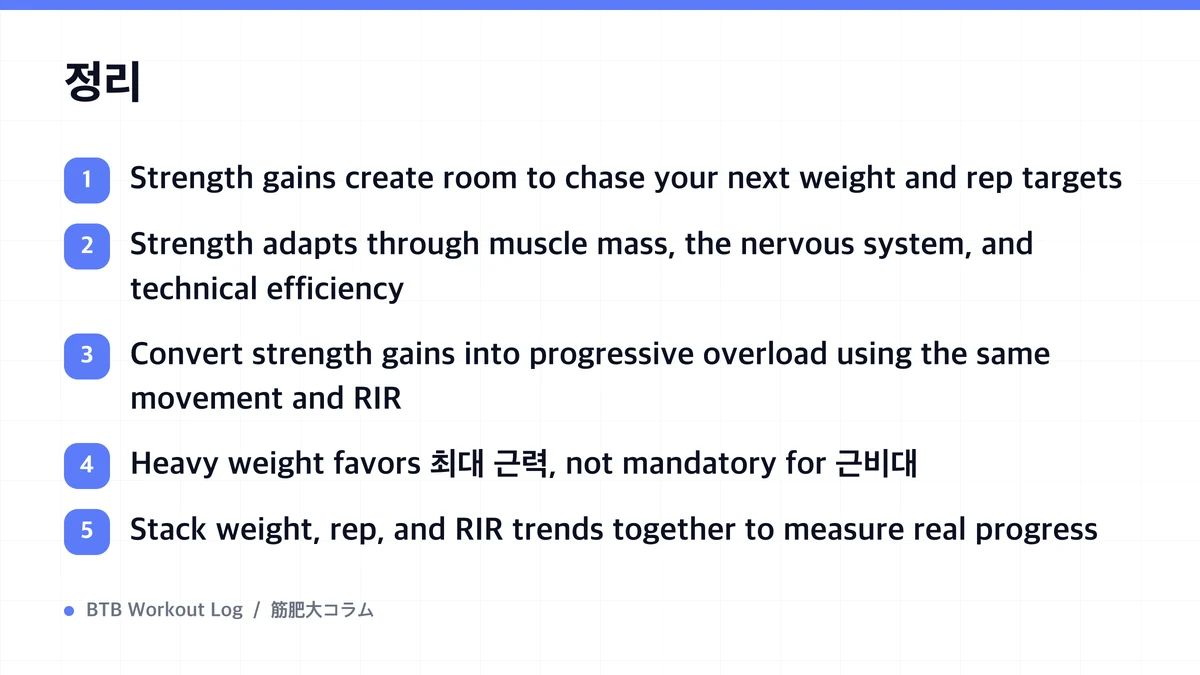
정리
- Strength gains create room to chase your next weight and rep targets
- Strength adapts through muscle mass, the nervous system, and technical efficiency
- Convert strength gains into progressive overload using the same movement and RIR
- Heavy weight favors 최대 근력, not mandatory for 근비대
- Stack weight, rep, and RIR trends together to measure real progress