
Is 'Langer Trainen is Effectiever' een Fout? Waarom een 2-urige Training Zich Niet Terugbetaalt
Langer is niet altijd beter. Spierhypertrofie hangt niet af van clocktime, maar van het aantal sets dat je doelspier nodig heeft met voldoende effort en juiste techniek, en of je daarvan herstelt.
Een korte sessie die onvoldoende werk bevat, kan baat hebben bij verlenging. Maar als je sets toevoegt waarbij de kwaliteit daalt of je dezelfde beweging herhaalt, dan groeit alleen je tijd in de gym, niet je groeivoorwaarden.
Langer trainen = meer prikkel geven – dat gaat niet automatisch op
Lange sessies zien er inspannend uit, en kort weggaan voelt als iets missen. Maar trainingstijd omvat opwarmen, wachten op apparatuur, rustpauzes tussen sets, schijven wisselen, notities en gesprekken. Twee mensen die 90 minuten trainen, hoeven niet dezelfde prikkel te hebben gehad, en je kunt twee sessies van 60 en 90 minuten niet zomaar vergelijken zonder hun inhoud te checken.
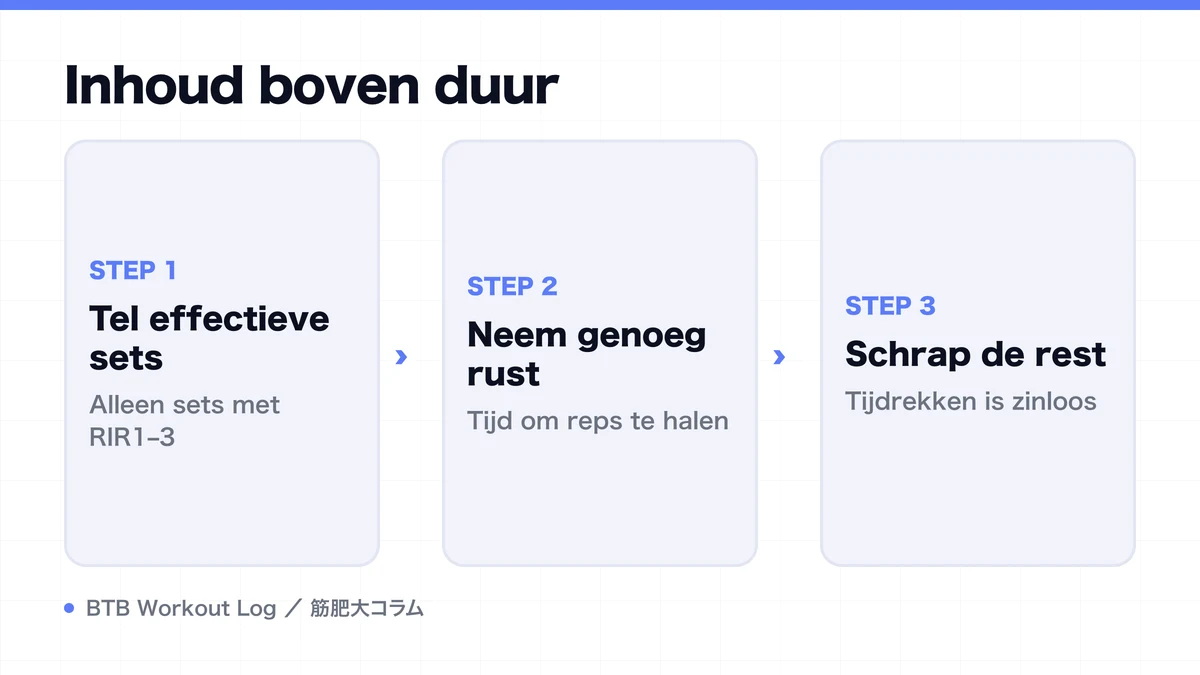
Voor spierhypertrofie tel je eerst de harde sets per doelspier, het gewicht en herhalingen per set, het bewegingsbereik, en hoeveel herhalingen je nog over had (RIR). Tijd zonder deze details is alleen een ruwe schatting van je trainingsvolume. Als je bereidingstijd en wachten langer maakt zonder het trainingsvolume te verhogen, kun je die sessie niet effectiever noemen dan de vorige.
Trainingstijd helpt als je nodig werk moet afmaken
Dit denkfout heeft wel waarheid. Wie zijn geplande sets niet afkreigt vanwege tijdnood en daarom de sessie verlengt, kan voordeel hebben voor spierhypertrofie. Stel je traint je borst meerdere keren per week, maar je schrapt steeds hoofdoefeningen omdat je haast hebt – dan heeft verlenging duidelijk zin. Maar hoeveel wekelijkse sets je nodig hebt varieert met je trainingshistorie, oefening, RIR, frequentie en herstelstatus; het is geen vaste norm voor iedereen.
Soms wordt je sessie langer omdat je voldoende rustpauzes wilt nemen. Onderzoek onder ervaren sporters toonde aan dat 3 minuten rust tussen sets voordelen gaf voor spierkracht en enkele maten spierdoorsnede vergeleken met 1 minuut. Dat betekent niet dat 3 minuten altijd goed is, maar het laat zien dat rustpauzes verkorten om op tijd klaar te zijn, ten koste van repetities of techniek, niet logisch is. Je kiest je rustpauze op basis van of je adem op orde is én of je dezelfde output kunt halen volgende set.
Extra tijd betekent niet automatisch extra prikkel
Het misverstand ligt in het geloof dat meer tijd op zich effectief is. Oefeningen met dezelfde bewegingsbaan voor één spier achter elkaar doen, sets voortzetten als reps en bewegingsbereik al weggaan, of alle sets tot vermoeiing doen zodat je later zwakker wordt – zulke verlengingen voegen geen effectieve prikkel toe evenredig aan wat je inspanning toeneemt.
De grens tussen sets die wel werken en sets die je alleen vermoeien, hangt niet van minuten af. Je kijkt of je doelspier nog belast wordt, of je intentiebereik en RIR behouden blijft, en of je volgende training hetzelfde gewicht en herhalingen aankan. Elke set tot uitval moet niet, en voordeel van meer sets neemt af – dat scheiden we niet af van teveel sets problemen. Als je langer trainen tot slechter herstel leidt, moet je inhoud aanpassen, niet timeouts.
Studies meten verschil in hoeveelheid en omstandigheden, niet zomaar minuten
Hypertrophy research centres on variables like wekelijkse sets, load, proximity to failure, frequency and rest intervals. A dose-response relationship has been reported between weekly training volume and muscle gain, and some studies show that experienced lifters benefit from higher volumes. But this doesn't lead to the conclusion that "spending more time in the gym equals more gains." What increased was not time itself, but the controlled workload defined by the research protocol.
Frequency works the same way: it's a tool to spread your weekly total across multiple days. If you're cramming too much into one session and output drops in the second half, splitting the same wekelijkse sets across different days often makes the work more manageable. In other words, research doesn't establish a universal boundary saying you should cut from 90 to 60 minutes or extend from 60 to 120 minutes.
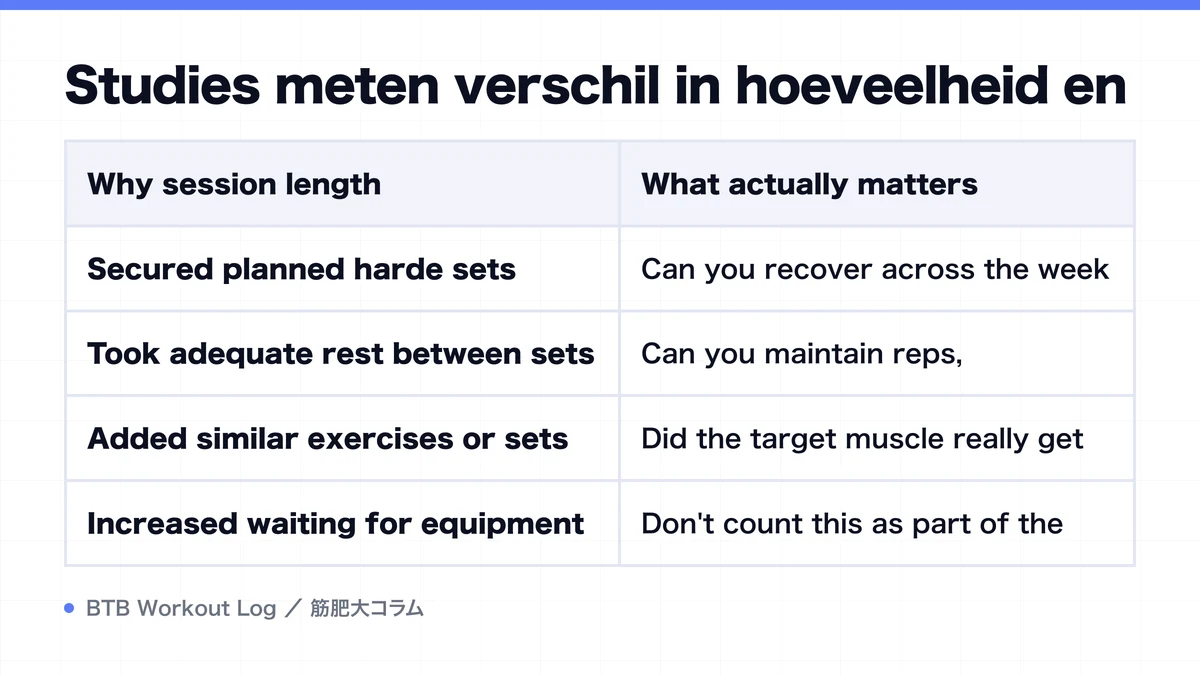
| Why session length increased | What actually matters |
|---|---|
| Secured planned harde sets | Can you recover across the week and repeat progress? |
| Took adequate rest between sets | Can you maintain reps, bewegingsbereik and RIR on the next set? |
| Added similar exercises or sets | Did the target muscle really get a new stimulus? |
| Increased waiting for equipment or chatting | Don't count this as part of the training effect |
Even with the same person and same programme, you can't compare results without logging why the duration changed. A week with thorough rest intervals means something different from a week where you added extra sets. Treating time as an independent variable doesn't work; instead, separate "what did I add or remove that caused the time to change?" Then your research reading and daily adjustments align.
Why longer sessions feel more effective
Time is easy to measure on the spot, but spierhypertrofie shows up over weeks or months. This lag makes the immediate, visible number seem inflated. Longer movement also tends to produce more sweat, pump and fatigue—which you can easily confuse with effective muscle stimulus. But "that was brutal" and "this builds long-term gains" are not the same thing.
Be careful about copying long sessions from experienced lifters just by their length. If they need that time because of progressive warm-ups on heavy lifts, generous rest periods, and strategic sets for weak points, they're not chasing duration—they're chasing effectiveness. Equally, short sessions aren't automatically efficient; if you're rushing rest or skipping necessary sets, you're just underdone. Looking at long-term progress instead of how you feel in one session frees you from obsessing over the clock.
Set your duration by performance targets, not the clock
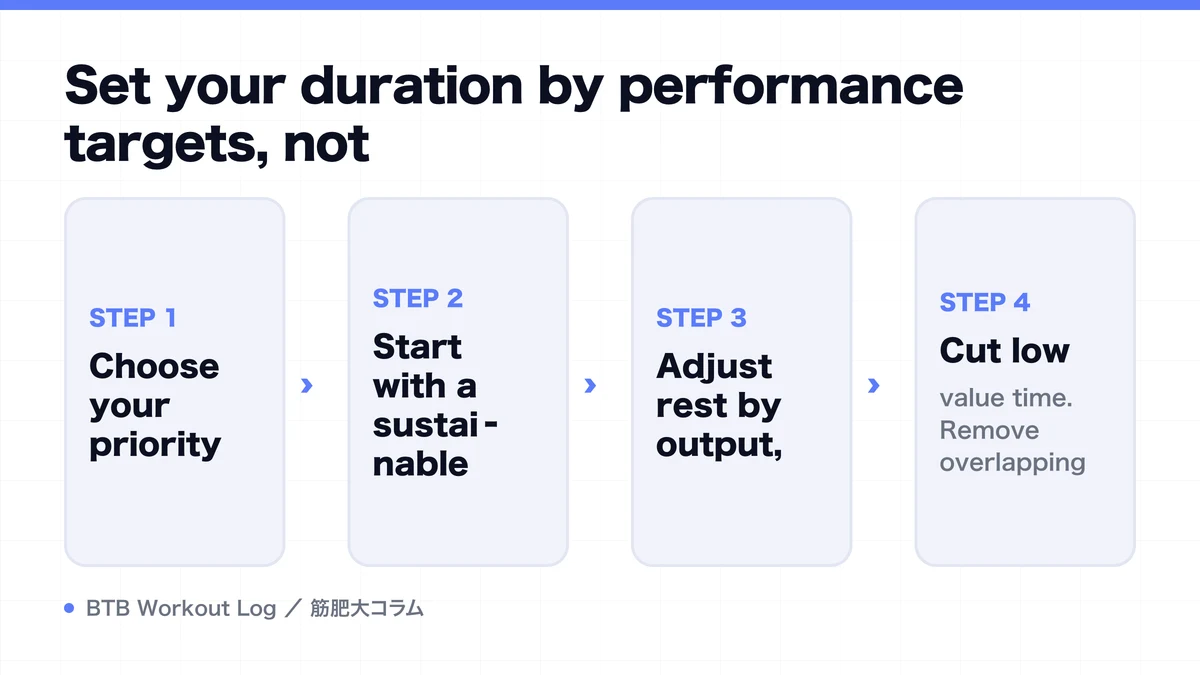
When deciding session length, don't ask "how many minutes?" first. Instead, set these performance targets:
- Choose your priority lifts. Place the main movements for the muscles you want to grow early, when focus is highest.
- Start with a sustainable set count. Watch how the end of the session and your next workout feel, then add sets only if needed.
- Adjust rest by output, not the clock. Don't cut rest short; wait until you can hit your target reps, bewegingsbereik and RIR again.
- Cut low-value time. Remove overlapping exercises, excessive equipment waiting, and purposeless extra sets.
After you make changes, track how weight, reps, wekelijkse sets and RIR move over several weeks on the same lifts. If you cut time but Progressive overload continues and weekly workload and herstel stay solid, the cut worked. If adding time brings progress back, that extra duration has a role. By using your records as your guide, you can compare whether the time you added actually led to your next breakthrough, not just whether you spent more of it there.
Veelgestelde vragen
- What's the ideal training duration for spierhypertrofie?
- There's no single number that works for everyone. Duration changes based on exercise selection, wekelijkse sets, load, rest intervals and gym traffic. The right length for your programme is whatever lets you finish your planned high-quality sets while keeping your output strong in the final sets and your herstel intact for next time.
- Can you build muscle with a short 30-minute session?
- Yes. If you focus on priority lifts, spread your wekelijkse sets across multiple days, and keep RIR and movement quality solid on each set, it works. But if you're cutting rest or skipping main sets just to fit 30 minutes, you're prioritising duration over quality.
- Is a 2-hour session too long?
- Time alone doesn't tell you. If it covers warm-ups for heavy lifts, proper rest, and sets across multiple planned muscle groups while keeping late-session quality and next-day herstel intact, it's fine. If you're adding sets with no purpose or seeing big reps drops over time, that's a sign to cut back.
Sleutel takeaways
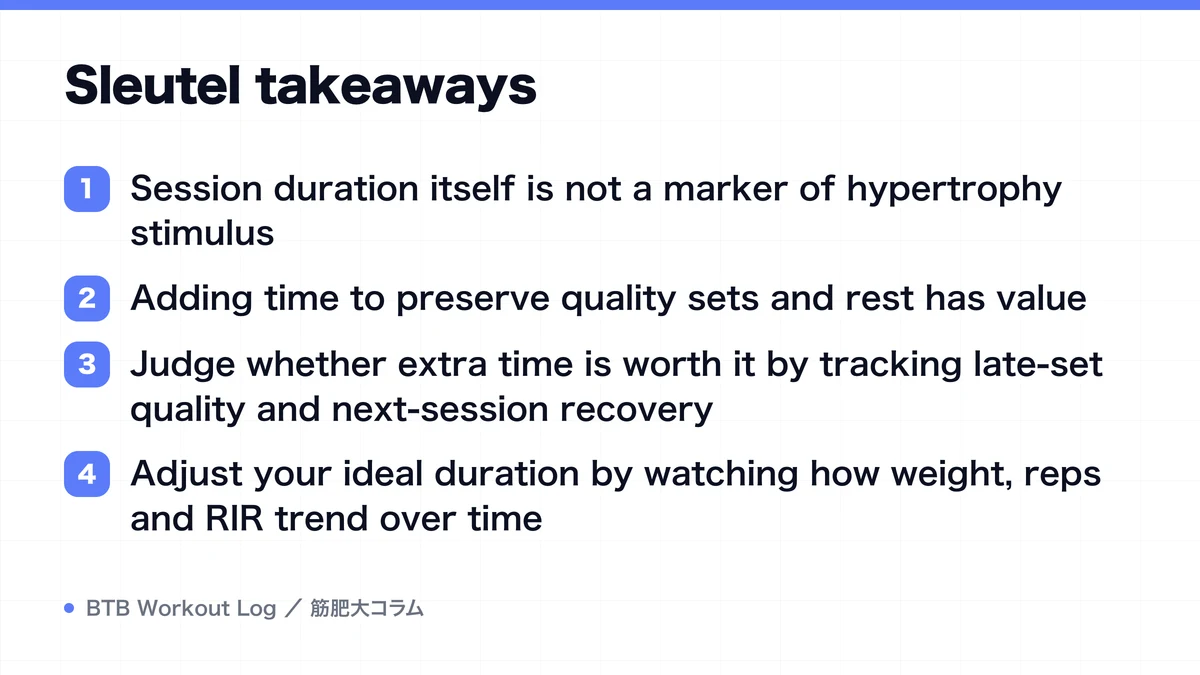
- Session duration itself is not a marker of hypertrophy stimulus
- Adding time to preserve quality sets and rest has value
- Judge whether extra time is worth it by tracking late-set quality and next-session recovery
- Adjust your ideal duration by watching how weight, reps and RIR trend over time
Bronnen
- Dose-response Relationship Between Weekly Resistance Training Volume and Muscle Mass
- Resistance Training Volume Enhances Muscle Hypertrophy in Trained Men
- Longer Interset Rest Periods Enhance Strength and Hypertrophy in Trained Men
- Resistance Training Frequency and Muscle Hypertrophy: Systematic Review and Meta-analysis